


I remember peeling off my uniform and feeling... strangely empty. Not because I’d lost myself, but because the map I’d used for years no longer fit the terrain. In this short piece I trace that quiet shock, the surprising wins I found online, and a few imperfect tactics I used to turn orders into ownership.
The Quiet Shock of Transition (military identity → civilian life)
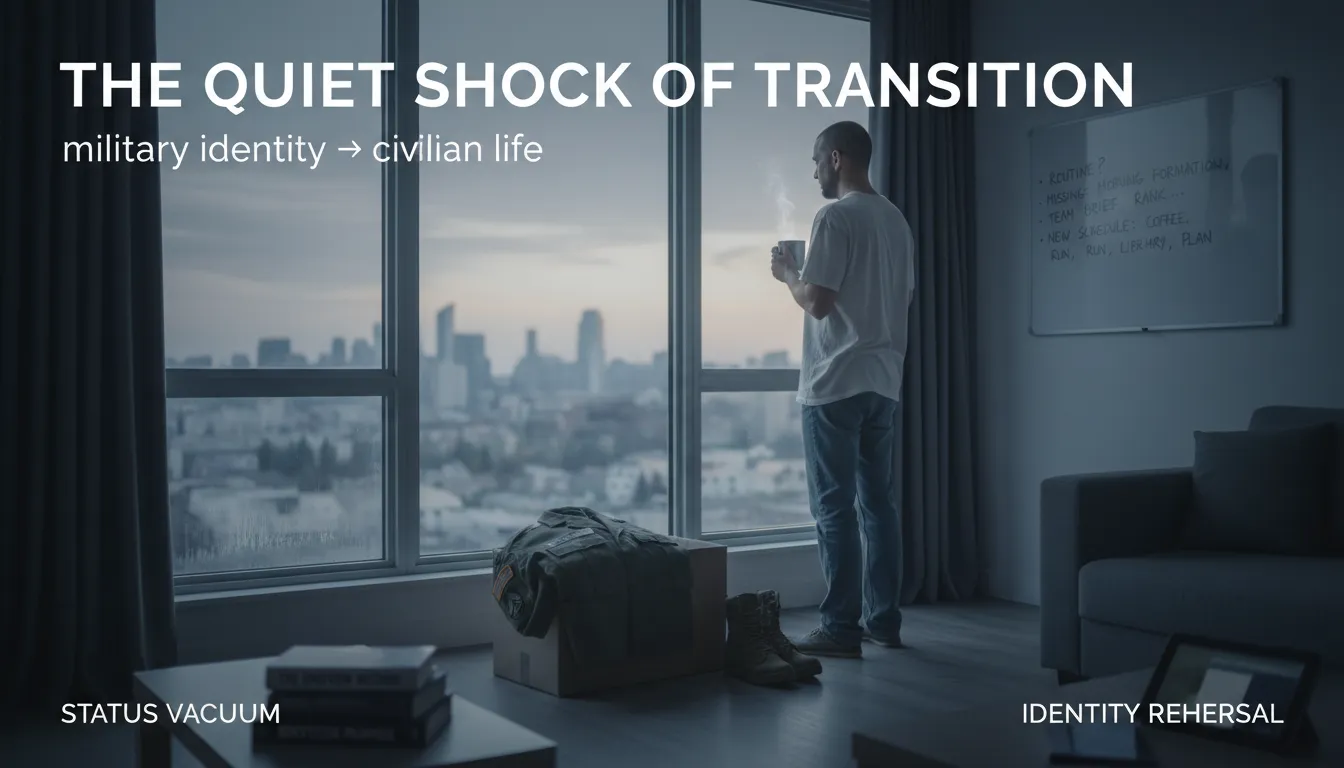
The first week out of uniform felt like a status vacuum. I still woke up before sunrise, but there was no formation, no briefing, no clear “who’s who.” I stood in my closet and reached for a blouse that wasn’t there. I missed the small rituals—boots by the door, a shaved face, the quick nods that meant “I’ve got you.” In civilian life, people asked simple questions I couldn’t answer: “So what do you do now?” “What’s next?” I had a résumé, sure. But my words felt thin compared to the weight of my old role.
Why military identity feels “lost” in civilian life
One of the hardest transition challenges isn’t employment—it’s the gap in purpose and direction that hits before the job search even starts. Research and lived experience line up here: when your role has been your identity for years, removing the role can feel like removing the self. It’s not that your military identity disappears. It’s that the container it lived in—rank, unit, mission, daily structure—gets taken away overnight.
That creates real psychological and social consequences: less belonging, more second-guessing, and a quiet fear that you’re “behind.” Financial stress often rises in the first six months post-transition, which adds pressure to “pick something” fast. Over 200,000 service members transition to civilian life annually. About 85% attend TAP workshops, yet only around 50% say they feel fully prepared—because preparation isn’t just paperwork. It’s identity rehearsal.
David Morrison, Transition Coach: "Identity isn't taken—it's reshaped through small, deliberate acts."
Practical readiness: rehearsal, rituals, and scheduling
TAP and VA resources matter, but I learned I needed daily anchors too—simple moves that kept me steady while I built new transition narratives.
Rehearse your intro: Write a two-sentence “now” statement and practice it:
I help ___ by ___.Keep two rituals: Morning PT or a set wake-up time, plus an end-of-day review.
Schedule purpose: Block time for job search, skill-building, and one social touchpoint.
Use support: TAP follow-ups, VA career tools, and veteran groups to reduce isolation.
Why Structure ≠ Identity (why rank doesn't define you)
When I left the service, I thought I was losing me. What I was really losing was the structure that held my military identity in place: the schedule, the chain of command, the clear rules, the shared expectations. In uniform, my social identity came with built-in cues—how to speak, where to stand, what mattered today. Outside, the cues disappeared, and it felt like free-fall.
Rank is a role cue, not your core
Rank tells people what you’re responsible for. It doesn’t tell them what you value. It signals authority, scope, and standards—but it’s not your character. That’s why status loss hits so hard in transition: the world stops reacting to the symbol, and you start wondering if the symbol was the whole story.
Captain Maria Santos, Former Platoon Leader: “Structure taught me how to move fast; my values taught me where to go.”
The day I mistook schedules for selfhood
My first month out, I tried to rebuild the same day: early wake-up, tight blocks, constant motion. But without a mission and a team, it felt empty. I’d finish a “perfect” day and still feel lost. That’s when it clicked: I had confused mission with me. The structure was useful, but it wasn’t identity. My identity was the values underneath—service, discipline, loyalty, problem-solving—things that still existed even when nobody was watching.
Cultural norms, civilian roles, and the identity gap
In civilian roles, the cultural norms are different. Feedback is softer. Status is less visible. People don’t share the same language. Narrative research shows cultural clashes and status loss are common reintegration themes, and that differentiating structure from identity reduces the existential risk of transition. Once I separated “how I operate” from “who I am,” the pressure dropped.
Quick aside: veteran communities helped because of shared language. When someone says “mission,” “standards,” or “accountability,” I don’t need a translation. That belonging makes reframing easier.
Action: audit structure vs identity
List your daily structure: alarms, workouts, checklists, routines.
Circle identity traits: values you’d keep with or without a title.
Keep the discipline, shed the costume: drop habits that only existed to match rank.
Rewrite your role: “I’m not my rank; I’m a person who builds systems and follows through.”

Military Traits That Actually Scale Online (transferable skills & systems)
During my military-to-civilian transition, I kept asking, “What do I even bring to the table?” I wasn’t missing identity—I was missing a map. Structure used to come from rank and routine. Online, structure comes from systems. That’s when I realized my best transferable skills weren’t tied to a job title. They were tied to service values I could repeat anywhere.
Lt. Col. Aaron Pierce, Veteran Entrepreneur: “The discipline is portable; the job description isn’t.”
Transferable skills that scale (even without rank)
Discipline: showing up when motivation is gone.
Clarity of mission: knowing the “why” before the “how.”
Rapid learning: adapting fast when the plan changes.
Accountability systems: tracking actions, not feelings.
Team-first communication: building trust inside veteran communities and beyond.
I’ve seen structured transition coaching do this well—taking military language and translating it into civilian terms that clients, employers, and customers understand. That translation matters, because online growth isn’t about being impressive. It’s about being clear.
How I turned military habits into online systems
I used to run after-action reviews like clockwork. Now I run them on my content. After every post, I write three lines:
What worked?
What didn’t?
What will I do next time?
That simple loop became my “content AAR,” and it stopped me from guessing.
I also use recon habits for market research. Instead of “What should I post today?” I ask: “What are people in veteran communities already struggling with?” I scan comments, DMs, and forum questions, then log patterns like intel.
Mini-case: my 10-minute checklist that became income
I built a 10-minute daily checklist—write one tip, answer one question, and repurpose one old post. I turned each checklist item into a short content series. Within weeks, those posts led to a small digital download and a few paid consult calls. Not huge money, but real proof that systems beat willpower.
Military.com (2026) framed this as scale through innovation and opportunity—and I get it now. With over 200,000 service members transitioning each year, the peer network is massive. And using early VA resources is linked to higher employment satisfaction, which tells me support systems matter as much as grit.

From Orders to Ownership (shifting from task-based to identity-based income)
Identity formation: when “do the task” stops working
In uniform, my value was clear: complete the mission, follow the order, hit the standard. After service, I ran into employment barriers I didn’t expect—job titles that didn’t translate, interviews that felt like a different language, and a weird pressure to “start over.” Around month three, I also felt the money stress. The financial trends are real: debt often rises in the first 6 months post-transition. I wasn’t failing—I was adjusting to a new system.
Identity-based income vs task-based income
Task-based income is simple: you get paid for what you do for a boss, hour by hour or task by task. Identity-based income is different: you get paid for what you represent—a clear promise to a specific group, delivered through repeatable systems. Research insights back this up: identity-based income systems reduce reliance on rank and formal structure. No one cares what you were called; they care what you can reliably solve.
Purpose priority: the steps I used to move from orders to ownership
Choose a niche: I picked one problem I could solve without pretending to be someone else. My “purpose priority” became: help one group, one outcome, one offer.
Rehearse the public identity: I practiced saying what I do in one sentence, then posted it, repeated it, refined it. I treated it like drill—small reps, daily.
Build small repeatable offers: I started with a simple service package and a checklist-based process. Then I turned the process into templates and automations so it could scale.
Samantha Lee, Veteran Small-Biz Mentor: "Ownership is rehearsed—start small and iterate until the identity sticks."
Practical readiness: systems replace rank
This isn’t instant freedom. The myth is “quit your job and you’re free.” The truth is leverage over effort takes time and smart systems. Long-term direction comes from repeatability—offers, content, follow-up, and delivery that work even when motivation dips.
If you’re still in the transition window, use what’s already there: TAP (attendance is high—about 85%—but only ~50% feel prepared) and VA resources can help you map benefits, training, and entrepreneurship options while you build financial stability.
Why Systems Replace Rank (the new mission is leverage, not effort)
Veteran readiness: structure is still useful, but it has to scale
When I got out, I tried to “work harder” the way I always had. No rank, no clear chain, no daily brief. So I replaced it with hustle. I thought effort would save me. It didn’t. What saved me was veteran readiness in a new form: building systems that create predictable outcomes, even when roles vanish.
Dr. Helen Park, Psychologist: "Systems give veterans back predictable outcomes when roles vanish."
That line hit me because it connects to mental health. The VA has reported that smoother transitions are linked to better long-term mental health outcomes for veterans, and early use of VA resources improves employment satisfaction and well-being. I didn’t need more grind—I needed less uncertainty.
Transition coaching taught me the new chain of command: process
In transition coaching, I learned to stop chasing tasks and start building repeatable processes: one way to find people, one way to start conversations, one way to deliver value, one way to get paid. That’s the new mission: leverage, not effort. Audience-building becomes your formation. Productization becomes your standard operating procedure. And a simple funnel becomes your “rank”—it earns trust while you sleep.
My turning point was automated outreach. I used to spend 40 hours a week manually messaging, following up, and trying to stay “visible.” Then I set up a steady funnel: a short weekly email, a simple landing page, and a follow-up sequence that answered the same questions I kept getting. The result wasn’t magic—it was repeatability. The work moved from constant pushing to occasional tuning.
Veteran communities scale trust through shared experience
Here’s what surprised me: veteran communities didn’t just help me feel less alone—they reduced friction. In civilian markets, trust is expensive. In veteran networks, shared experience accelerates it. That belonging and accountability can be scaled through systems: consistent content, clear offers, and a community loop that keeps people engaged. Military.com has highlighted how online business rewards scale and opportunity—systems are how you get there without burning out.
If you’ve felt like you lost your identity, you didn’t. You outgrew the old one. Now you build the structure on purpose—and you let it carry you.
