


Nobody prepares you for the silence. When I left, the briefings were done, the paperwork filed, and I walked into a surprising emptiness—no mission at 0500, no rank to anchor me. This piece is what I wish someone had said: who you become after service matters more than the job you take next.
1) The Silence After Service: Identity, Not Discipline
Nobody warned me about the quiet. Not the exit paperwork. Not the briefings. Not the transition assistance program. The real shock in the veterans transition civilian journey is the silence after the last formation—no rank, no structure, no mission handed to you at 0500. Just… space.
The first month, I remember waking up at 0430 for no reason. My body still knew the rhythm, but my life didn’t have a target. That’s where the gap lives. Most veterans I know don’t lose discipline. They lose identity. And that identity question doesn’t show up on a checklist.
Discipline Isn’t the Problem—Direction Is
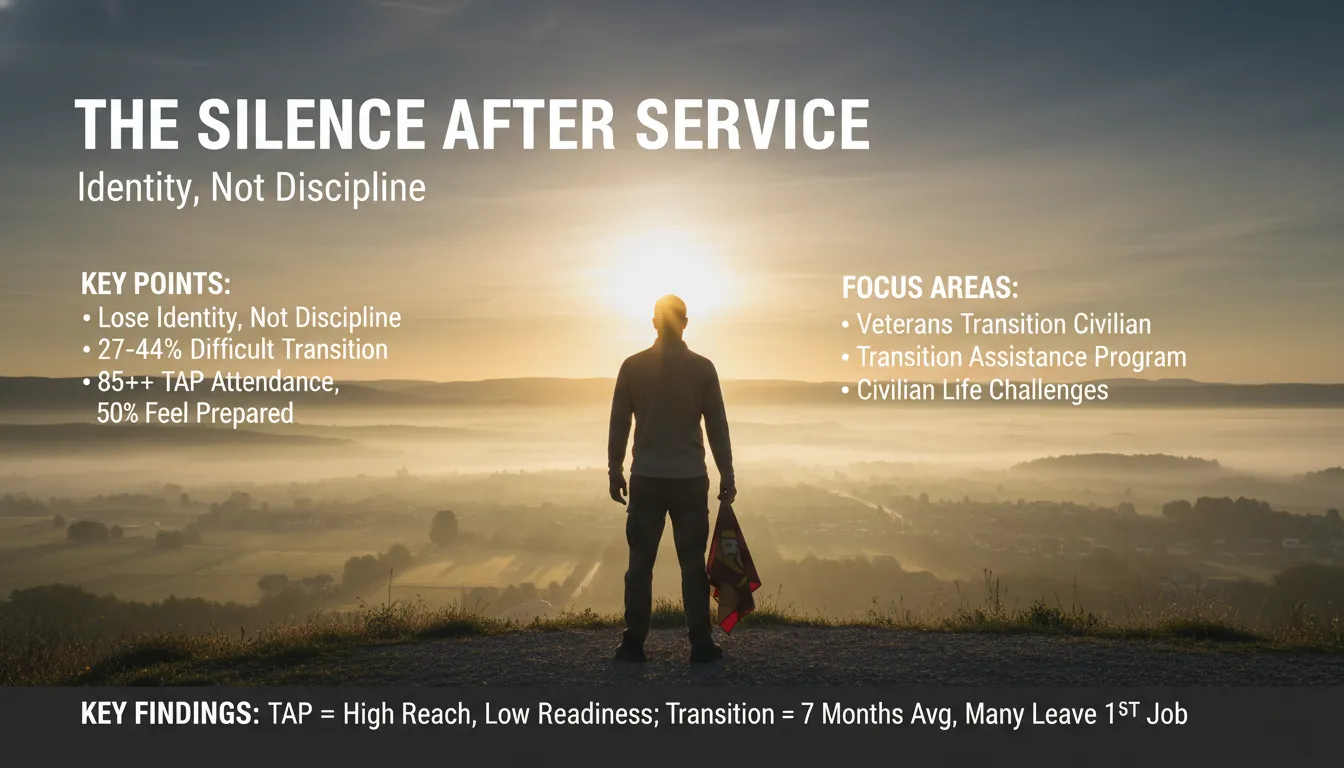
Over 200,000 service members move into civilian life every year, mostly in their 20s and 30s. Some people adjust fast. Data shows 27%–44% report a difficult transition, while about 65% report no difficulty. That range matters, because it proves something I’ve seen up close: the struggle isn’t universal, but it’s real—and it’s often personal.
When it’s hard, it usually looks like this: you’re still capable, still early, still driven… but you don’t know what to aim at. The average timeline to feel settled is around 7 months, and many leave their first civilian job within a year. That’s not laziness. That’s civilian life challenges colliding with a missing sense of purpose.
Why TAP Helps, But Doesn’t Always Make You Ready
Most of us attend TAP—85%+ do. But only about half say they feel fully prepared. That’s the difference between structure and readiness. TAP can help you translate skills, build a resume, and learn benefits. It can’t hand you a new identity.
33% cite finding a job as the top challenge
Many aren’t confused about how to work—they’re unsure who they are without the uniform
Supporting veterans' transitions is both a moral and economic imperative. — Juan Andrade, USAA CEO
If you need next-step tools, I’d look at VA career services and SkillBridge. Not as a “fix,” but as a bridge while you rebuild direction on your terms.
2) The Lie We're Told and the Truth We Carry
The story that keeps us small
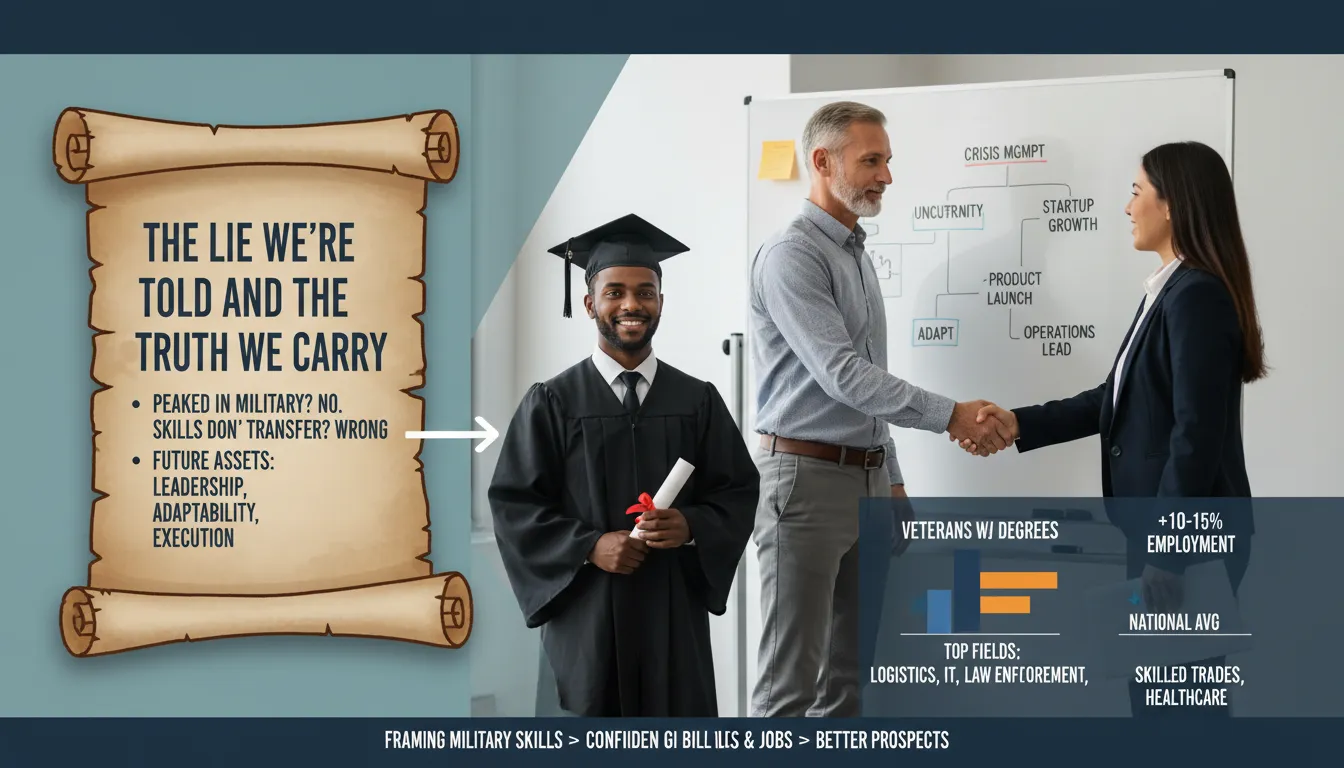
After I got out, I heard the same lines on repeat: “You peaked in the military.” “Those skills don’t transfer.” “Just be grateful you served.” It sounds harmless, but it hits hard when you’re already dealing with veteran struggles military life doesn’t prepare you for—silence, no structure, no clear mission.
That story shrinks your view of your own value. It turns your service into a closed chapter instead of a foundation. And it makes post military jobs feel like a downgrade instead of a new arena.
Transferable skills veterans already use—without noticing
The truth I carry is simple: what we did wasn’t “military-only.” It was problem-solving under pressure. It was execution when the plan wasn’t perfect. Those are transferable skills veterans can bring anywhere.
Leading under pressure → crisis management in startups and fast-moving teams
Executing without clarity → product launches, project delivery, and tight deadlines
Adapting when plans collapse → operations roles where the goal stays the same but the path changes daily
I saw it firsthand. I took a deployment logistics plan and translated it into a warehouse process at a civilian job. Two weeks later, the workflow was cleaner, the handoffs were clear, and the team stopped losing time on avoidable mistakes. Same thinking. Different uniform.
Reality check: credentials + framing improve veterans job prospects
Framing matters. When I started describing my experience in plain business language, my confidence went up—and so did the quality of conversations. Research backs this up: seeing military skills as transferable improves confidence and job outcomes.
Education helps too. Veterans with degrees see 10–15% higher employment rates and faster income recovery. And over 40% of eligible veterans use the GI Bill within two years to turn experience into credentials.
That’s why veterans job prospects are often strongest in sectors that value operational, technical, and leadership experience:
Logistics
IT
Law enforcement
Skilled trades
Healthcare
You didn't serve to stop being useful—you served to get better at solving impossible problems. — Juan Andrade, USAA CEO
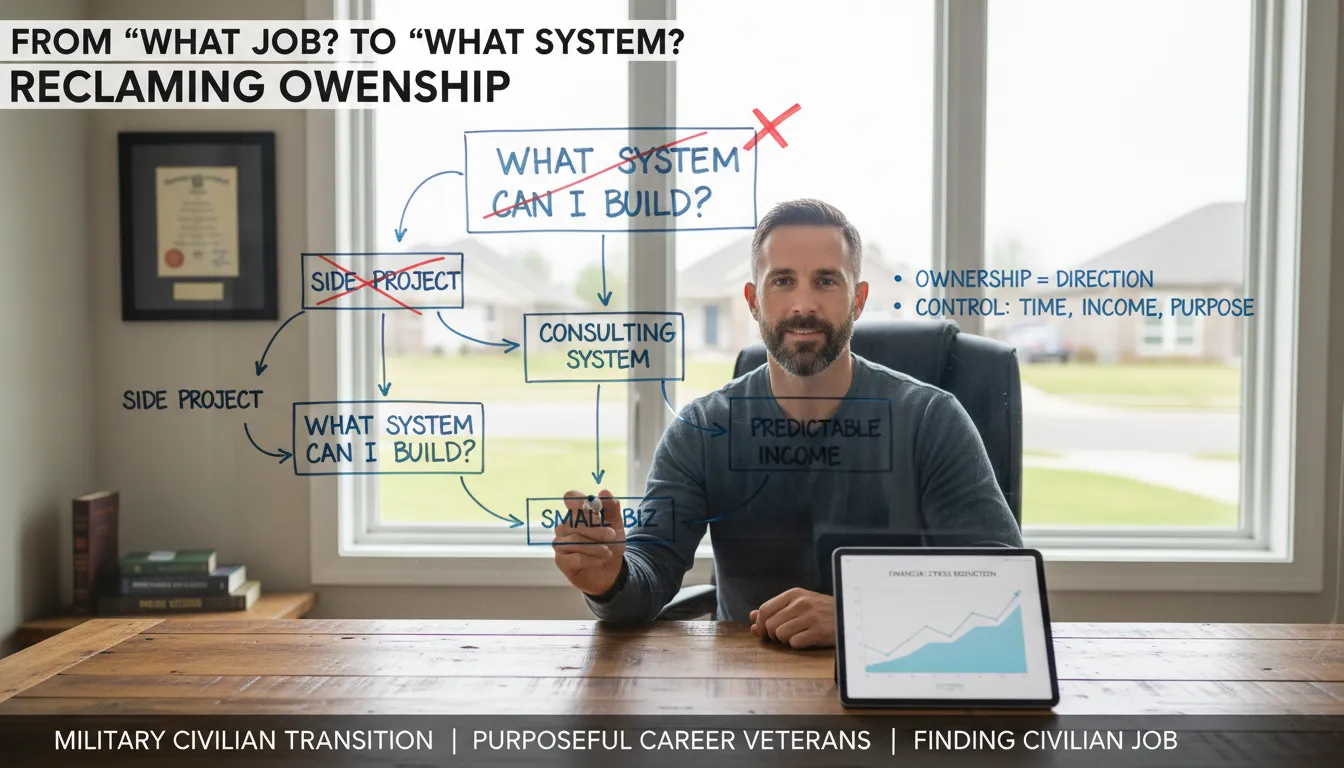
3) From 'What Job?' to 'What System?': Reclaiming Ownership
In my military civilian transition, I kept asking the same question: “What job should I get?” I thought the goal was to find the perfect title and lock it in. But that question kept me stuck, because it made my future feel like something a company had to hand me.
Everything shifted when I asked a better question: “What system can I build?” Not a fantasy. Not a “get rich quick” plan. A simple system that creates direction, predictable action, and predictable results.
Operators don’t need permission; they need direction
In service, direction was built into the day. Out here, nobody gives you the mission at 0500. That’s why so many of us struggle—not with discipline, but with identity and structure. And it shows up fast: about half of veterans leave their first post-military job within a year because the transition is harder than people admit.
Ownership fixes that. Ownership strategies reduce churn and improve long-term satisfaction because you’re not just “finding a civilian job.” You’re building a path you can adjust.
Redeploying your expertise isn't defeat—it's strategy. Own your next mission. — Juan Andrade, USAA CEO
Build a system that controls time, income, and purpose
Financial stress is real early on. One in three veterans reports financial stress in the first year, and it can take around 4 months to land a civilian role. Systems that create predictable income reduce that pressure.
Small contracting business: one service, one customer type, one repeatable process.
Freelance operations consultant: help small teams with planning, SOPs, logistics, or project execution.
Social enterprise: a mission-driven service that supports other veterans while generating revenue.
Test small systems before you fully jump
You don’t have to gamble. Use the Transition Assistance Program and VA career services to map skills, then run small pilots through SkillBridge or part-time trials. I treat it like a field test: short timeline, clear metrics, and a debrief.
This is what a purposeful career veterans path looks like: not replacing service—redeploying it with control of my time, my income, and my mission.
4) Practical Steps, Resources, and Small Experiments
If I could redo my transition, I’d stop “job hunting” like it’s the mission. I’d start system-testing. You’re not starting over. You’re redeploying. Practical, short experiments reduce risk and clarify direction faster than applying to random jobs.
Start small, measure fast, and iterate—it's how operations become careers. — Juan Andrade, USAA CEO
Short Checklist (Use Programs With Outcomes)
Transition Assistance Program (TAP): Don’t just attend—walk in with 3 outcomes: resume creation veterans draft, a target industry list, and 5 networking messages ready to send.
Use GI Bill benefits: Over 40% of eligible veterans use the GI Bill within two years. Education and training increase employment odds—pick a program tied to a real role (IT support, project management, CDL, nursing, cyber).
SkillBridge + VA career services: SkillBridge is underused for “system-testing” a civilian lane before you commit. Pair it with VA career services for coaching, job leads, and interview practice.
Build a one-page system plan: One page. No fluff. Just direction.
One-Page System Plan Template
 Mission (next 90 days): ______
Skills to prove: ______
Income target: ______
Time rules (hours/week): ______
3 experiments: ______
Next review date: ______
Micro-Experiments (Low Risk, High Signal)
90-day consulting sprint: Help a local business with ops, scheduling, logistics, or training. One problem, one deliverable, one testimonial.
Two-week skill certification: Pick a short cert that maps to hiring filters (CompTIA, OSHA-10, Google certs). Fast proof beats big promises.
Volunteer leadership role: Run a VFW resources project, coach a team, or lead a community event. Test if you miss leading people—or just miss structure.
Metrics to Watch (Reassess Every 90 Days)
The average veteran finds a civilian job in about 4 months, but many take closer to 7 months to adapt. And half leave their first civilian job within a year. That’s why I track metrics, not titles.
Metric | What “Better” Looks Like |
|---|---|
Income stability | Predictable pay + lower stress |
Job satisfaction | Work I don’t dread |
Time autonomy | Control of schedule |
Confidence | I can explain my value clearly |
Also use USAA support programs and VA/VFW resources for budgeting, career tools, and mentorship—because your next mission should be built, not guessed.
5) Wild Cards: Analogies, Hypotheticals, and One Weird Thought
Redeployment Isn’t an Ending, It’s a Conversion
When I think about adjustment civilian life, I stop trying to “translate” my service into a job title. I picture something simpler: converting a rifle into a farmer’s plow. Same steel. Same hands. Different field. In uniform, my tool was focus under pressure. Out here, that same focus can build a schedule, a budget, a business, or a degree plan. The mission changes, but the operator doesn’t disappear.
Purpose is portable—carry it into whatever you build next. — Juan Andrade, USAA CEO
A Three-Month, $5,000 Journaling Prompt
Here’s a hypothetical I use when my brain starts spiraling: If you had three months and $5,000, what system would you build? Answer it honestly, in writing. Not the “perfect” answer. Your answer. Would you build a training routine that fixes your sleep and energy? A simple service business with three repeat clients? A certification path that leads to stable income? One in three veterans reports financial stress in the first year post-service, so this prompt isn’t fantasy—it’s focus.
I like to journal it as a short plan: what I’d learn in week one, what I’d test by week four, and what I’d measure by week twelve. Education counts here too. About 33% of veterans pursue education during transition to boost self-confidence, and that confidence often comes from small wins, not big speeches.
A Quick Tangent: Family Changes the Math
My plan is never just “my” plan. Family context matters. Military spouses unemployment sits around 22%, over four times the national average. That reality can turn a transition into a pressure cooker. If you’re carrying the whole household, your next system might be childcare coverage, a spouse job search pipeline, or a tighter cash-flow tracker before anything else. That’s not failure. That’s leadership.
One Weird Thought for Your Next Reunion
Imagine a reunion where, instead of swapping deployment stories, we share spreadsheets. What would yours track—time, income, workouts, applications, leads, class credits? That spreadsheet is proof of identity beyond service: control of your time, your income, and your mission. And if you don’t have one yet, good. Build it. That’s the new chapter.
