


I used to scroll and feel late. College kids launching AI startups, thumbnails promising overnight wins — and me, fresh out of a deployment, wondering if I missed the update. Then I noticed something: the skills the internet worships are flashy; the skills I carry are structural. Leadership, stress tolerance, mission focus — these aren’t relics. They’re the foundation of AI systems. In this post I tell the story of why veterans aren’t behind; they’re being rebuilt for the AI era.
Why I Thought I Was Late (and Why I Wasn't)
Veterans AI career transition: the moment the knot hit
I remember sitting on my couch, doom-scrolling like it was a duty station. A 19-year-old “college dorm creator” popped up on my feed, shipping a SaaS demo like it was nothing. Clean landing page. Fast edits. Comments full of “bro is printing money.”
And I felt that familiar knot in my stomach—imposter syndrome meets FOMO. My brain did the math in the worst way: They’re early. I’m late. Like everyone else got the AI update and I missed the download.
Military experience AI skills: the reality check I needed
Then I caught myself. Because while they were building product demos, I was building teams. I was learning how to lead people who were tired, stressed, and still expected to perform. I learned to move with purpose, not vibes. I learned how to make decisions when the cost of being wrong was real.
That’s not a gap. That’s training.
Lt. Col. Sarah Mitchell: "The cadence of military life trains you to design and run systems — that’s the language of AI work."
The internet confuses speed with value
Online, velocity looks like success. Viral wins look like proof. But most of what I see is motion without a mission. People sprint, burn out, and restart. Over and over.
What actually holds up is boring stuff:
Clear systems
Repeatable workflows
Feedback loops
Emotional control when things break
Military Service Ultimate Credential: not a detour, a rebuild
This is where the Matrix metaphor clicked for me. Neo didn’t wake up and instantly bend reality. He got unplugged first. He trained. He learned the rules.
That’s how my Veterans AI career transition started to feel. Not like I was behind—like I was being rebuilt. If I treat my service as systems experience, my Military experience AI skills stop looking “non-technical” and start looking like the Military Service Ultimate Credential it really is.
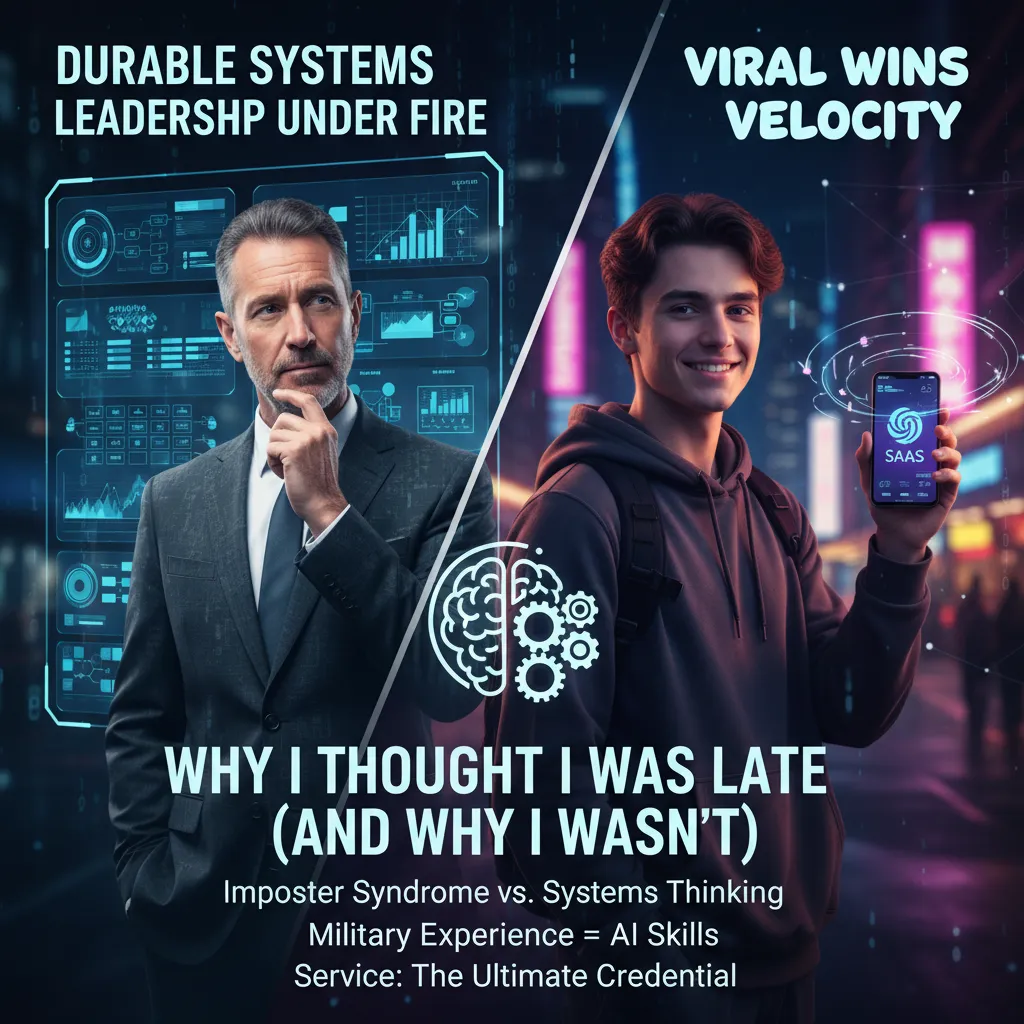
The Civilian Matrix Is Loud — But Mostly Noise
I open my phone and it’s the same loop: “AI side hustle,” “build in public,” “$10K MRR in 7 days.” The feed makes speed look like success, and success look like a stopwatch. Attention is the currency, so everyone acts like they’re printing it.
And yeah, it messes with your head. You start thinking you missed the update.
Okay, sometimes I still click the thumbnails. Old habits.
Pattern Veterans Using AI: Seeing the Game Behind the Game
Here’s what I’ve noticed: most of what looks like momentum online is just motion. People sprint from tool to tool, niche to niche, prompt to prompt. It’s loud, but it’s not always progress.
There’s a quiet stat floating around the industry: most AI entrepreneurs burn out in 6–12 months. Not because they’re dumb. Because they’re running on hype with no structure.
No system to follow when motivation drops
No discipline when results are slow
No emotional resilience when the algorithm changes
Strategy Tactics Veterans Approach: Purpose Beats “Move Fast”
Dr. Aaron Delgado, Director of Veteran Tech Initiatives: "What civilians mistake for 'move fast' is often move confused. Veterans move with purpose."
That line hits because I’ve lived it. In uniform, you don’t get to “vibe” your way through a mission. You plan, execute, review, adjust. That same Strategy Tactics Veterans Approach is a cheat code in AI business—because AI rewards operators who can run cycles, not chase trends.
Discipline training clear objective: Your Anti-Burnout Moat
You survived 0500 formations. You handled deployments. You operated when tired, stressed, and uncomfortable. Compared to that, building a digital system—content, offers, automations, outreach—is lighter weight than a ruck march.
The trap is trend-chasing without a Discipline training clear objective. That creates churn: new tool, new plan, new identity every week. Veterans are built to avoid that. Structured habits reduce early burnout, and systems discipline becomes a competitive moat when the hype fades.
You Weren't Behind — You Were Training (Neo Moment)
When Neo wakes up in The Matrix, he doesn’t jump straight to bending reality. He coughs. He panics. Then he trains. He gets unplugged, learns the rules, and upgrades his mind before he ever wins a real fight.
That’s the part I missed when I first got out. I thought everyone else had some secret AI download. But what I was really feeling was the shock of a new operating environment. I wasn’t starting from zero—I was relearning the terrain.
What Actually Different Veterans: We Train in the Dark
Most civilians only see progress when it’s public: posts, launches, “wins.” Veterans are used to progress that’s invisible early on—reps, checklists, after-action reviews, boring consistency. That’s why the AI era can feel like a delay at first. The training phase looks like nothing… until it suddenly looks like momentum.
Start Strategy Not Tactics
I had to stop comparing my day-one to someone else’s highlight reel. Viral tricks are tactics. They change every week. Strategy is the mission: who you serve, what problem you solve, and what system delivers the result.
Rule of thumb I live by now: Start Strategy Not Tactics. Once the strategy is clear, tactics become simple choices—not emotional guesses.
Systems thinking software design: Your Military Skills Translate
In practice, the crossover is real:
Military procedures become cloud deployment discipline: checklists, version control, rollback plans.
Mission planning becomes product roadmaps: scope, timelines, risks, contingencies.
Documentation and repetition become leverage: you build once, then run it the same way every time.
Maj. Jason Lee, Product Lead (veteran): "The same planning that kept my team safe on deployment now keeps my builds stable in production."
Small Wins: Document, Repeat, Iterate
When I felt lost, I went back to what I knew: write it down, run the process, review, adjust. I had to write mine on a napkin once.
Quick exercise (2 minutes): write a one-line mission statement for your AI project:
My AI project helps [who] achieve [result] by [system/process].
Identity Shift: Redeploying Your Purpose
The hardest part of my transition wasn’t learning new tools. It was waking up and realizing the uniform used to answer the question, “Who am I?” Without it, everything felt like static. That’s why I keep coming back to one reframe: you’re not starting over. You’re redeploying into a new domain—same operator, new mission set.
Most veterans struggle not because we lack skill, but because we don’t know how to explain it without sounding “too military.” That’s backwards. Your service is not baggage. It’s an ultimate credential—proof you can learn fast, lead under pressure, and execute when it counts. That confidence shift changes hiring conversations.
Rachel Torres, Career Coach for Veterans: "Translating military language into civilian impact is the single biggest multiplier for job success."
Veterans Earn AI Credentials by Translating the Mission
When I started mapping my roles to civilian deliverables, the fog lifted. Here’s the practical step: translate rank and job title into outcomes a company can measure.
Military Role | Civilian Deliverable |
|---|---|
Operations Lead | Product Ops / Process improvement |
Comms / Signals | Systems support / Network reliability |
Maintenance / QA | Reliability engineer / Quality systems |
My buddy Erin didn’t know “ops” translated to SaaS uptime. Three coffees later, she had a job interview—because she stopped describing tasks and started describing impact: availability, response time, incident drills. That’s also where Veterans Earn AI Credentials fits: pair your leadership with a short AI cert, and suddenly you’re not “new,” you’re current.
Veteran Employee Resource Groups + Mentorship coaching veteran transition
Career coaching and mentorship improve transition outcomes because they speed up cultural translation. Join Veteran Employee Resource Groups at target companies, and look at programs like Hiring Our Heroes and VetsinAI. Ask for Mentorship coaching veteran transition focused on resumes, interviews, and “civilian language.”
Also: don’t overlook military spouses. They’re often fast re-starters—another talent pool that understands change, pressure, and rebuilding from scratch.
What Actually Wins in AI Business (Spoiler: Not Hype)
I’ve watched the same movie play out: someone finds a trend, posts a loud demo, gets a spike of attention… then disappears. In the military, we had a name for that kind of plan: no sustainment. In AI business, hype is the same thing—noise without a system.
Strategic AI implementation veterans: the real winners
What actually wins is boring on purpose. It’s the stuff we already respect:
Evergreen systems (offers and workflows that work next month too)
Repetition (run the play until it’s clean)
Data review (after-action reports, but with dashboards)
Optimization (small fixes that stack)
Emotional control (no panic pivots)
That’s why Strategic AI implementation veterans have an edge. We default to repeatable processes, and that reduces risk in AI production environments. Civilian builders often treat AI like magic. We treat it like equipment: maintain it, test it, log it.
Elliot Zhang, Head of AI Apprenticeships: "When veterans apply systems thinking to AI, automation scales safely and predictably."
AI tools force multiplier (not a shortcut)
AI is an amplifier of disciplined systems. When you plug AI into a messy workflow, you don’t get speed—you get faster chaos. But when the workflow is tight, AI tools force multiplier becomes real. With mature prompts and clear steps, AI tools can handle up to 70% of repetitive work (drafting, summarizing, tagging, routing), while you stay on decisions and quality.
AI Agent prompt engineering: an easy entry point
If you want a simple start, learn AI Agent prompt engineering: writing instructions like an SOP so an agent can execute tasks the same way every time. Think: “commander’s intent + constraints + checklist.”
Compounds Month Growth Opportunities: a weekly checklist
Define objectives: one mission metric (leads, demos, renewals).
Build small automations: one workflow, one tool, one outcome.
Measure outcomes: time saved, error rate, conversion rate.
Iterate weekly: keep what works, cut what doesn’t.
It’s mission planning with Wi‑Fi—same principles, new tools.

12-Month Roadmap: From Zero to Doing (Compound Growth)
When I first stepped into the civilian AI world, I felt like I missed the briefing. So I built one. This roadmap is how I create Compounds Month Growth Opportunities without drowning in options—just steady reps that stack.
Month 1–3: Transition strategy (pick the mission)
First, I inventory strengths like an after-action review: leadership, process, calm under stress. Then I choose 1–2 tech tracks tied to AI readiness engineering skills—usually cloud + data or automation + basic software. I write a one-sentence mission statement and keep it visible.
Track examples: Google Skills certificates (IT Support, Data Analytics) + a simple Python/automation path
Training Upskilling Initiatives: Google Cloud Days and related programs—over 23,000+ service members, federal workers, and contractors have been trained through these pipelines
Month 4–6: Skill acceleration (learning-by-doing)
This is where I stop “studying” and start moving. I look for Paid apprenticeships real-world training or community college programs that force output and feedback. Smoothstack partnerships and similar models can be a bridge from zero to employed.
Karen Blake, Program Director at 1st Hope Corps: "Paid, hands-on training closes the gap faster than passive courses — veterans thrive in learning-by-doing."
Industry reporting also notes one in ten of one million career certificate graduates were service members or veterans—proof the pipeline is real.
Month 7–12: Productize and automate (ship outcomes)
Now I build assets that compound. I aim for one “public” channel and one “owned” channel, plus a small product.
Launch a YouTube channel (weekly)
Build an email list (simple lead magnet)
Automate funnels (AI tools can handle 70% of drafts, edits, and follow-ups)
Ship a micro-SaaS or automation service (small, useful, paid)
Year 2+: Scale with systems
With consistency, I can step into consulting, a side business, or a full-time engineering role—same system, bigger reps.
Logistics tip (the quiet multiplier)
I block two 90-minute deep work sessions each week. That’s it. Those sessions compound more than motivation ever will.
Programs, Proof, and Where to Plug In
I stopped telling myself “I’m late” when I saw the numbers. Veterans are adopting this stuff early. Over 23,000+ active service members, federal workers, and contractors have trained through Google Skills and Google Cloud Days. And in Google’s Career Certificates, 1 in 10 of the first 1,000,000 graduates were service members or veterans. That’s not hype—that’s a pipeline.
Veterans AI Readiness Programs (Start Here)
If you want a clean on-ramp, these are the names I keep seeing scale:
Google Skills + Google Cloud Days (fast exposure, real tools)
Hiring Our Heroes (employer-connected cohorts and fellowships)
VetsinAI (community, events, and practical AI pathways)
Smoothstack (structured training tied to job placement)
1st Hope Corps (paid, hands-on apprenticeship style)
Veteran Business Project (builder mindset + business support)
AI Training Paid Opportunities Beat Passive Courses
I’m biased toward programs that pay you to learn, because pressure + structure is where veterans win. 1st Hope Corps stands out for paid, hands-on reps. And Smoothstack frames it the same way:
“Veteran readiness translates neatly into AI readiness when companies provide structured, paid pathways.” — Michael Rhodes, Senior Talent Lead at Smoothstack
Employer Paths + Federal Modernization Initiatives
Some companies are building internal upskilling lanes—Booz Allen is a known example. This matters because integrating veterans into the AI ecosystem isn’t just jobs—it’s national security. We already understand security protocols, access control, and mission risk. AI needs that mindset.
My Next Move: One Program, One Mentor, One Project
Pick one program from the list.
Find one mentor (VetsinAI, VetsinTech, or a veteran ERG).
Ship one small project in 90 days (a chatbot, a resume tool, a simple automation).
Links to check: Google Skills, Google Cloud Days, 1st Hope Corps, Smoothstack, Hiring Our Heroes, VetsinAI, Veteran Business Project, Booz Allen.
Sources: Havok Journal, Smoothstack, Stripes, VetsinTech, 1st Hope Corps, Veteran Business Project, Booz Allen.
Wild Cards: Quotes, Hypotheticals, and the Final Call
Veterans adopt AI early: the “start today” wild card
I’ve learned that the biggest gap isn’t talent—it’s starting. Picture this: you start today, and in six months you build a simple AI agent that automates 50% of a local small business’ admin. Scheduling, invoices, follow-ups, basic customer replies. Nothing flashy. Just reliable. Like Neo in the training program, you don’t bend reality on day one—you learn the rules, then you stack reps until the system obeys.
That’s how consulting gigs show up. Not because you went viral, but because you delivered calm, repeatable results. That’s Strategic AI implementation veterans are built for: clear scope, clean handoffs, and steady improvement. It’s the opposite of the civilian Matrix noise.
Veteran transition success patterns: the apprenticeship wild card
Or you take the other route: you join a paid apprenticeship, grind through it, and finish in about four months (program-dependent). Within a year, you’re in a security-focused AI role—threat detection, policy automation, audit support, or secure agent workflows. It’s not magic. It’s compounding gains from disciplined work, the same way a ruck march feels brutal until you remember: it’s still easier than a deployment, because you control the variables.
I still have a bad habit of checking notifications at 0300 — old reflexes die slowly.
Col. (Ret.) Daniel Price: “Structure is the real asymmetry in the AI race — and veterans already own it.”
And that’s why this line keeps landing for me: “Skynet doesn’t fear hype. It fears structure.” Human aside: neither do clients. They fear chaos, missed deadlines, and promises that evaporate.
If you want follow-through (and less analysis paralysis), do the next right thing: subscribe to the blog, follow the channel, and build one small, repeatable system this week.
Write a one-sentence mission statement.
Choose a 90-day project you can finish.
Pick one training program and commit.
Find one mentor and ask one clear question.
