

I remember the tab I closed: a half-written course plan, a list of tools, and that familiar tightness—too many options, not enough clarity. Over time I learned the real problem wasn’t tools or skill, it was that no one gave me a realistic starting point. In this post I’ll walk you through the tiny, honest steps I used to turn day-to-day know-how into a digital product people actually bought.
The Myth That Kept Me Stuck (and Maybe You Too)
For the longest time, I thought I was being “responsible” by waiting. Waiting to Sell Digital Products until I had the three things everyone online seemed to have:
A huge audience
A flashy website
Years (and years) of expertise
So I did what a lot of creators do. I planned. I researched. I saved links to tools I didn’t need yet. I told myself I was working on my Digital Product Launch… but really, I was hiding.
The “Someday” Checklist That Wasn’t Real
My internal checklist sounded smart: “Once I hit 5,000 followers, I’ll launch.” “Once my site looks legit, I’ll sell.” “Once I feel like an expert, I’ll charge.”
But here’s what I didn’t want to admit: that checklist had no finish line. Every time I got closer, I moved the goalpost. And the product stayed in my notes app.
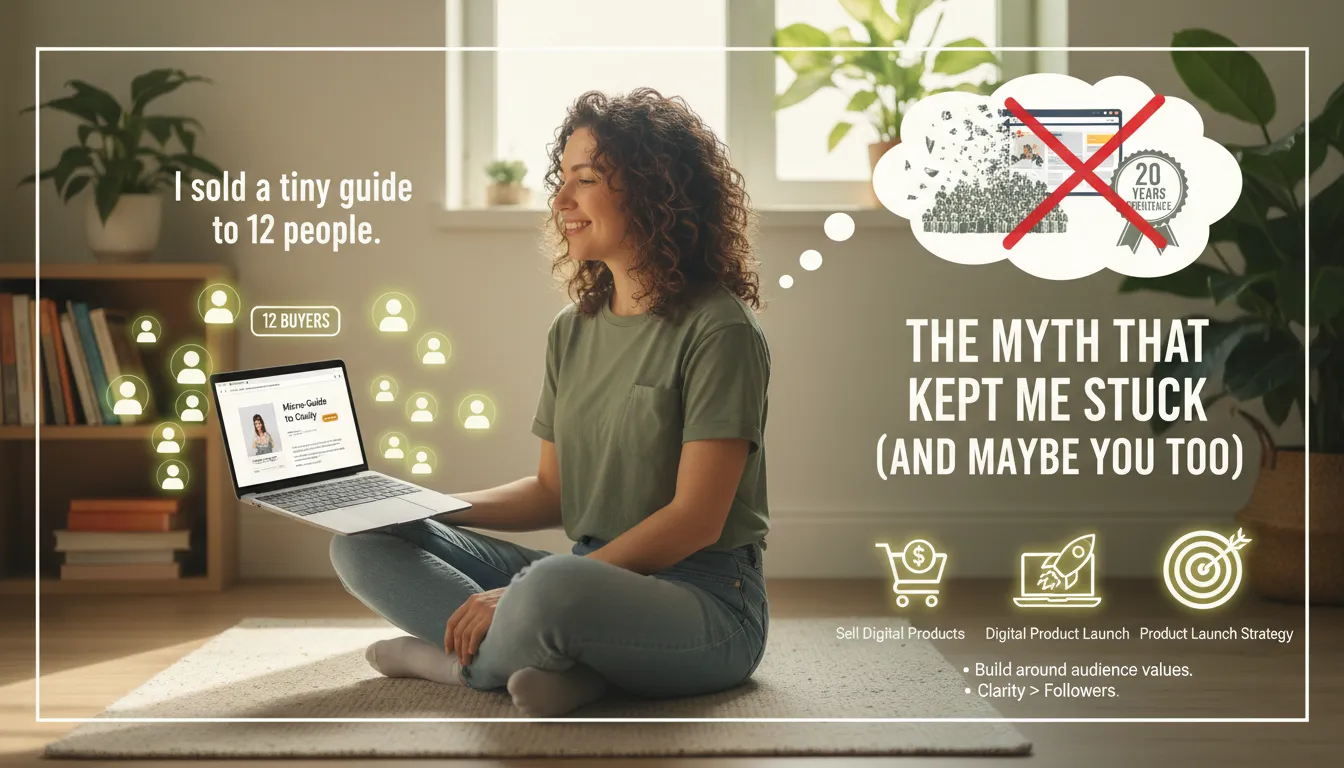
The Tiny Sale That Changed Everything (12 People)
One week, I got tired of waiting and made a small guide. Nothing fancy—just a simple PDF that solved one specific problem I’d already solved myself. No logo. No website. No big email list.
I shared it with a small group and a few friends. I had fewer than 500 followers at the time, and I expected silence.
Twelve people bought it.
That number might not sound like much, but it hit me hard: real buyers exist for micro-solutions. People weren’t paying for my “brand.” They were paying to get the result faster than figuring it out alone. Speed beat perfection.
Clarity Is the Real Product Launch Strategy
That first sale taught me what I wish someone had told me earlier: the fuel for a launch isn’t followers or fancy tech. It’s clarity.
Clarity means:
Who you help
What problem you solve
How you explain the result in plain language
Ava Martinez, Product Launch Consultant: “Clarity trumps scale when you’re starting — one clear customer is worth more than a vague audience of thousands.”
This is also where research-backed launch advice gets real: strong launches are built around your audience’s values and expectations, not your follower count. And your best advantage is first-party data—the questions people ask you, the replies to your emails, the DMs, the comments, the words they use. That information creates clarity faster than chasing reach.
If you’ve learned something in the last 12 months that helps someone skip confusion and get a win, you already have something worth packaging. The myth says you need scale. The truth is you need a clear promise and a clear person.
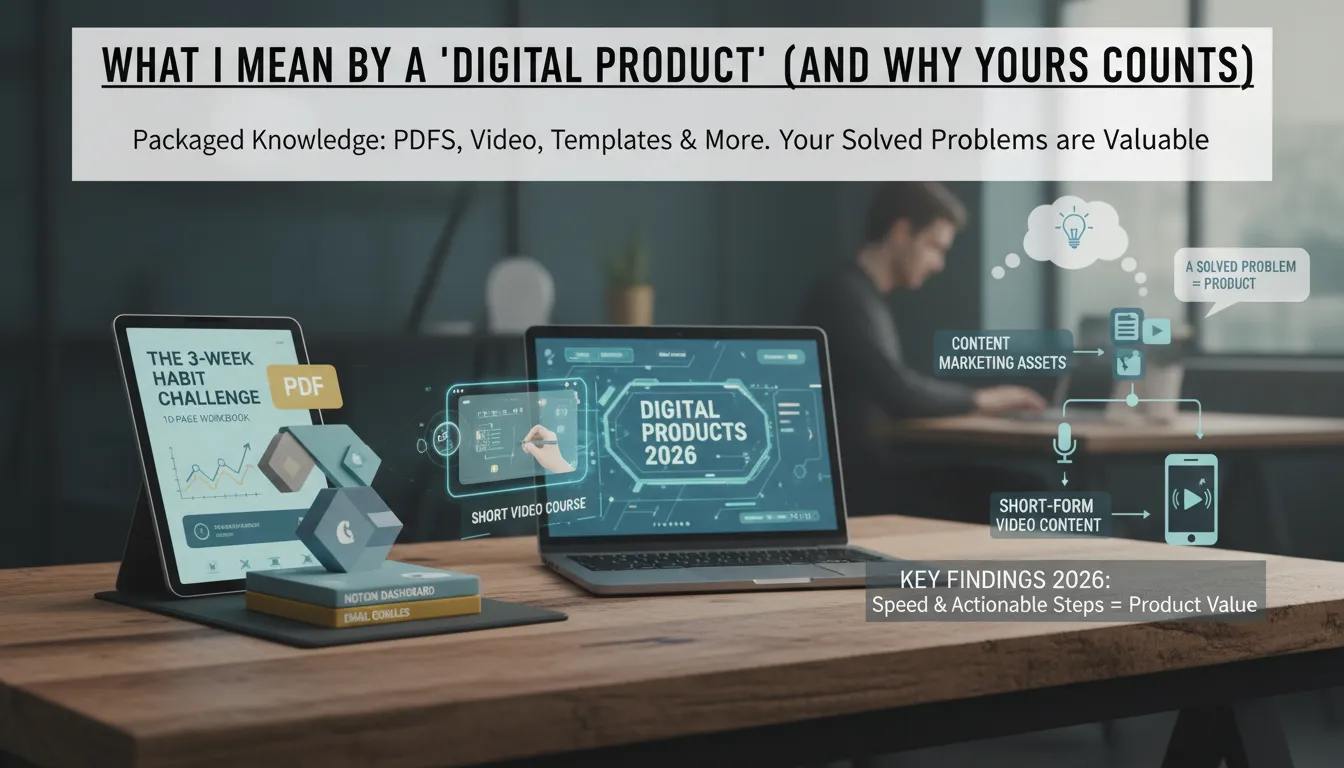
What I Mean by a 'Digital Product' (and Why Yours Counts)
When I say digital product, I’m not talking about some huge, polished course with a film crew and a fancy platform. In Digital Products 2026, a digital product is simply packaged knowledge—something a person can download, access, or consume online to get a result faster than doing it alone.
That “packaged” part matters. It means you took what you know and turned it into a clear path someone else can follow.
Digital Products 2026: Packaged Knowledge, Not Perfection
Here are formats that count (and sell) every day:
PDF guide (quick steps, checklists, examples)
Workbook (prompts + exercises that create action)
Short video course (simple lessons, clear outcomes)
Template or toolkit (plug-and-play files)
Mini email course (a short sequence that teaches one outcome)
Notion dashboard (a system someone can copy and use)
In 2026, people value speed and actionable steps. They don’t want more information—they want a shortcut to implementation. That’s why these formats work so well as Content Marketing Assets: they’re useful, specific, and easy to share.
My Simple Example: A 3-Week Habit Experiment → A 10-Page Workbook
I used to think I needed a “real” product idea. Then I remembered a three-week habit experiment I ran for myself—nothing fancy, just a small system to stop skipping workouts. I wrote down what I did, turned it into a 10-page workbook, and put it up for sale. It sold.
Not because I’m the world’s leading habit expert. It sold because it helped someone solve a real problem with a clear plan.
Daniel Kim, Creator Economy Researcher: "A useful product solves a real friction point — format is secondary to clarity of result."
You Only Need to Be a Few Steps Ahead
If you’re a teacher, coach, freelancer, stay-at-home parent, or recent graduate, you probably have a process you’ve already figured out—lesson plans, client onboarding, meal routines, study systems, budgeting, time blocking. If someone would pay to get your steps without trial and error, that counts.
Match the Deliverable to How Fast They Want the Win
One thing I’ve learned: format should match the buyer’s pace.
Fast wins → PDF guide, template, Notion dashboard
Guided change → short video course or mini email course
And because Short-Form Video Content is a core part of the 2026 marketing mix, I often pair the product with quick videos that show one step in action—then the product becomes the “full system” people can grab when they’re ready.
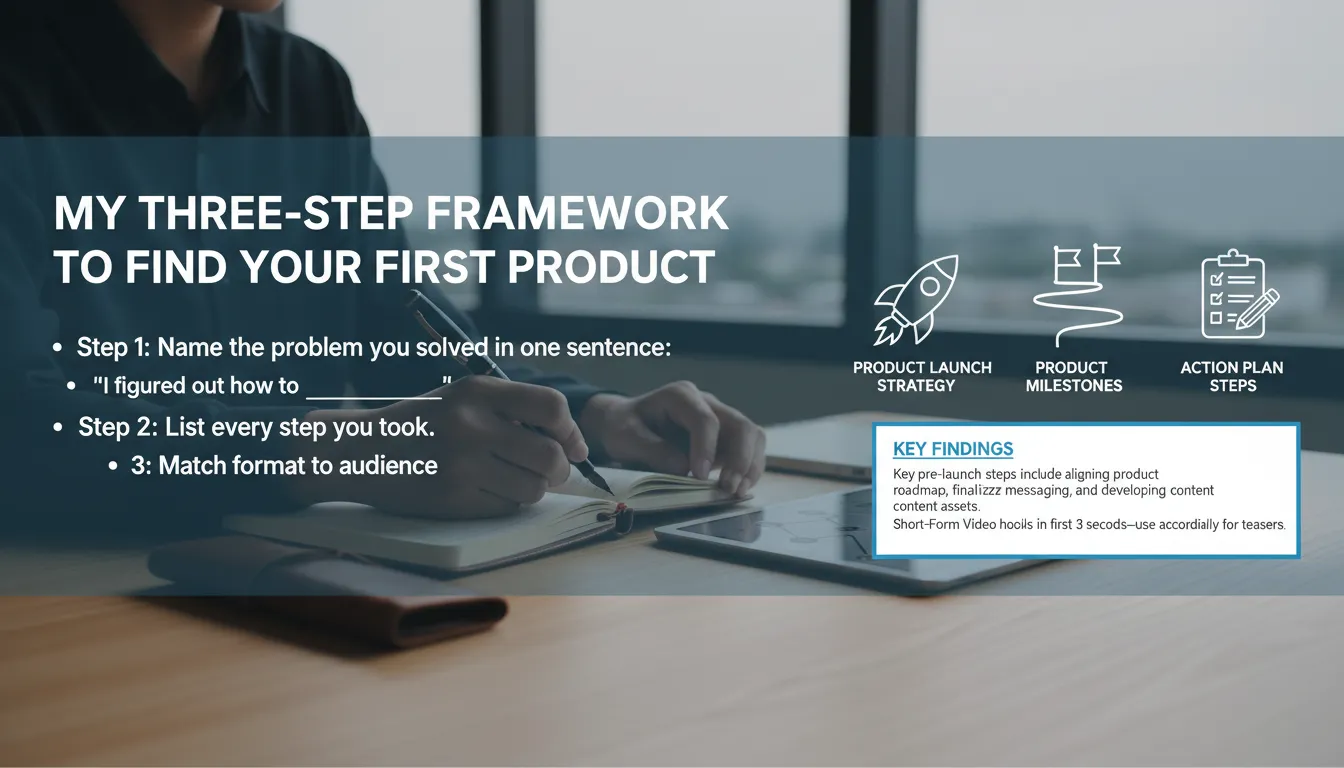
My Three-Step Framework to Find Your First Product
I used to think I needed a “big idea” before I could build anything. Then I realized the real issue wasn’t ideas—it was clarity. The moment I wrote my product down in one sentence, everything got easier. It felt like a real Product Launch Strategy, not a daydream.
Action Plan Steps: Step 1 — Name the problem you solved (one sentence)
Pick a challenge you solved in the last 1–3 years. Not ten years ago. Not something you’re still stuck in. Something recent enough that you remember the messy middle.
Open a notes app and finish this sentence:
I figured out how to ____________.
When I did this, I stopped trying to create “a course about everything” and started building something specific. If you want a fast test, imagine this as a short-form video teaser: can you say the problem in the first 3 seconds without explaining your whole life story?
Product Roadmap Milestones: Step 2 — List every step you took (even the obvious ones)
Next, I brain-dumped the process I followed from stuck to solved. I didn’t edit it. I didn’t make it sound smart. I just listed what I actually did.
This becomes your outline and your early Product Roadmap Milestones—because each step can turn into a page, lesson, template, or checklist.
Write the steps in order (first thing you did, second thing, third thing).
Circle the steps people always ask you about.
Cross out anything “nice to know” for version one.
This is also where pre-launch gets real: you’re aligning your roadmap, tightening your messaging (“Here’s the exact result”), and spotting what content assets you’ll need (examples, screenshots, templates, before/after).
Ava Martinez, Product Launch Consultant: "Treat your first product like a prototype: it exists to prove demand, not to be perfect."
Step 3 — Match the format to your audience (not your comfort zone)
I used to choose formats based on what felt easiest to create. That slowed me down. Now I ask: how does my buyer want to learn?
Fast learners: PDF guide, workbook, template, toolkit, Notion dashboard
Need hand-holding: short video lessons, mini course, email course
Keep the first version narrow: one person, one problem, one solution. Your MVP can be a single PDF or a short course—small enough to finish, clear enough to sell.
If you want help turning these Action Plan Steps into a simple build-and-launch flow, grab my free checklist: Get the Free Launch Checklist — Click Here.
Why So Many Ideas Die (and the Quick Fix I Used)
I used to think my problem was time. Or confidence. Or “not having the right platform yet.” But if I’m honest, my ideas didn’t die because they were bad. They died because I kept doing the same loop.
The Procrastination Loop I Didn’t Notice (Until It Was Obvious)
It always looked productive from the outside. I’d get a spark of excitement, open 12 tabs, and tell myself I was doing smart Pre-Launch Activities. Then I’d hit the wall.
Excitement: “This could really help people.”
Research rabbit hole: tools, platforms, pricing, funnels, branding.
Overwhelm: too many options, too many opinions.
Delay: “I’ll come back when I’m more ready.”
Dead idea: weeks pass, the energy fades, nothing ships.
The worst part? I’d confuse planning with progress. I was “working” on my product without ever making something a real person could use.
My Quick Fix: A One-Problem PDF + 10 Real Humans
Here’s what finally broke the cycle: I stopped trying to build the full thing and made a tiny version that solved one problem. A simple PDF. No fancy design. No course platform. Just clear steps.
Then I offered it to 10 people I already knew (friends, coworkers, old clients). Not to “validate the market” in a big dramatic way—just to get real feedback fast. Speculation is loud. Feedback is quiet and useful.
What confused you?
What felt most helpful?
What would you pay to get faster results?
That small test gave me more direction than weeks of guessing. It also made Product Launch Execution feel real, because I had something to deliver.
Daniel Kim, Creator Economy Researcher: "The people who ship aren't the most prepared—they're the ones who choose momentum over perfection."
Ship Over Polish (Because Your Product Must Exist First)
Full launches often take 3–6 months of planning, content, and community building. That’s normal. But an MVP can be validated in days. The goal isn’t perfection—it’s proof. Proof that someone wants the outcome you’re selling.
Test Messaging Fast with Short-Form Video + UGC
In 2026, Short-Form Video is the fastest way I’ve found to test what people actually respond to—especially when the hook lands in the first 3 seconds. I’d post quick clips explaining the one problem my PDF solved, then watch what got saves, replies, and DMs.
Even better: I’d ask early readers to share a quick note or screenshot of their result (that’s UGC, user-generated content). Community-driven proof travels faster than polished ads, and it makes social commerce feel natural instead of pushy.
Who This Actually Works For (Real People, Not Startups)
I used to think digital products were for people with slick branding, a huge following, and a “real” business plan. But the more I watched everyday creators launch, the more I realized this approach is built for normal schedules and normal lives—because it starts with what you already know, not what you wish you had.
Target Audience Values (Not Vanity Metrics)
This works when you focus on Target Audience Values: what people care about, what they’re frustrated by, and what they expect will make them feel successful. Most buyers aren’t looking for a perfect creator. They want a clear shortcut—something that helps them get a result faster than trial-and-error.
That’s why I don’t start with “build an audience.” I start with “name the problem.” When your product matches real feelings and expectations, you don’t need a massive platform to make your first sales.
Real-World Creator Archetypes (With Simple Examples)
If you have practical knowledge, you’re in. You don’t need startup capital, tech skills, or formal credentials. Here are the kinds of people I’ve seen this fit immediately:
Teachers who turn lesson plans, rubrics, or classroom systems into templates.
Coaches who package a 7-day reset, a tracker, or a simple workbook.
Freelancers who sell proposal templates, onboarding checklists, or pricing calculators.
Stay-at-home parents who share meal routines, home schedules, or family organization boards.
Recent grads who create interview prep kits, study systems, or portfolio frameworks.
A Micro-Case: The Teacher Who Sold Templates
I helped a friend who teaches middle school. She kept saying, “I’m not a creator.” But she had a folder full of classroom hacks—behavior trackers, parent email scripts, and quick-start routines she’d refined over years.
We picked one clear result: make classroom management easier in the first 30 days. Then we packaged her best tools into a small template set. No fancy website. No big launch. Just a clean description, a simple checkout page, and a few posts in teacher groups. That was it.
Ava Martinez, Product Launch Consultant: "Everyday expertise is often the most marketable—if you frame it as a clear result."
Sales Enablement Solutions + Community-Driven Strategies
What made it work wasn’t hype—it was Sales Enablement Solutions that reduced friction: clear before/after outcomes, a short FAQ, and examples of how to use each template. Then we leaned on Community-Driven Strategies: sharing inside spaces where teachers already ask for help.
If you want to go one step further, create Member-Exclusive Spaces (even a small email list or private group) so you can collect first-party feedback. Research shows first-party data strategies can yield up to 8x ROI on ad spend and lower acquisition costs—because you’re not guessing what people want. You’re listening.
Small Products First (Credibility Before Complexity)
I like small, targeted products because they build trust fast. Each sale is proof your idea works, and that credibility can fund bigger projects later—without you needing to “act like a startup” to get started.
My Honest Next Step: A Checklist and a Small Ask
Action Plan Steps: Take Five Minutes Before You Talk Yourself Out of It
If you read this far, you already know what your product could be. The only thing left is to take the first step before you open a new tab, start “researching,” and lose the thread.
Set a timer for five minutes and write one sentence: “I figured out how to ________.” That’s it. Not a brand statement. Not a perfect niche. Just the real problem you solved. That one line becomes your anchor for your Digital Product Launch, because it forces clarity instead of endless planning.
Product Launch Planning: Use My Free Launch Checklist (No Upsell)
I made a free, no-fluff Launch Checklist to help you move from idea to something you can actually sell. It walks you through the exact Action Plan Steps: what to create, how to price it, and where to find your first buyers—without needing a big audience or a fancy website.
Get the Free Launch Checklist — Click Here
No tricks. No “free then surprise offer.” Just the checklist, because I want you to get to a real first version.
Your Small Ask: Micro-Test With 10 People, Then Iterate Once
Here’s my small ask: don’t launch to “everyone.” Launch to 10. Pick ten people who look like your future buyer (friends, coworkers, a small online group, past clients—anywhere you can get honest feedback). Send them your first version as a PDF or a short course outline and ask two questions: what confused you, and what would make this more useful?
Daniel Kim, Creator Economy Researcher: "Micro-tests and genuine feedback are the fastest path from idea to a sellable product."
Give yourself a simple cadence: collect feedback for one week, make one clean round of changes, then sell it. Not forever. Not “until it’s perfect.” Just one iteration loop, then you put a price on it.
One More Thing for Later: Discoverability and Smart Scaling
After you’ve shipped, you can start thinking about reach. That’s where Answer Engine Optimization and Conversational SEO help people find your product by the exact questions they’re already asking. And when you’re ready to scale, AI can speed up your marketing workflow—research shows AI integration can boost ROI by 22%, CTR by 47%, and campaign speed by 75%. But that’s later. First, we ship.
When you try the checklist, come back and tell me what you’re making and who it’s for. Drop your one-sentence problem statement in the comments or ask a question about your idea—I read every one, and I’ll reply.
