


I remember the first time I tried to 'go viral'—I posted five times in a day and learned nothing but exhaustion. I’ve been where you are: disciplined but directionless. What changed for me wasn’t a clever growth hack; it was a simple, repeatable process that fit the way I already think as a veteran.
1) The Problem: Noise Beats Direction
Online Business advice is loud, but it’s not a plan
When I first stepped into Online Business, it felt like walking into a crowded room where everyone was yelling different orders. Everywhere I looked, there were tactics shouted like commandments:
“Post 5 times a day”
“Go viral or die”
“Just be consistent”
None of that told me what to repeat. None of it gave me a system for turning effort into income. It was noise dressed up as strategy.
Veterans don’t lack discipline—we lack a repeatable process
Most of us coming from the military aren’t short on grit. We know how to show up early, do the work, and push through. What we don’t always have in the online world is direction—a clear process that makes results predictable.
Mark Sullivan, Veteran Business Mentor: "Discipline is the easy part; direction is the rare skill."
That quote hit me because it explained why I felt stuck. I was working hard, but my work wasn’t connected to a repeatable outcome.
My scattered Social Media Marketing phase
I tried to “do it right” by doing everything at once. I ran three platforms at the same time, chasing reach and trends, thinking Social Media Marketing was just more posting and more hustle. It looked productive on the outside, but it felt like busywork on the inside.
I’d post, tweak, delete, repost—then wake up and do it again with no clear feedback loop. No SOP. No standard. Just motion.
Why this hits Veterans and Home-Based Businesses hard
Veterans and Home-Based Businesses are a natural match: lower startup costs, flexible hours, and the ability to scale without asking permission. But that flexibility can turn into chaos fast when the only guidance is “do more.”
We’re trained for:
SOPs that remove guesswork
Feedback loops that show what’s working
Execution under pressure without falling apart
Online, I wasn’t using those strengths. I was reacting to noise—when what I needed was a process I could run again tomorrow.

2) The Real Shift: From Content to Repeatability
Digital Entrepreneurship: The Question That Changed Everything
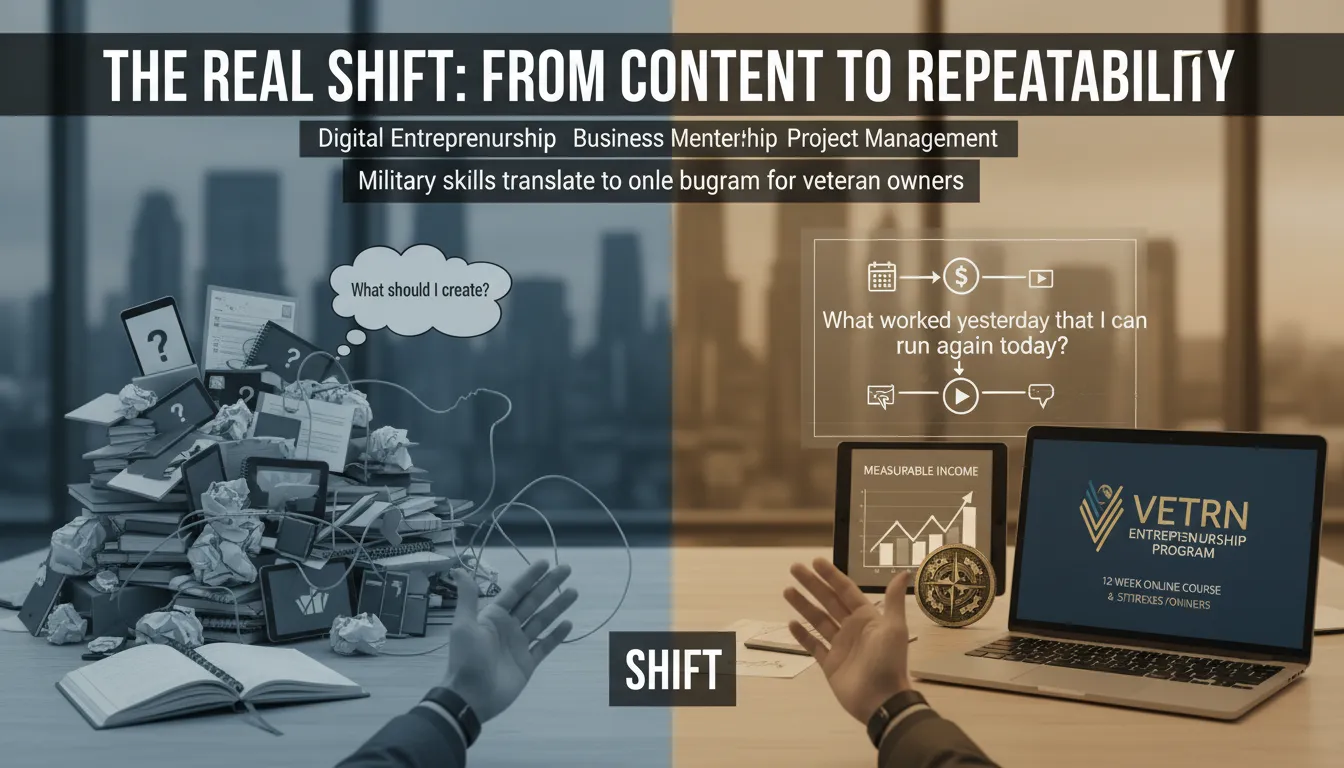
For a long time, I treated online income like a creativity test. Every morning I’d stare at a blank screen and ask, “What should I create?” That question kept me stuck. The moment things changed wasn’t when my content got “better.” It was when my process became repeatable.
I replaced that old question with one that actually builds momentum: “What worked yesterday that I can run again today?” When I started thinking like that, my posts stopped being random bursts and started becoming measurable income drivers.
Project Management: Turning Posts into a Simple SOP
Veterans don’t struggle with discipline. We struggle with direction. Online business is loud—post more, go viral, be consistent—but none of that matters without a system. Once I treated content like Project Management, everything got clearer: one objective, one repeatable action, one result to track.
Here’s the simple structure I used:
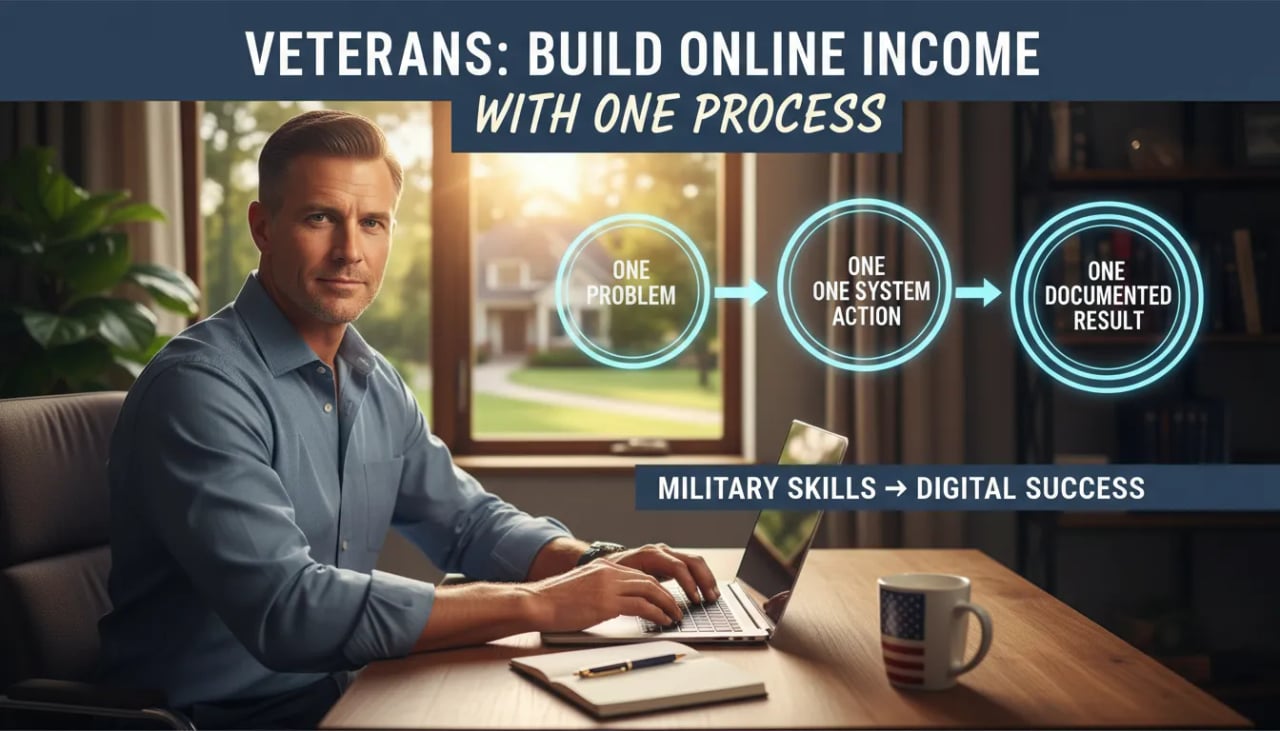
One problem I help someone solve
One system I use to solve it
One daily action to share it
One documented result to prove it works
No stacked funnels. No 17 tools duct-taped together. Just a clean loop I could run under pressure.
Business Mentorship: Document, Repeat, Improve
Here’s a quick example. I wrote one post that hit hard because it followed a clear format: problem → lesson → simple steps → call to action. Instead of chasing a new idea the next day, I documented that format and ran it again. Then again. I replicated it three times in one week and doubled my engagement. Same message, same structure, better execution each time.
Sarah Thompson, VETRN Instructor: "Turning a tactic into a system is where the compounding happens."
This is why Business Mentorship matters. In programs like the VETRN Entrepreneurship Program (a 12-week online course for veteran business owners), the win isn’t “more content.” The win is building a process you can repeat, measure, and improve—like an SOP with a feedback loop.
3) The Simple Process I Use (and You Can Steal)
When I started building online income, I didn’t need more motivation. I needed a Business Plan that was simple enough to run every day. Online business has low Startup Costs and real Scalability Digital Businesses potential, but only if you stop guessing and start running a repeatable process—like an SOP.
Simple Process Checklist | What it means |
|---|---|
One problem | Pick one clear customer pain |
One system | Build one repeatable workflow |
One daily action | Do one measurable micro-task |
One documented result | Track proof and improve |
One Problem (Pick One Pain, Not Ten)
I choose a single problem I can explain in one sentence. Example: veterans who want remote consulting income but don’t know how to package their experience. That’s it. If you’re building Home Based Businesses, clarity beats complexity every time.
One System (One Workflow You Can Repeat)
My system stays small on purpose:
Landing page with one promise and one call-to-action
Follow-up message (email or DM) that asks one question
Single offer (one service, one price, one next step)
No funnels stacked on funnels. No 17 tools duct-taped together. I keep tech minimal until the process proves it can produce results.
One Daily Action (A Micro-Task You Can Measure)
This is where veterans win. I set one daily action that’s impossible to “kind of do.” Examples:
Reach out to 3 new contacts who match the problem
Publish 1 tested post that points to the landing page
One Documented Result (Proof Before Scale)
I track simple metrics: contacts made, replies, calls booked, sales, and time spent. Then I adjust one thing at a time.
Col. David Reynolds, Small Business Advisor: "Document the result before you try to scale it."
Once the numbers are steady, that’s when I think about scaling—content volume, ads, partnerships, and even SDVOSB certification if federal contracts fit the mission.

4) Resources, Programs, and a Rough Roadmap
Where to get help (so you don’t build alone)
I didn’t need more motivation. I needed a lane and a team. If you’re serious about online income, start with programs built for us.
Boots to Business (SBA): entrepreneurship training from the SBA with multiple sessions that help you turn an idea into a plan.
Veterans Business Outreach Centers (VBOCs): local training, mentorship, and counseling. This is where I’d go first for feedback, planning, and help finding local grants.
VETRN Program in Entrepreneurship: a 12-week online course that forces structure—perfect if you want a clear weekly cadence.
Warrior Allegiance and Warrior Rising: community, coaching, and veteran-to-veteran support when you need accountability.
PenFed Foundation Veteran Entrepreneur Program (VEP): support designed to help veteran businesses grow, not just start.
Funding Options and support (after the process works)
Funding doesn’t fix a broken process. But once your process is repeatable, money can help you move faster.
SBA Loans: the SBA offers loans and training that can fit veteran-owned businesses when you’re ready to invest in tools, ads, or inventory.
SDVOSB certification: if you qualify, it can open doors to set-aside contracts and stronger credibility.
Crowdfunding platforms: useful when you can clearly show what you sell and what buyers get.
Mentorship programs: VBOCs and veteran networks can help you avoid expensive mistakes.
Linda Martinez, PenFed Foundation Program Lead: "Pair a repeatable process with mentorship and funding and you increase your odds dramatically."
A simple three-step roadmap (built like an SOP)
Build the process (1–2 weeks)
One problem → one offer → one daily action(post, outreach, or calls).Document proof (4–12 weeks)
Track leads, calls, sales, and results. Write down what worked yesterday so you can run it again today.Scale with mentorship and funding (after validation)
Bring your numbers to a Veterans Business Outreach Centers advisor, explore Funding Options, and only then consider SBA Loans or programs like PenFed Foundation VEP.
Wild Cards: Two Thought Experiments and a Quote
Stay Mission Focused: Run the Next Month Like a 12-Week Deployment
Here’s a thought experiment I come back to when my income feels random: what if I treated my next month like the first phase of a 12-week deployment? Not the whole war—just the mission window. I’d stop chasing new ideas and start standardizing what already works. I’d pick one problem I can solve, one system to deliver it, and one daily action I can execute even on low-motivation days. Then I’d document everything like it matters—because it does. If I can’t explain what I did, I can’t repeat it. And if I can’t repeat it, I can’t trust it.
Networking Opportunities: Picture Your Online Business as a Convoy
Second thought experiment: imagine your online business is a convoy moving through uncertain terrain. You don’t need ten routes and twenty vehicles. You need one clear route (your system), one daily patrol (your action), and one after-action report (your documented result). The route is how you get leads or clients. The patrol is the one task you do every day to move the mission forward. The after-action report is proof—what you tried, what happened, and what you’ll adjust tomorrow.
And here’s the part most people miss: convoys don’t run solo. When I look for Networking Opportunities, I’m not “being social.” I’m building comms. One good connection can shorten the route, warn me about hazards, or point me to a better objective.
Peer Mentoring: Borrow Confidence Until Yours Catches Up
Peer Mentoring is the fastest way I’ve seen veterans stay consistent without burning out. A peer can spot gaps in your process, challenge your assumptions, and keep you accountable to the standard you set. Military skills translate to entrepreneurship when we apply them as structured processes—and peers help us keep that structure when the noise gets loud.
Mark Sullivan, Veteran Business Mentor: "Scale comes last — validate, then expand."
I keep that quote close because it resets my priorities. Validation beats ambition every time. Build the process first. Document the proof second. Scale comes last.
