
I remember the first week after my discharge: I treated my fledgling side-hustle like a mission—work harder, post more, out-hustle the algorithm. For a while it worked. Then life intervened: a deployment simulation, a family emergency, and suddenly the business didn’t. That’s when I learned the brutal difference between grit and infrastructure. In this post I walk you through why motivation is a spark, why systems are the engine, and how I use one repeatable framework to keep income steady even when I’m not 'on.'
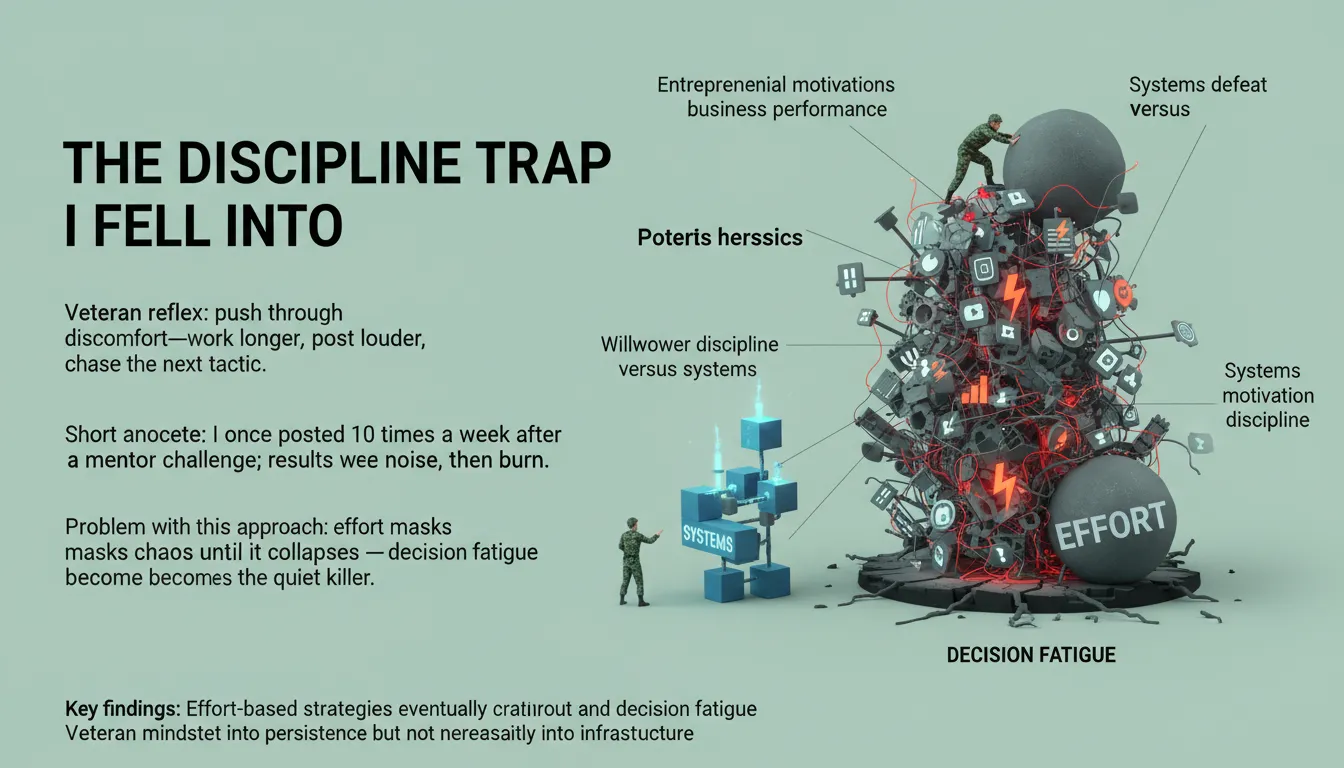
The Discipline Trap I Fell Into
Systems defeat motivation discipline when you stop relying on grit
As a veteran, my reflex is simple: when it hurts, push harder. In uniform, that mindset saves missions. In business, it can quietly wreck entrepreneurial motivations business performance because it trains you to treat every problem like a test of toughness instead of a problem of structure.
So when my business felt slow, I didn’t look for a better process. I looked for more pain to تحمل. I worked longer. Posted louder. Bought another course. Chased the next tactic like it was the missing piece.
The week I tried to “out-discipline” chaos
One mentor challenged me to post 10 times in a week. I took it like a dare. I planned nothing. No content system. No follow-up. No clear offer. Just raw output.
For a few days, it felt productive. Likes came in. A couple DMs popped up. Then the noise hit: people asking questions I couldn’t answer fast, leads I didn’t track, ideas scattered across notes, and a calendar packed with “shoulds.” By day six, I was tired and irritated. By day eight, I didn’t want to open the app.
Willpower discipline versus systems: the hidden cost is decision fatigue
Effort-based strategies can create traction for weeks or even months, but they demand constant presence. Without repeatable processes, every day becomes a new set of decisions:
- What do I post today?
- Who do I follow up with?
- What offer do I pitch, and how?
That friction is the quiet killer. It drains energy that should be saved for high-value decisions, like refining the message or improving the offer. I wasn’t failing because I lacked discipline. I was failing because I was using discipline to cover for missing infrastructure.
“You do not rise to the level of your goals. You fall to the level of your systems.” — James Clear
“Structure converts discipline into leverage.” — Andrei Isip
Why Motivation Always Fails Long-Term
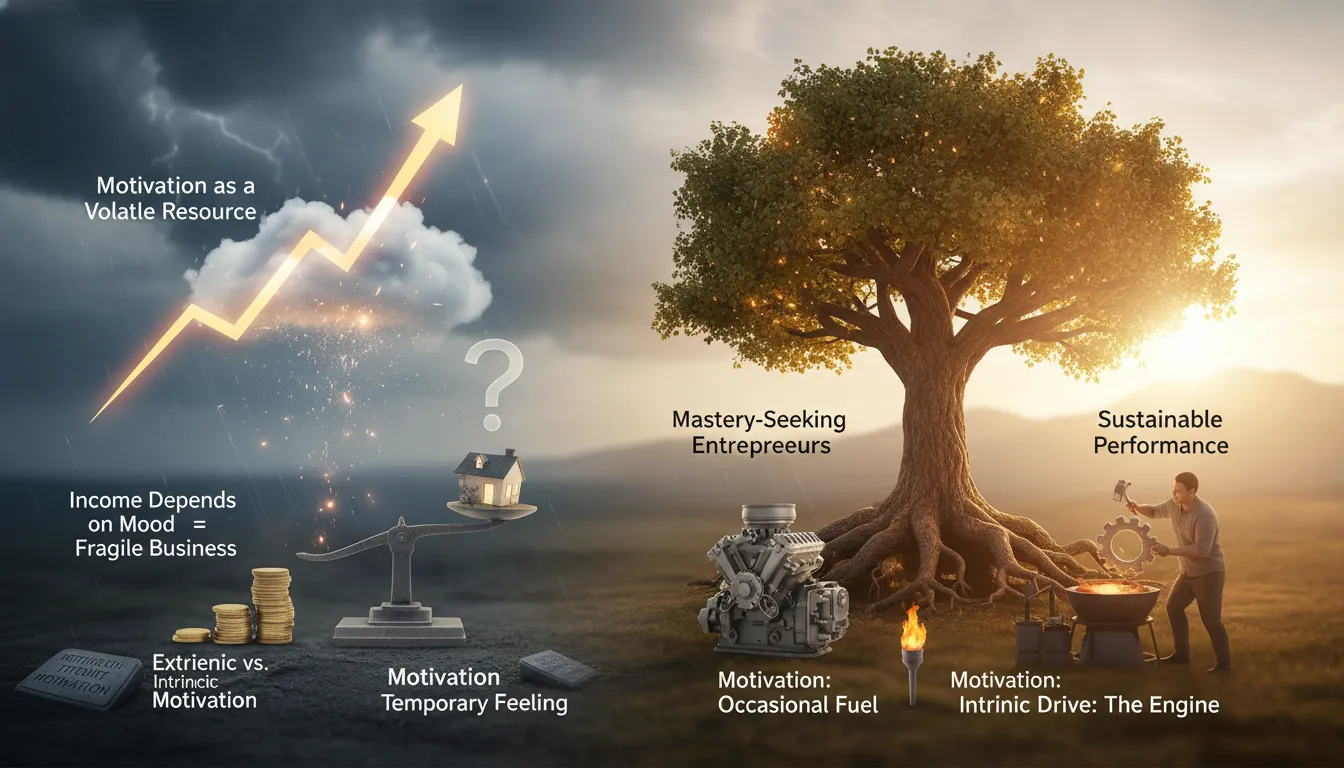
Motivation temporary feeling: it spikes, then life shows up
I used to treat motivation like the engine of my business. If I felt fired up, I posted. If I felt confident, I sold. If I felt “on,” I built. But motivation is a Motivation temporary feeling—it comes in waves, then disappears when sleep is short, the kids get sick, or stress hits.
“Motivation is emotional fuel. It spikes. It fades.” — James Clear
That’s when I learned the hard truth: motivation-dependent income is fragile by design. If your income depends on your mood, you’re basically employed by your feelings.
Extrinsic versus intrinsic motivation: what actually lasts
I chased results like most new founders: money, likes, quick wins. That’s Extrinsic versus intrinsic motivation in real life—external rewards versus internal drive. The problem is, external rewards don’t show up every day, so effort drops.
What changed things for me was leaning into Intrinsic motivation entrepreneurs build around: mastery. Research on mastery-seeking entrepreneurs shows more sustainable performance because they keep going even when the scoreboard is quiet. They’re driven by getting better, not just getting paid.
Why your brain quits before you notice
Another piece I didn’t see: primed and implicit goals shape what we do beneath conscious awareness. If my phone primes me for comfort, I “accidentally” scroll. If my environment primes me for work, I “accidentally” write. My effort was being allocated before I made a decision.
“Automated systems are the antidote to emotional cycles.” — Andrei Isip
What I replaced motivation with
- Necessity: minimum daily actions that keep the machine moving
- Passion: one weekly block for creative work
- Independence: automation so I can step away without losing momentum
- Achievement: simple scorecards, not vibes
I stopped treating motivation as the engine and started treating it as occasional fuel. The process runs either way.
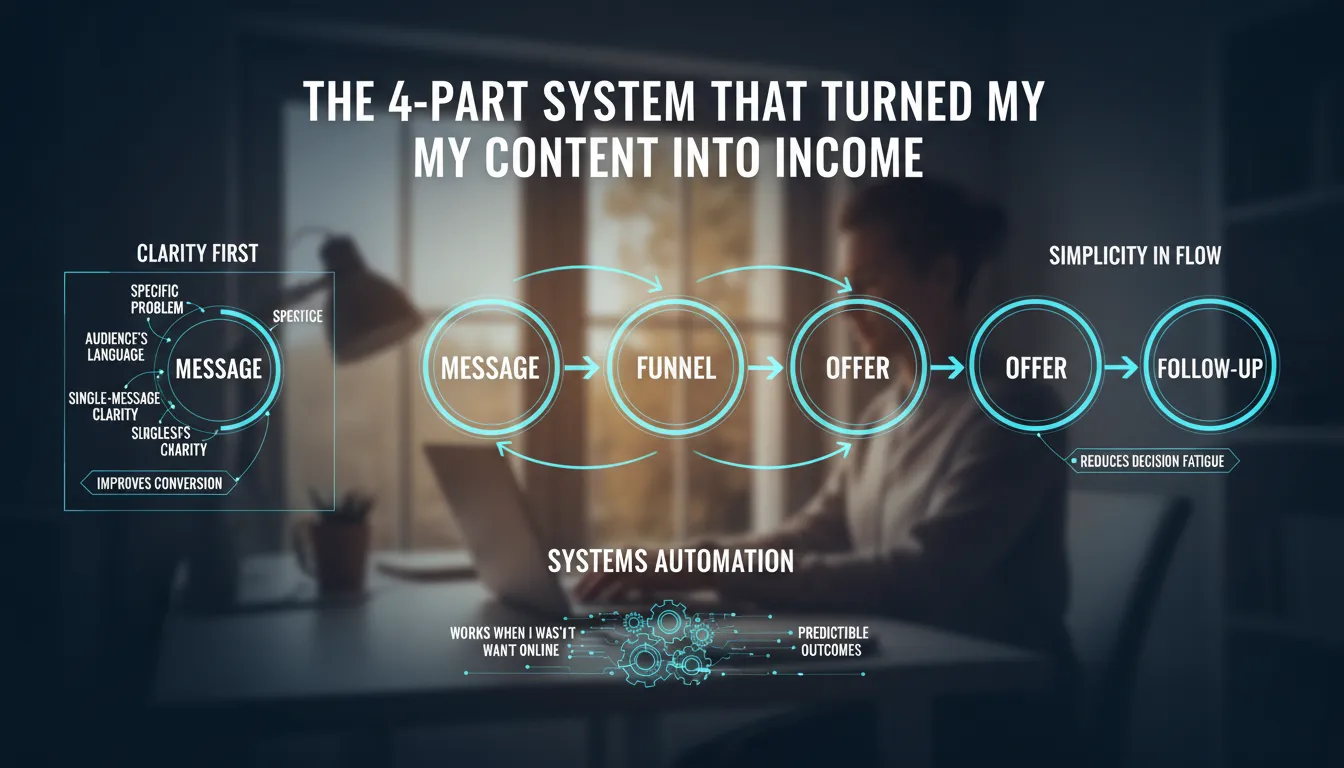
The 4-Part System That Turned My Content Into Income
For a long time, my content only “worked” when I was online and fired up. If I missed a day, everything slowed down. That’s when I stopped chasing motivation and started building an end-to-end machine: message → funnel → offer → follow-up. That’s how I learned to builds momentum through systems, not moods.
1) One clear message (the conversion lever)
I tightened my positioning until someone could repeat it back in one sentence. When I did that, replies got sharper and my conversion rate improved because people understood me faster. As James Clear says:
“Clarity beats clever every time.” — James Clear
My rule: call out one specific problem in the audience’s language, then point to one outcome.
2) One simple funnel (less choice, more action)
I used to send people everywhere—posts, DMs, random links. It created decision fatigue. A simple funnel fixed that by answering four things: who it’s for, what I solve, why it works, and what to do next.
“A funnel isn’t manipulation; it’s direction.” — Andrei Isip
3) One focused offer (remove confusion)
I stopped stacking options and “bonus” overload. One problem. One solution. One next step. The offer didn’t need more features—it needed fewer decisions.
4) One follow-up loop (Business systems automation that stabilizes income)
This is where attention turns into reliable revenue. I set up Business systems automation with a short email sequence that nurtured trust while I was offline.
- Day 1: quick win + my story
- Day 3: proof + common objections
- Day 5: clear CTA to the offer
| Metric | How I tracked it |
|---|---|
| Conversion rate | Before vs after funnel (30–90 days) |
Why Systems Create Calm (Not Just Cash)
“The biggest benefit of systems isn’t money. It’s mental space.” — James Clear
I used to wake up and ask, “What should I do today?” That one question created ten more. Post where? Say what? Follow up with who? By noon, I was already tired—not from work, but from decisions.
Systems create momentum consistency through repeatable processes
Everything changed when I stopped rebuilding my week-to-week playbook and started refining one living machine. I wrote down the steps that actually moved the business forward, then made them repeatable. That’s the real secret behind Long-term success repeatable processes: small, repeated actions that compound into real results over time.
Automated business systems helped too. Not “set it and forget it” hype—just simple automation that removed manual effort. Follow-ups went out even when I was offline. Leads got qualified before they ever reached me. That meant I could focus on high-value work instead of busywork.
Adapts to life variability (when life hits hard)
Motivation doesn’t survive real life. Systems do. I’ve watched routines break during deployments, family emergencies, burnout, and burnout recovery. When my business depended on my mood, it stalled. When it depended on a process, it kept moving.
“Systems don’t care about your mood; that’s why they work.” — Andrei Isip
Habit formation behavioral systems reduce mental friction
Systems reduce mental friction by cutting the number of daily choices required to operate. Instead of guessing or scrambling, I just run the checklist:
- One message I repeat
- One funnel that directs the next step
- One offer that solves one problem
- One follow-up loop that runs while I’m offline
That’s calm. Not because it’s easy—but because it’s predictable.
Audit, Automate, Repeat — What I Do Next
When I feel that old urge to grind, I pause and swap the question. I stop asking, “What should I try next?” and start asking, “What should run without me?” That shift cuts mental friction decision-making reduction fast, because I’m not hunting for motivation—I’m building rails.
“If your business only functions when you’re driving it, you own a responsibility, not an asset.” — Andrei Isip
My Audit Checklist (What’s Stealing My Time)
I do a simple audit and sort everything into three buckets. This is the start of business systems automation—seeing the work clearly before I “fix” it.
- Attention-required tasks: daily DMs, manual follow-ups, “quick” admin that eats an hour.
- Break-when-absent tasks: leads stop moving, payments get missed, delivery depends on my memory.
- Automation candidates: anything repeatable, trackable, and boring.
Automation Priorities (In Order)
I learned the hard way: scaling without repeatability compounds chaos. So I build for repeatability first; scale second. Here’s my priority stack for automated business processes scalability:
- Follow-up loop automation: email/SMS sequences, reminders, and a simple “next step” path. Automation of follow-up is the fastest path to stabilized revenue.
- Offer delivery automation: payment → onboarding → access → checklist. No manual handoffs.
- Content evergreenization: turn one post into a weekly rotation (repost, email, short clips) so leads keep coming even when I’m offline.
“Work once; let the system repeat.” — James Clear
Then I standardize: one clear message, one focused offer, one delivery path. Less choice. Less drag. More calm.
Wild Cards: Tiny Experiments and a Hypothetical
Goals provide direction systems
I still set goals, but I stopped worshiping them. Goals provide direction systems provide freedom. When I’m tired, stressed, or pulled into family stuff, the goal doesn’t carry me. The system does.
A convoy, tow trucks, and the truth about motivation
I think of my business like a convoy. Motivation is that quick engine burst that gets you moving. It feels powerful, but it fades. Systems are the tow trucks. They don’t care how I feel. They keep the convoy rolling when one vehicle breaks down, when the route changes, or when I’m not even in the driver’s seat.
Hypothetical: could you survive 60 days of silence?
Here’s the question that changed how I build: what if I automated 30% of my outreach—could I survive a 60-day silence and still hit payroll? If the answer is no, I don’t have a business asset yet. I have a single-person dependency with a paycheck-shaped timer.
Compounding effects small actions
So I run wild cards: tiny, controlled tests that show me leverage fast. One of the best is simple: I automate one email sequence, then I measure revenue for 90 days before I change anything else. Not because I’m lazy, but because Compounding effects small actions only show up when I stop resetting the experiment every week.
‘Small experiments expose system gaps faster than big efforts.’ — Andrei Isip
‘Compounding beats intensity.’ — James Clear
Habit formation behavioral systems
This is how I build Habit formation behavioral systems: one clear message, one offer, one follow-up loop that runs even when I’m offline. Then I watch the numbers that matter—revenue retention through 30/60/90-day quiet windows, and conversion lift after I tighten messaging clarity. If it holds steady, I keep it. If it breaks, I fix the system, not my mood.
