
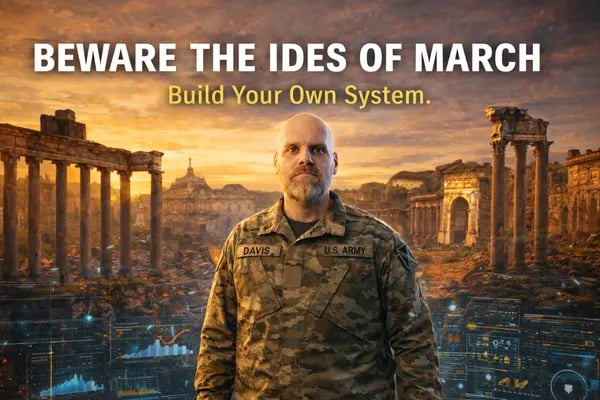


History remembers the Ides of March as the day Julius Caesar walked into the Senate, confident the system he led would shield him — and then got stabbed in the back. This infamous betrayal wasn’t just about politics; it’s a stark reminder that sometimes systems aren’t built to protect everyone equally. Veterans often experience their own “Ides of March” moment when they leave the military and realize civilian life wasn’t designed to support their unique skills and mindset.
You’ve marched, executed orders, and upheld discipline, only to find that the promised ladder turns into a never-ending hamster wheel. The foundation you trusted feels shaky, the career paths unclear. This blog explores that exact moment when veterans wake up to the truth: the system was never built for them. But here’s the twist—unlike Caesar, you can rewrite the rules and build a system that works for you.
Did You Know?
Julius Caesar was warned to 'Beware the Ides of March' by a soothsayer, a warning he ignored until it was too late.
Source: Plutarch's Lives
The Promise We Were Sold
Most veterans grew up hearing the same straightforward story. Do the right things. Serve your country. Work hard. Climb the ladder. Retire someday. Sounds like a mission plan so simple even a private first class could follow it, right? The promise was stability—get in line, follow orders, and eventually, steady paychecks and a comfortable retirement would follow.
But when many leave the military and try to climb that same ladder in civilian life, something strange happens. The ladder feels less like a ladder and more like the world’s maddest hamster wheel. You end up working longer hours than you bargained for. The paycheck isn’t quite enough to escape the rat race. Job security? Suddenly as fragile as a glass grenade in a firing range.
What they didn’t tell you in boot camp was that the civilian system was designed for a different playbook. One where the path is tangled in office politics, overtime hustle, and invisible ceilings disguised as “promotion opportunities.” You start to realize the ladder isn’t just slippery—it might be spinning faster than you can keep up with.
Getting sold this “simple mission plan” is like being trained to win a marathon, only to find out halfway through you're expected to compete in a triathlon instead. The sense of purpose you had driving your every move in the military clashes with the reality of office cubicles, endless emails, and a paycheck that barely covers the bills. The disillusionment hits harder than a drill sergeant’s whistle.
You followed orders. You executed missions. You bought into the story. Yet the system that promised you stability—and maybe even a comfy retirement—feels like it was never built for veterans who think in terms of strategy, precision, and mission accomplishment. Instead, you’re stuck in a loop where the more you hustle, the less forward traction you gain.
And like Julius Caesar walking into the Senate, believing the system would protect him, many veterans face a harsh realization: the civilian system wasn't designed with their success in mind. It’s a bitter pill, but it sets the stage for something more powerful—a chance to build your own system, tailored to you and your strengths.
The Ides of March Moment
March 15th is legendary for Caesar's betrayal, a classic gotcha moment. Veterans have their own version—the quiet, soul-crushing realization that hits when you see the civilian world’s “system” wasn’t designed for you. Unlike Caesar’s soothsayer shouting “Beware the Ides of March,” your warning is quieter, subtler, often disguised as fatigue or frustration after your third week in a “normal” job.
One veteran friend of mine, let’s call him Jake, told me he clocked 60 hours a week at work, only to look at his paycheck and feel like his life was on an eternal hamster wheel. “I realized I was following someone else’s mission, someone else’s plan. But there was no briefing on building a life that actually worked for me,” Jake said, shaking his head.
That moment of realization can feel like waking up mid-mission only to find the map was upside down all along. You went from executing orders flawlessly to staring at a cubicle wall, wondering how you ended up in a place where the ladder you climbed was spinning but never going anywhere.
Another vet, Maria, shared a moment where she caught herself saying, “I’m serving, but not my country—my employer—who doesn’t know how to appreciate a damn thing I’ve done.” That’s the Ides of March moment in civilian life: betrayal, but not by enemies you can see. It’s by a system that promised to reward hard work but delivers red tape, underwhelm, and the slow squeeze of invisibility.
It's like you were handed a tactical manual with thousands of pages on how to operate complex machinery overseas but zero instructions on navigating job boards, benefits programs, or how to reboot a broken dream.
That’s when the mind shift starts. You might hear a quiet inner voice saying, “Maybe I don’t have to follow the rules the system set up—for a game I wasn’t invited to play.” The real moment of power isn’t simply leaving the system behind but realizing you can build your own, one step at a time.
That internal shift, the one where you stop asking, “How do I get a better job?” and start demanding, “How do I build a system that works for me?”—that’s your personal Ides of March. No daggers, no drama, just a subtle yet seismic pivot in the way you approach your future.
Because when you finally realize the system wasn’t made for you, the real mission begins—not to fit in, but to create something better. That’s the power and promise of the Ides of March for veterans. It’s not the end; it’s the surprising beginning.

The Shift That Changes Everything
Veterans face a monumental shift when they leave the structured world of military orders and the familiar hunt for a “better job.” The real game-changer? They stop asking, “How do I get a better job?” and start asking, “How do I build systems that work for me?” It’s less hustle, more strategy—less clock punching, more system launching.
Think of it like this: job-seeking is a hamster wheel, with frustration and spinning gears. Building your own system is like firing up a well-oiled machine designed to work on your terms. Veterans who make this pivot aren’t just looking for a way out of the job market—they’re reinventing the whole playbook. They’re creating processes, automations, and workflows that play to their strengths.
Take Sarah, a former logistics specialist turned online business owner. Instead of chasing gigs, she designed an automated client follow-up system that emails leads, books appointments, and frees up her time to focus on growing her brand. Or Mike, who transformed his meticulous military project management skills into a service that trains companies on operational efficiency. Both left the job chase behind and embraced system-building as the real mission.
Using proactive strategies is key. You don’t just wait for opportunities—you create them. The mindset shift is about thinking bigger than your next paycheck. It’s about developing scalable frameworks, leveraging automation tools, and building networks that amplify your impact. This move isn’t just a side hustle; it’s a foundational change that empowers veterans to thrive on their own terms.
To visualize how this shift plays out, consider the distribution of focus for veterans after transition. While some remain hunting for jobs or dabbling in side hustles, a significant and growing 45% invest in system-building endeavors. This reflects a growing trend that the future belongs to those who design their own operational playbooks.
This mindset shift isn’t just theory—it’s a practical upgrade. Here’s a glimpse of what it looks like in action: a simple JavaScript function automating follow-up emails, a tiny but powerful system to save time and increase business efficiency. Veterans embracing system-building tap technology like this to multiply their impact.
Why AI Is the New Strategic Advantage
Artificial Intelligence has stealthily become the secret weapon for veterans stepping into civilian entrepreneurship. It’s like having a full digital operations team in your back pocket—minus the awkward office small talk. AI tools today specialize in turbocharging research, generating content, automating marketing, and slashing the time spent on repetitive tasks. It’s not just about making life easier; it’s about gaining an edge that traditional systems never offered.
Veterans, who are masters of mission execution, can leverage AI programs like Jasper, Copy.ai, and even niche platforms like Veteran.ai, which tailor automation specifically for veteran entrepreneurs. Imagine a tireless assistant that drafts blog posts, analyzes market trends, handles email campaigns, and crunches data at the speed of light. That’s the kind of strategic advantage AI delivers—transforming solo business efforts into scalable operations.
For example, consider Jake, a former Marine who launched a construction consulting firm. With AI-powered tools such as HubSpot’s marketing automation and Clearscope for content SEO, Jake shifted from feeling overwhelmed by marketing to effortlessly feeding qualified leads into his sales funnel. His AI-driven system schedules emails, generates follow-up sequences, and highlights the hottest prospects, freeing him to focus on project management and client relations.
Similarly, Lydia, an Army vet turned freelance writer, uses Grammarly’s AI-powered writing assistant coupled with MarketMuse to craft well-optimized articles that land clients with ease. Before, the tedious hours of editing and keyword research drained her energy. Now, Lydia’s AI toolkit does the heavy lifting, boosting her productivity and income.
But AI’s impact isn’t confined to marketing and content. It extends to streamlining back-office functions as well. Tools like Zapier connect apps and automate repetitive workflows—from invoice generation to social media posting—eliminating the hamster wheel of small tasks that can bog down even the most disciplined vets.
This bar chart below shows the major benefits veterans report when using AI tools. Research speed hits 85%, data analysis climbs to 80%, and content generation registers at 78%, highlighting where AI really shines. With these stats, it’s clear why AI isn’t just a trend—it’s a foundational pillar for veteran entrepreneurs building their own systems.
The real power of AI is that it allows veterans to pivot away from outdated career assumptions and take control by creating personalized systems that work for them. No longer chained to the fragile, one-size-fits-all civilian model, AI empowers vets to innovate, automate, and scale on their terms.
That code snippet above illustrates how a veteran entrepreneur might use an AI toolkit to automate their marketing system: generating ideas, creating content with an informal tone, and scheduling it for maximum impact—all on autopilot. With such tools, veterans turn smart strategies into automated, repeatable systems.
AI doesn’t just enable survival—it offers a strategic advantage, the kind that Julius Caesar probably would have killed for. For veterans in today’s world, it’s not just about working hard anymore; it’s about working smart, using AI as the ultimate force multiplier. Here’s to rewriting the playbook—and building systems built for veterans, by veterans.
The Veteran Advantage
Veterans aren’t just folks with cool stories and perfectly trim haircuts. They’re walking, talking Swiss Army knives of skillsets honed under pressure, in high-stakes environments where failure simply wasn’t an option. Military service gifts you leadership that can steer through chaos, discipline that laughs off distractions, strategic thinking sharper than a bayonet, adaptability that slides through sticky situations, and resilience tougher than boot leather. These aren’t just buzzwords thrown around in motivational talks—they’re the bread and butter of a veteran’s unique skillset, circled, underlined, and highlighted.
Now, imagine taking those battle-tested skills and plugging them into the wild, ever-evolving beast that is business. That’s where the true magic happens. Business, with all its spreadsheets and market trends, can seem like a completely different battlefield. But veterans? They bring a warrior’s mindset to this new mission, turning complex challenges into strategic victories. They don’t just climb ladders—they build ladders, repair broken rungs, and sometimes, they even invent elevators.
Skills That Translate to Cash Flow
Leadership in the military teaches you to make decisions with incomplete info, rally teams, and execute missions that matter—a perfect fit for leading startups or managing projects. Discipline means your follow-through is second to none; those “to-do lists” don’t stand a chance. Strategic thinking isn’t limited to battle plans but extends to market analysis and competitor positioning. Adaptability means pivoting when a campaign stalls or when the algorithm changes. And resilience? That’s the secret sauce when clients ghost or deals fall through.
But here's the kicker: the system veterans often find themselves in post-service has never truly been designed for them. That’s why many entrepreneurs from military backgrounds start asking not just how to get a better job, but how to build systems—business systems—that actually work for them, not against them. Enter AI.
Combining Military Prowess and AI Power
If veterans’ skills are the hardware, artificial intelligence is the high-octane software boost. Consider AI a digital squadmate who’s got your six. From automating boring repetitive tasks to helping crunch data faster than a human team could dream of, AI arms veterans with next-level capability. Research shows veterans using AI tools not only get more done but innovate smarter and faster.
Here’s a fun snippet of code that roughly shows how the synergy works behind the scenes:
In short, leadership and strategic thinking get turbocharged by AI’s data analysis. Discipline and adaptability mesh with automation to boost efficiency. And veteran resilience sparks innovation when matched with AI’s creative outputs. It’s like having a well-trained special ops team digitally augmented to tackle business challenges that used to leave others paralyzed.
Choosing Your AI Arsenal
But not all AI platforms wear the same uniform. Picking the right one for your business system is like choosing the right gear for a mission. IBM Watson, Google Cloud AI, and Microsoft Azure AI are the front runners here, each with their own perks and quirks. Some excel at natural language processing for content creation and customer engagement, others shine in workflow automation, and all bring military-grade security—that’s non-negotiable when you’ve been trained in top-secret operations.
Veterans equipped with these AI platforms can build their own systems—systems tailor-made for their mission, with scaling and success in sight. The dual advantage of military precision and AI-driven insight makes a force no startup or corporate giant wants to underestimate.
The veteran advantage isn’t just a catchphrase. It’s a battle plan for winning in the post-service world, leveraging unmatched skills and the sharpest tools technology can offer. And hey—if Julius Caesar had AI, maybe he’d have dodged those Ides of March. Just saying.
The New Mission
Veterans, listen up. The battlefield has shifted — no longer is it terrain you can map or enemy lines you can see. The new fight is digital entrepreneurship. And instead of bullets, your ammo is automation and smart systems. If you thought marching orders were simple before, welcome to the world where you call the shots—and build the mission from scratch.
Why the shift? Because the traditional job ladder crashes down like a house of cards once you're out of uniform. The hamster wheel of punching clocks and juggling side gigs only spins faster without getting anywhere. Real freedom? That comes when you build income systems that work for you—even when you’re binge-watching the latest series or, heaven forbid, taking a day off.
This is where automation swoops in, caped with AI powers. Think of AI as your digital squad leader: researching niches, generating content, crafting marketing plans, and automating the boring, repetitive grunt work. No more being stuck doing tasks a robot could handle overnight. Instead, you get to focus on strategy—and maybe having some fun.
Building a system isn’t just about slapping a website together or launching a social media account. It’s about creating a lean machine that reliably generates income while you focus on growth and innovation. It means assembling a toolkit of AI-driven services and workflow automations that handle the heavy lifting, tracking analytics, and optimizing your efforts constantly.
For example, imagine this: an AI tool researching the best market niches tailored for veterans, generating compelling blog content, designing a marketing campaign, and then scheduling every task automatically—all without you lifting a finger after hitting “start.” That’s the kind of new mission you want, because this fight isn’t against an enemy platoon but against time and inefficiency.
It’s time for a new operational plan that pivots towards building intelligent systems. Not jobs. Not gigs. Systems. Veterans are uniquely positioned to excel here, given their unparalleled discipline, mission focus, and operational experience. You’ve been trained to work smarter, and in this new arena, automation is the ultimate force multiplier.
The Real Meaning of the Ides of March
The Ides of March isn’t just an ancient date for betrayal—it’s a metaphorical alarm for veterans waking up to a hard truth. Julius Caesar’s system failed him spectacularly, and many veterans discover their own “system failure” once they leave the military. Spoiler alert: the civilian system was never designed with veterans in mind.
Instead of intimidation, this date should inspire awareness. The infamous warning from the soothsayer wasn’t just a creepy prophecy; it was a call to be alert. Veterans need a modern-day equivalent: a reminder that relying on a system “as is” can lead to frustration and feeling stuck in a hamster wheel.
Real empowerment happens when veterans shift from asking, “How do I get a better job?” to “How do I build a system that works for me?” Because following someone else’s playbook isn’t always the winning strategy beyond the battlefield.
Self-advocacy becomes the ultimate weapon. Taking control means building your own operational system instead of waiting for the perfect setup to fall into your lap. This shift is the secret to breaking free from broken promises and fragile stability.
Consider this playful snippet below — it’s a cheeky nod to the original warning, urging veterans to beware the system that wasn’t made for them, and instead, start coding the system that is.
Frequently Asked Questions
Veterans often wonder how their military skills translate to civilian life beyond the usual resume buzzwords. The truth? Leadership, strategy, and discipline from service are gold for careers in project management, logistics, and operations. Platforms like LinkedIn’s veteran groups and SeekOut help highlight these hard-earned skills to employers who want a reliable, mission-focused player on their team.
Starting your career journey post-service isn’t about hopping on someone else’s hamster wheel. Step one: take control. Ditch the old playbook and craft your own game plan using digital tools like Trello or Notion. Map out what drives you, set goals, and build systems that work for you – not the other way around.
Wondering how to boss it up with AI? Think of AI as your digital squadmate—always ready to have your back. Writing blogs, automating boring tasks, and crunching data at lightning speed are all on the table with tools like Jasper, ChatGPT, Zapier, and Tableau. Use AI to work smarter, trim your to-do list, and leave competitors scratching their heads while you sprint ahead.
How can veterans leverage their military skills in civilian careers? ▼
What are the first steps to taking control of my career after service? ▼
How can I effectively use AI as a veteran entrepreneur? ▼
Conclusion
Beware the Ides of March: that moment when veterans realize the civilian system was never built for them. Julius Caesar walked into the Senate thinking the system would protect him; veterans often discover the system wasn’t designed for their success. The promise of climbing the ladder often looks more like running in place.
The real shift comes when veterans stop chasing another job and start building systems that serve their mission—using AI as their secret weapon. Tools like ChatGPT and automation platforms become the digital squadron that helps veterans leverage discipline and mission focus into scalable businesses.
Your military mission ended, but your strategic mission hasn’t. The question is: will you keep playing someone else’s game or finally build your own system? The new battlefield is digital. The new command center? You.
🎯 Key Takeaways from the Ides of March Moment
- → The civilian system wasn’t built for veterans—the key is building your own.
- → Stop chasing jobs; start creating systems that work for you.
- → Leverage AI as your digital operations team to maximize your mission.
- → Military discipline + AI = powerful business advantage.
- → Your mission continues—choose to build your own game, not play someone else’s.
