
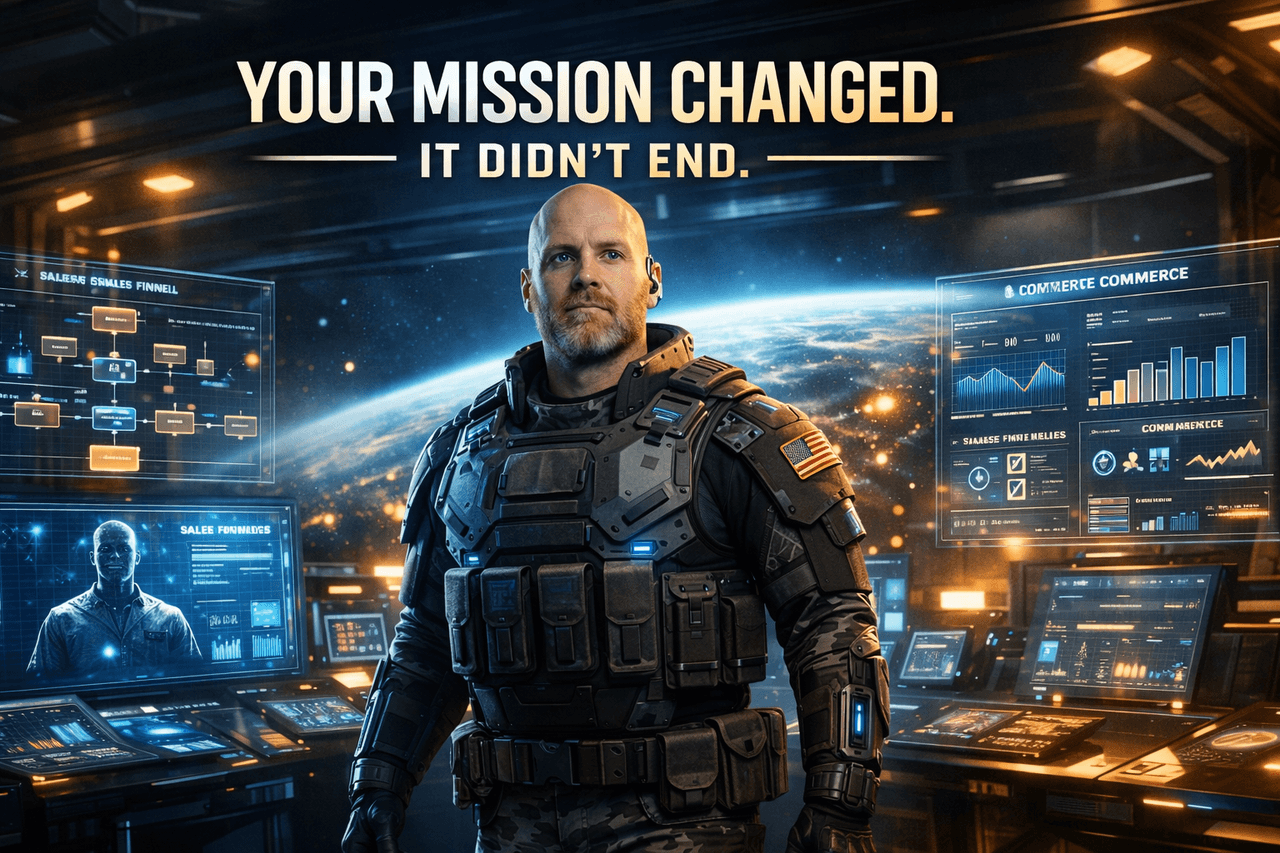
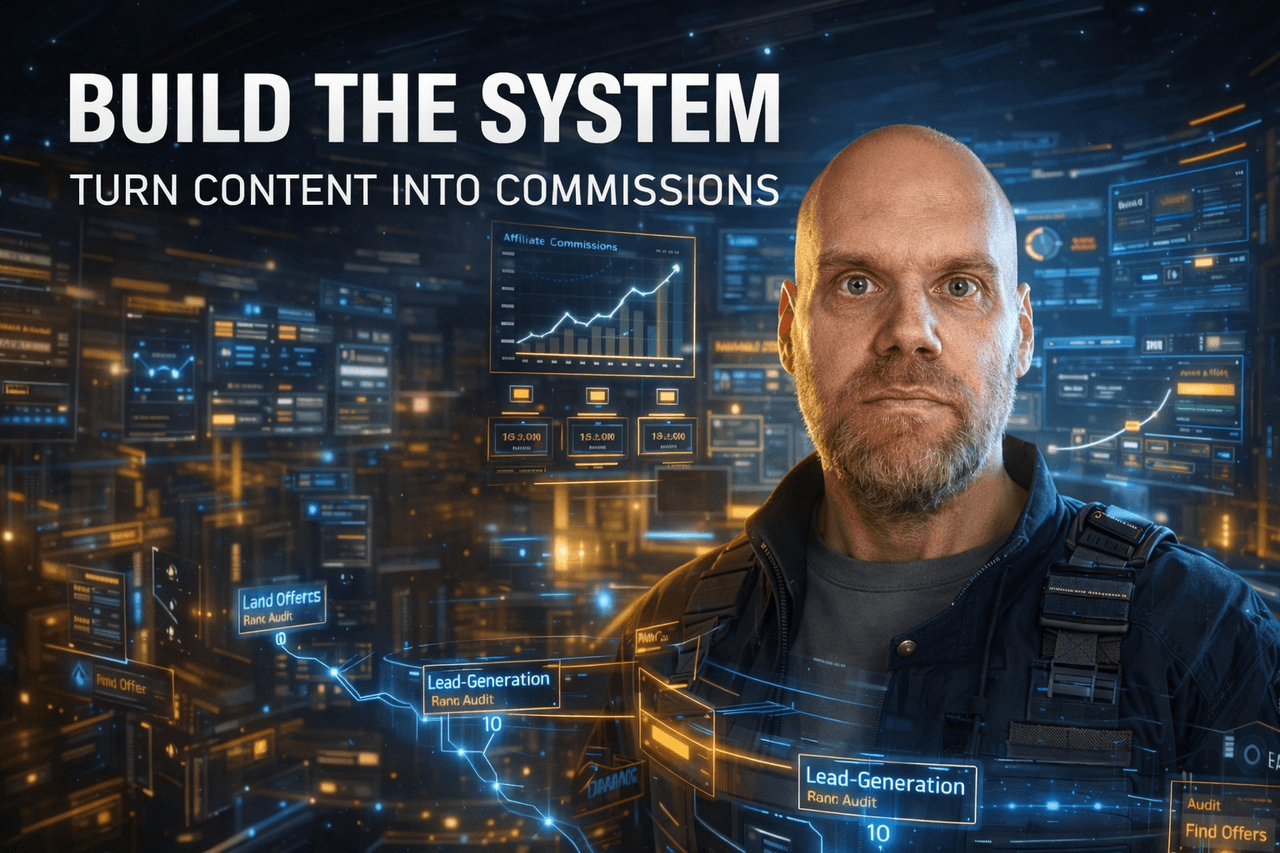
You’ve carried the weight of a clear mission for years—orders, teamwork, structure guiding every move. Then one day, you take off the uniform, and suddenly the world goes silent. No commands, no battle rhythm, just an unfamiliar quiet. This strange silence after the mission ends hits deeply for many veterans. It’s not just about finding a job; it’s about missing the purpose and meaning that structured service brought.
This gap, this absence of mission, can linger long after you land a civilian role. What if instead of losing your purpose, you could shift it? The mission mindset you honed in the military—leading systems, solving complex problems, executing under pressure—is still your greatest asset. The challenge is finding a new battlefield where that mindset thrives.
The journey ahead will explore how to reclaim your mission in today’s digital world, transforming that silence into a new form of purpose.
Did You Know?
Over 75% of veterans report feeling a profound loss of purpose and structure after leaving the military, despite successfully transitioning to civilian jobs.
Source: Department of Veterans Affairs
The Problem Nobody Talks About
Most transition advice zeroes in on jobs. Resume workshops. LinkedIn optimization. Corporate interviews. These are vital, no doubt—they solve the income problem. But what they don’t address is much harder: the loss of mission.
For veterans, that mission used to be everything. You trained and operated in high-pressure environments where every day carried purpose. You weren’t there merely to fill a seat; you were relied on to solve problems, lead systems, execute missions, and build outcomes under pressure. Those skills don’t vanish the moment the uniform comes off. What disappears is the clear objective and structure that once surrounded them.
When you transition to civilian life, the feedback loops and mission clarity evaporate. No one hands you a command brief or gives a battle rhythm to follow. Instead, you face a quiet world that doesn’t replicate the intensity or immediacy of military operations. That silence—the absence of a clear mission—is often the hardest part of adjusting. It’s what many well-intentioned career workshops fail to acknowledge.
Restlessness sets in because the veteran mindset is wired for action, for systems, for execution. Sitting through endless meetings about meetings isn’t fulfilling. You weren’t trained to pass time—you were trained to create results, to respond to fast-moving, complex challenges.
But this mindset doesn’t disappear. It just needs a new battlefield. Online business and entrepreneurship offer a unique opportunity to rekindle a sense of mission. They demand the same skills: problem-solving, leadership, planning, and execution. The terrain is unfamiliar, but the framework is the same.
Consider this code snippet, which illustrates how veteran skills can translate seamlessly into a fresh mission. Instead of military operations, the objective shifts to building and automating an online business system. The mindset stays intact, applying skills in a new context but with the same drive and discipline.
That new mission won’t come with a battle brief handed to you. But the skills and mindset you developed are your greatest advantage in navigating and conquering this different battlefield.
The Digital Battlefield
When veterans leave the structured world of military service, they often face a silence that’s deafening. The digital realm, however, offers a new kind of battlefield—one where their unique skills can thrive and redefine mission success. The internet is now the largest arena for opportunity, demanding systems, leadership, and mission-focused execution just like the military.
Veterans excel online because business on the internet depends not on chance, but on well-oiled systems. Think of marketing funnels instead of supply lines, automation instead of traditional logistics, content generation instead of patrols, and AI agents instead of assistants. The tools are different, but the principles remain the same.
This similarity means veterans are not just participants in the digital economy—they are primed to lead. The mindset of mission planning, iterative execution, and strategic victory carries over seamlessly to building and scaling online businesses.
Consider a transition where a veteran crafts a digital mission aimed at building a fully automated sales funnel. The objective is clear, tools like AI content generators and email automation are lined up, and a team of digital strategists and creators coordinate to complete the mission. This operation mirrors a military campaign in every sense, emphasizing precision, teamwork, and adaptability.
This digital battlefield rewards veterans for core competencies they have already honed: problem solving, leading complex systems, and executing missions under pressure. These skills find new outlets in online entrepreneurship, where structuring workflows, optimizing funnels, and iterating rapidly are crucial to success.
By comparison, the traditional corporate world often lacks this level of clear purpose and mission urgency. That can leave veterans disengaged despite stable incomes. Online business offers the compelling clarity and challenge veterans crave.
The bar chart below illustrates how veterans’ skills apply strongly when transitioning into online business systems. The highest values show veterans' natural fit for problem solving, mission execution, and especially leading digital systems—more so than traditional corporate roles.
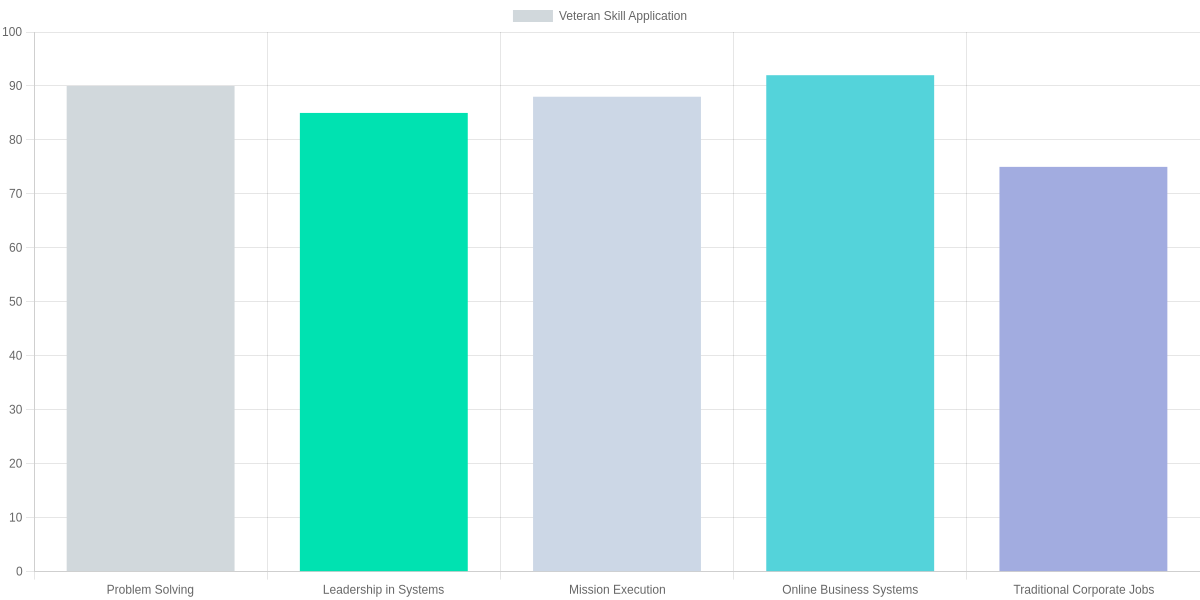
Seeing online business through the lens of mission and systems transforms its intimidating complexity into a familiar challenge. Veterans can lead with confidence, knowing the same mindset that navigated battlefield operations can now conquer digital landscapes—and find new purpose along the way.
Why AI Is the Force Multiplier
Two decades ago, launching a business meant assembling a team. Marketing, content creation, research, funnel building—each required skilled people obsessed with a single mission. Today, AI replaces much of that human horsepower, acting as a force multiplier that lets one person do the work of many.
Veterans, trained to operate with precision in high-stakes environments, instinctively understand the power of force multipliers. AI is simply the modern-day equivalent, operating faster, smarter, and tirelessly. It takes mission planning and execution off the shoulders of teams and puts it into a streamlined digital battlefield.
Take Jasper AI, ChatGPT (GPT-4), or Copy.ai as examples. These platforms handle complex tasks that once required multiple specialists. Jasper AI offers data-driven niche research, producing SEO-tailored content in minutes and integrating tightly with funnel-building platforms like ClickFunnels. ChatGPT shines with its conversational abilities, enabling diverse content across campaigns and automating email sequences through plugin connections. Copy.ai brings creative marketing copy to life with ease and multi-step automation workflows that transform ideas into launched campaigns quickly.
This transformation plays out in a straightforward way that any veteran accustomed to operational sequencing can appreciate. AI acts like a squad leader who scouts profitable markets, drafts communications, constructs funnels, and launches campaigns—all in an automated, repeatable cycle.
Comparison of leading AI tools as business force multipliers | |||
Feature | Jasper AI | ChatGPT (GPT-4) | Copy.ai |
|---|---|---|---|
Niche Research | Uses data-driven insights to identify niches | Provides conversational exploration for idea validation | Offers tailored prompts for niche discovery |
Content Generation | Produces SEO-focused content quickly | Generates diverse content formats conversationally | Creates marketing copy with creative flair |
Marketing Funnel Building | Integrates with funnel platforms like ClickFunnels | Suggests funnel copy and email sequences | Offers templates designed for sales funnels |
Automation Capability | Supports API for workflow automation | Enables plugin integrations for automated tasks | Allows multi-step campaign automation |
Usability | User-friendly dashboard and templates | Flexible chat interface with fine-tuning | Intuitive UI with step-by-step guidance |
The beauty of this AI force multiplier is not just speed, but precision. Veterans recognize the importance of every detailed step in an operation. AI mirrors this, breaking down business launch into actionable stages and executing them flawlessly—no delays, no missed intel.
Consider a simplified AI-driven sequence:
This code snippet distills what AI does behind the scenes: it researches a niche, generates relevant content, builds a marketing funnel, and launches the campaign without needing a squad of human operators.
For veterans, AI’s role as a force multiplier is not just about productivity gains. It represents an opportunity to engage their mission-driven mindset in a new domain. They already know the value of systems, iteration, and rapid execution. AI simply accelerates these principles on a digital battlefield, replacing old logistics with automation, patrols with content, and assistants with AI agents.
By embracing AI as the modern force multiplier, veterans can transition smoothly from the silence after the mission ends to a vibrant new mission where they lead systems that deliver outcomes under pressure—just like in the service, but now amplified by technology.
The Identity Shift Veterans Need
For those who have served, the end of military service can feel like a profound identity rupture. Years of defined roles, clear missions, and a shared sense of purpose suddenly evaporate. The uniform comes off, but the need for mission-driven focus remains. Veterans often find themselves grappling not just with finding a new job but with rediscovering their identity in a world that doesn't operate on orders and battle rhythms.
This identity transition is a challenge often overlooked by traditional career advice. Workshops on resumes and interviews address income, but they do little to replace the deep-seated sense of mission that military life instills. The veteran mindset, trained to problem-solve under pressure, lead teams, and build tangible outcomes, cannot simply be switched off. Instead, it must be reoriented to new missions outside the battlefield.
The good news is that this shift is possible—and necessary. Veterans possess skills that map directly onto new arenas that demand mission-focused thinking. A new battlefield awaits: the digital world, where systems replace logistics and funnels replace patrols. Here, mission planning, execution, and iteration drive outcomes just as in the military, but with tools like AI and automation as force multipliers.
What veterans need is a framework for identity transformation—one that honors their experience while guiding them to channel their talents into fresh, civilian missions. This shift transforms rigid military structure into flexible, collaborative goals aligned with personal and professional growth. Instead of mission success defined by command and control, victory is now measured in impact and achievement on new fronts.
Adopting this mindset opens doors to entrepreneurial ventures, leadership in innovative industries, and roles where strategic thinking meets creativity. Whether building online businesses or leading digital teams, veterans can find new purpose in missions designed for the modern age.
The journey from soldier to civilian mission entrepreneur can be supported by digital tools that automate routine tasks and unlock time for strategic work. This not only helps veterans regain their sense of command but empowers them to thrive in post-service life.
Below is a simple code example illustrating this identity shift, symbolizing how military mission traits evolve into civilian mission frameworks—a visual metaphor for the transformation veterans experience.
The System That Actually Works
When the mission ends and the silence sets in, chasing random tactics won't fill the void. What veterans truly need is a system—one that transforms their mission-focused mindset into a structured, repeatable process for success in the digital world. Building systems rather than chasing fleeting tactics allows you to operate with discipline and clarity, just like in the service.
The key is in breaking down your transition into manageable steps that leverage your natural strengths: leadership, problem-solving, and mission execution. This isn’t about hustling blindly; it’s about creating a framework that uses technology and AI as your force multipliers.
Consider the following step-by-step system tailored for veterans eager to conquer the digital battlefield. Begin by identifying a profitable niche—your new mission area. Next, develop a content plan guided by AI that aligns with your expertise and target audience. Then, build automated marketing funnels that run tirelessly, using platforms designed to maximize efficiency and impact. Finally, launch your system and monitor performance metrics regularly, iterating just like a mission debrief to optimize success.
This structured approach mirrors military operations: plan, execute, assess, and adjust. The difference is the battlefield is now online, and the weaponry includes AI agents and automation tools instead of infantry and radios.
Veterans have an edge in this arena because online business systems demand exactly the skills ingrained from military service—discipline, strategic planning, and relentless execution under pressure. The tools are accessible and powerful, making it possible to launch and grow with a lean team or even solo.
To help you navigate this new terrain, consider some of the top platforms that embody this system-oriented approach. ClickFunnels offers robust funnel-building with strong automation capabilities, ideal for veterans who want a comprehensive marketing system that requires minimal technical skills. Kajabi is perfect for those interested in creating courses and membership sites, combining AI content tools with sophisticated marketing automations. Leadpages serves as an easy-entry option for simple lead capture and landing pages, with basic AI features suited for veterans wanting straightforward implementation.
Each platform varies in its ease of use, price, and AI integration, but all support the core system principles: consistent mission focus, automation of routine tasks, and measurement of results for continual improvement. Choosing the right system depends on your goals and how much time you want to dedicate to learning the platform.
Here's a glimpse of how this system might look programmatically, embracing AI as your strategic partner:
By leveraging AI to identify niches, generate content, automate marketing funnels, and monitor results, you can reclaim that sense of purpose and mission in civilian life. This methodical approach doesn't just patch the silence—it replaces it with a clear, actionable plan that propels you toward sustained success.
Building a system like this is not a shortcut; it’s the blueprint for veterans to win in the digital world. Just as you relied on mission orders and battle rhythms before, now you'll rely on data-driven decisions and automated workflows. This is the system that actually works, blending veteran discipline with cutting-edge technology to design a new mission where victories are measurable and meaningful.
The Spiderweb Strategy
After leaving a mission-driven environment, veterans often feel the silence of civilian life keenly. The Spiderweb Strategy offers a powerful way to recreate that sense of purpose online by building a network of interlinked content—the digital web where your influence grows.
At the core is a primary content piece like a blog post or video that acts as the hub. Around it, related content radiates podcasts, infographics, social media posts, newsletters, and more. Each piece drives traffic back to the hub and to each other, creating a cohesive ecosystem.
This approach transforms passive content into an active battlefield for attention and impact. Veterans’ skills in mission planning and systems management translate perfectly here. Each content type gets deployed strategically, connected by calls to action and consistent messaging.
For example, a blog post titled The Strange Silence After the Mission Ends could be the anchor. Videos interview veterans navigating transition, podcasts discuss digital entrepreneurship, and social media posts highlight key insights—all linking back.
Scaling becomes achievable by automating workflows and leveraging AI tools like Jasper for content generation or Zapier to automate posting schedules. This spiderweb builds authority, attracts opportunities, and fills the silence with purpose.
This isn’t guesswork, it’s a system. It’s the digital battlefield where veterans can thrive, leading new missions online with the same intensity and discipline they had before.
Frequently Asked Questions
Leaving military service often leaves many wondering what to focus on next. The key is to find a new mission that aligns with your skills and values. Veterans thrive in environments that demand leadership, problem-solving, and precise execution—qualities that shine in entrepreneurship and online business.
Artificial intelligence is revolutionizing how business gets done. Tools like AI-powered niche research and content generators lighten the load of routine tasks. Using AI allows you to focus on strategy and mission execution, treating it as a powerful teammate rather than just technology.
The skills homed in the military—mission planning, managing complex systems, leading teams, and operating calmly under pressure—transfer seamlessly into civilian roles. These abilities are especially critical in project management, digital marketing, and efficient business operations that benefit from military-grade discipline and focus.
What should I focus on after leaving service?▼
How can AI help me in business?▼
What skills transfer from military to civilian work?▼
Conclusion
The Strange Silence After the Mission Ends resonates deeply. Veterans transition from structured missions to civilian life and face an unexpected silence, a lack of clear purpose. But this silence isn’t the end—it’s a call to a new mission.
Veterans are uniquely positioned to thrive in the digital battlefield. The skills learned in service—discipline, leadership, problem-solving—translate into building AI-powered business systems. The mission mindset doesn’t end; it evolves. Instead of traditional jobs, veterans can lead by creating automated funnels, content systems, and financial freedom.
Remember, your mission didn’t end when you took off the uniform. It shifted. Embrace this new terrain and use your veteran mindset to build outcomes, lead systems, and achieve victory in the world of digital entrepreneurship.
🎯 Key Takeaways from the Conclusion
- → The mission mindset doesn’t end; it evolves into new objectives online.
- → Veterans’ skills translate perfectly to digital entrepreneurship and AI-powered systems.
- → Building systems, not chasing tactics, leads to lasting success and financial freedom.
- → The digital battlefield offers a new mission and purpose beyond traditional jobs.
- → Veterans can leverage discipline, leadership, and problem-solving in AI-driven business models.
