
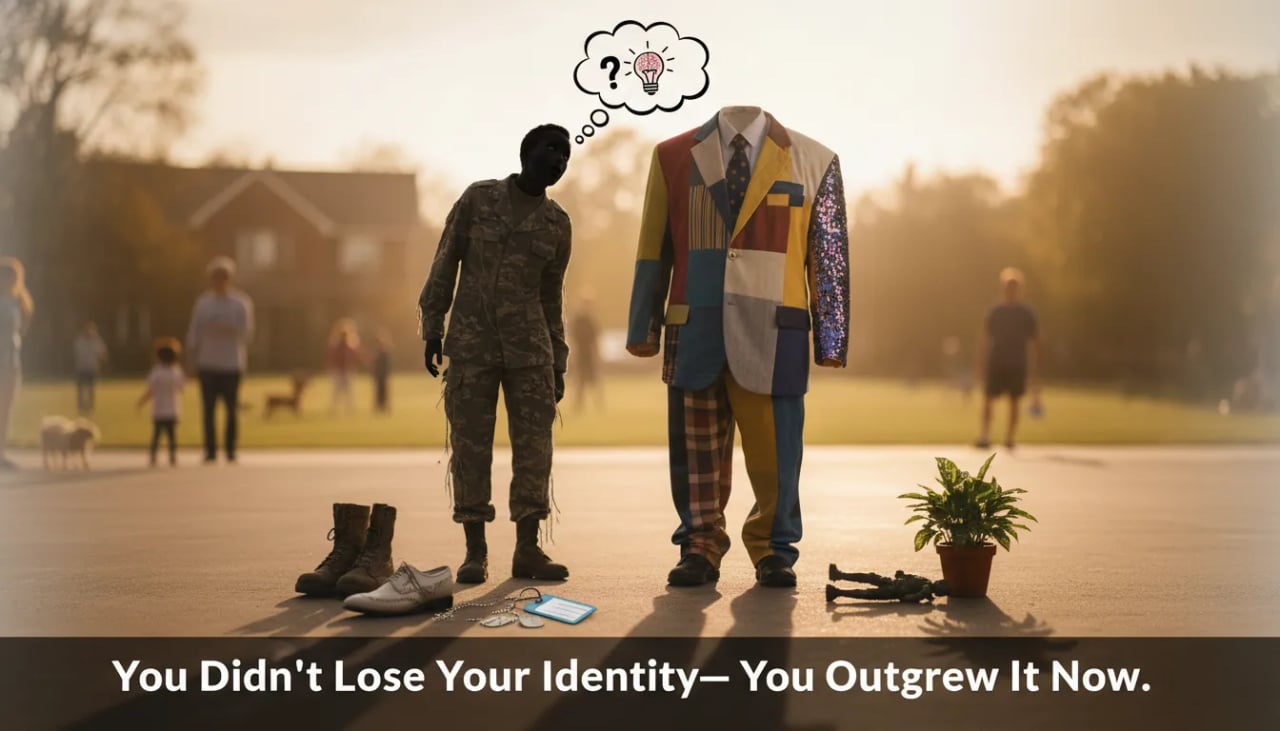



I remember the first Saturday after my last uniform was folded: a silence so loud I boiled pasta twice just to have a reason to stand up. That’s when it hit me—not that I’d lost something, but that my old identity had finished its job. In this piece I’ll walk (and occasionally jog) you through why that silence isn’t a failure, how to tell the difference between restlessness and laziness, and the painfully boring but totally effective steps I used to build a new, civilian-friendly identity.
1) The Quiet Shock: When the Frame Vanishes
Military Veteran Identity: Life Inside the Frame
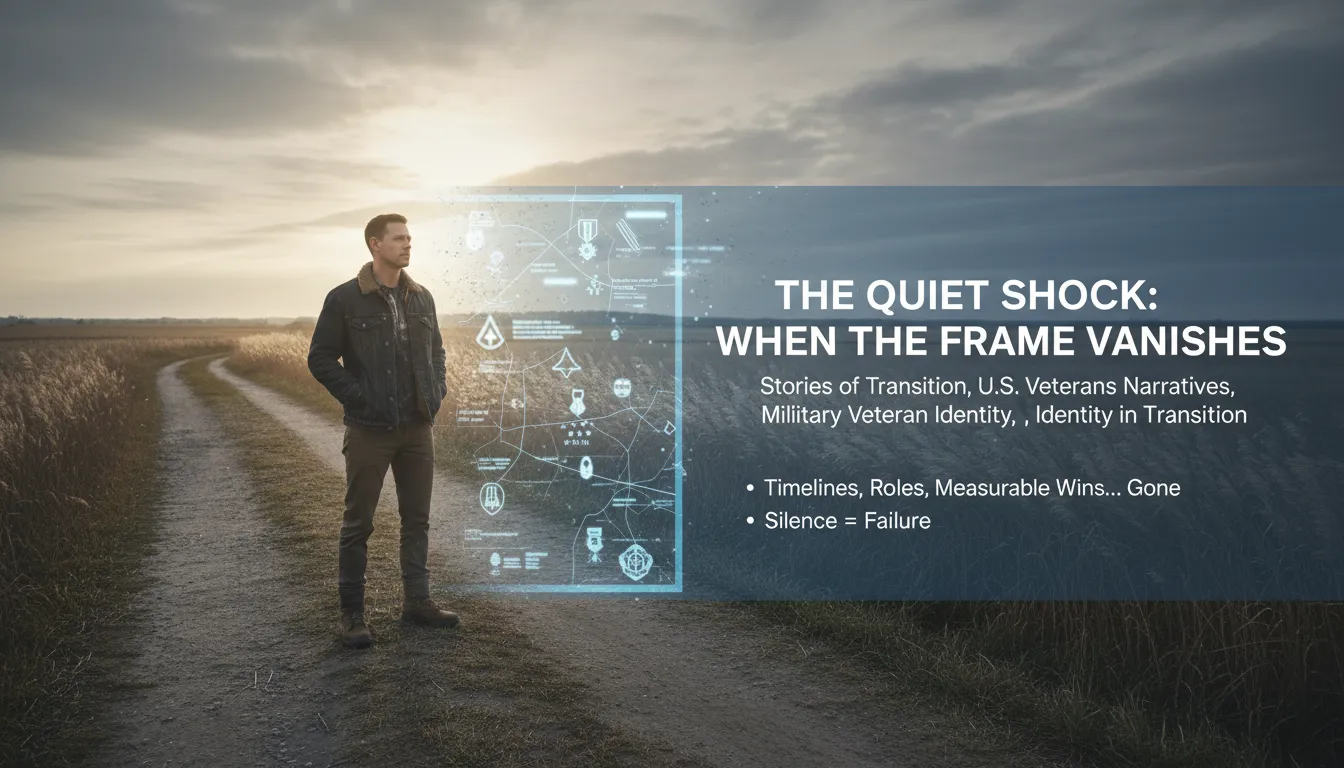
The military doesn’t just give you a job. It gives you a frame. Timelines. Roles. Clear lanes. Measurable wins. You know where you fit, how you rank, and what “good” looks like. Even your bad days come with a checklist and a formation time.
Then you separate, and the frame disappears like it got PCS orders without telling you.
Maj. Tom Reyes (Ret.), Transition Coach: "The uniform doesn’t vanish—its rules do. That’s where people trip up."
Stories of Transition: My First Week of “Freedom”
My first week out, I woke up early out of habit and just… stood there. No PT. No mission brief. No one yelling my last name like it was a love language. I made coffee and felt weirdly guilty, like I was skipping something important.
Every task felt optional. Apply for jobs? Optional. Work out? Optional. Eat lunch? Shockingly optional. In uniform, life had rails. In civilian life, it felt like someone handed me a map with no “You are here” dot.
Identity in Transition: Why the Silence Feels Like Failure
This is where a lot of U.S. Veterans narratives sound the same: the quiet afterward feels like you did something wrong. But you didn’t. The challenge isn’t readiness or work ethic—you still have the values. It’s that strong military identity ties make civilian status feel like a downgrade, even when it’s just different.
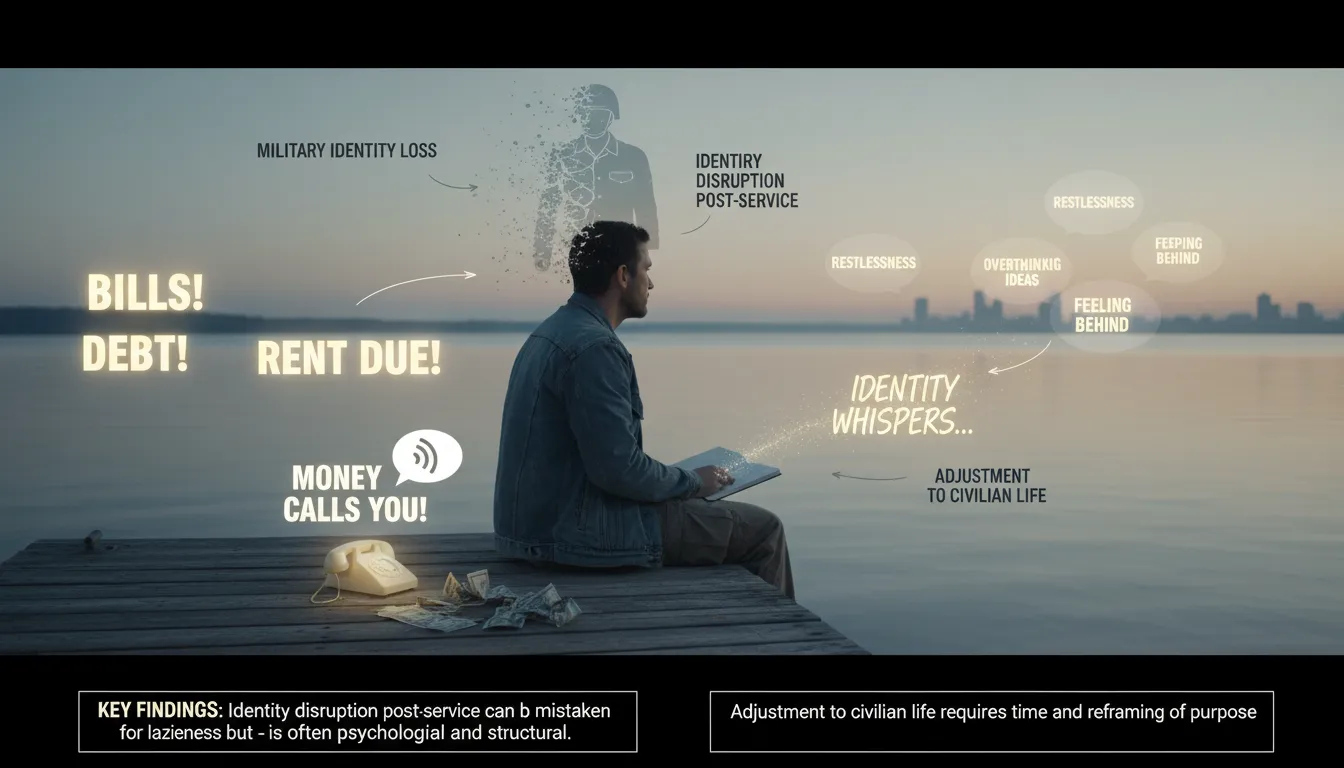
Money problems are loud. Bills call. Bank accounts scream. Identity problems are quiet. They show up as:
Restlessness
Overthinking
Jumping from idea to idea
Feeling “behind” with no clear reason
That’s not laziness. That’s unassigned potential—energy with no address.
Quick Prompt
What’s one small thing after service that suddenly felt purposeless—like it mattered a lot before, and now it’s just… floating?
2) Why Identity Feels Harder Than Money (Spoiler: It's Silent)
Money problems are loud. Like, “UNKNOWN NUMBER” loud. Bills don’t whisper—they ring, they email, they send letters with scary fonts. Identity problems? Those sneak in like a cat at 3 a.m. and just sit on your chest.
Civilian life adjustment: loud stress vs quiet stress
In civilian life adjustment, the loud stuff is easy to spot:
Rent due
Car making a new sound (always a bad sign)
Bank app giving you that “are you okay?” balance
The quiet stuff is what makes you think you’re “fine” while also feeling like you’re slowly buffering.
Military identity loss doesn’t scream—it whispers
Military identity loss (and the broader identity disruption post-service) often shows up as:
Restlessness
Overthinking
Jumping from idea to idea
Feeling “behind” without knowing why
Dr. Laura Bennett, Clinical Psychologist: "Restlessness after service often signals a missing role, not a missing person."
That hit me because I wasn’t “broken.” I was just… unassigned. The military gave me a frame: where I fit, how I measured up, what winning looked like. Then it ended, and the silence felt like failure.
My “idea-of-the-week” era (aka existential crisis veterans starter pack)
I had a streak where every Monday I became a new person: coffee business guy, cybersecurity guy, fitness coach guy, “maybe I’ll buy land” guy. By Friday, I was back to doom-scrolling and calling it “research.” Classic existential crisis veterans energy.
Here’s the truth: That’s not laziness. That’s unassigned potential with directionless energy—psychological and structural, not a character flaw.
Quick self-check: money stress or identity stress?
Can I name the problem in one sentence? If not, it’s probably identity.
Do I feel busy but not effective? Identity.
Would a paid-off bill fix this feeling? If no, identity.
Journal for 7 days: “What drained me?” “What gave me purpose?” Patterns show up fast.
3) Signs You're Not Lost—You're Between Identities
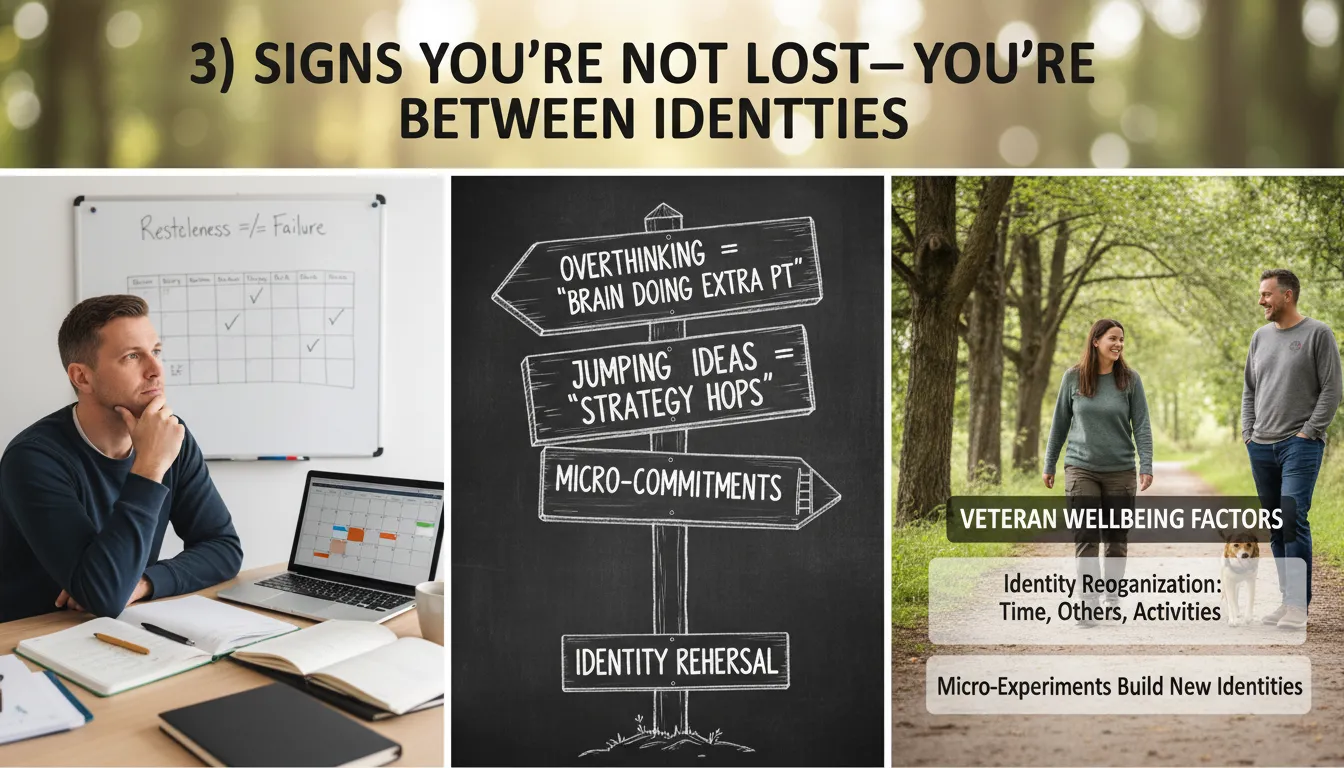
I thought my restlessness meant I was failing at Adjustment to civilian life. So I did the most military thing possible: I tracked it for two weeks like it was a mission log. Turns out I wasn’t broken—I was in the awkward hallway between “who I was” and “who I’m building.” That’s not laziness. That’s unassigned potential.
Common signs (aka your brain doing weird but normal stuff)
Restlessness — like your body is waiting for orders that never arrive.
Overthinking — my brain doing extra PT… for no promotion.
Jumping from idea to idea — “strategy hops” with zero follow-through.
Feeling behind — even when life is fine on paper.
Research backs this up: identity reorganization takes time, significant others, and meaningful activities. Translation: you need reps, people, and a reason.
Mini-exercises that actually help
Time-blocking: schedule two 30-minute “build the next me” blocks weekly.
Micro-commitments: pick one tiny action you can’t talk yourself out of.
Identity rehearsal new roles: try the role before you “become” it—volunteer once, shadow someone, take one class, join one meetup.
“Small rehearsals stack up. Nobody saw my new self form—until it did.” — Sgt. Ava Collins (Ret.), Peer Mentor
Not sure if it’s transition discomfort or something clinical?
Normal: scattered, edgy, bored, questioning everything. Red flags: thoughts of self-harm, heavy substance use, panic that won’t ease, isolation for weeks, or intense Post-traumatic stress symptoms (nightmares, flashbacks, constant hypervigilance). If those show up, reach out—veteran transition hotlines and local programs exist for a reason.
Quick family note (they spot different stuff)
Loved ones notice Veteran wellbeing factors you miss: sleep changes, anger spikes, “ghosting” friends, or going quiet.
7-day identity experiment
Pick one role: “student,” “coach,” “builder,” “helper.”
Do one 20-minute action daily that matches it.
Write one line:
Today I acted like a ____ by ____.
4) The Truth: Your Military Identity Did Its Job
I’ll confess: when I hit the Military to civilian transition wall, I panicked. I thought the part of me that “knew”—who I was, what I was worth, what the next step was—had vanished. Turns out it didn’t die. It graduated. Like a tool you used hard, then put back in the box because the mission changed.
Here’s the line I needed to hear (and maybe you do too): Your military identity wasn’t taken from you. It did its job. If you had a Strong military affiliation, that identity wasn’t just a uniform—it was your whole operating system. And when the system shuts off (especially after an unplanned exit), your brain starts doing weird stuff: reevaluating everything, questioning your value, and wondering why you suddenly feel “off.” That disruption is real.
Dr. Marcus Haynes, Sociologist: "Military identity often serves as a scaffold—remove it and you get a wider room to build in."
That’s Self-identity reconstruction in plain English: the scaffold comes down, and now you build something that fits civilian space. Not rank-based. Not permission-based. Not dependent on someone else’s system. Because if you keep waiting for a civilian “chain of command” to tell you you’re doing life correctly… you’ll be waiting until retirement.
Myth-Busting (Because My Brain Needed It)
No, you’re not broken—you’re in transformational identity change.
Yes, you can reuse your strengths without reenlisting in your own head.
No, missing structure doesn’t mean you’re weak—it means your identity was central (and that can raise risks like depression or substance use if you don’t rebuild on purpose).
Translate the Old Metrics into Civilian Markers
I started swapping military scorecards for civilian ones:
Rank → skills, certifications, portfolio
PT test → energy, sleep, consistency
Awards → impact: projects shipped, people helped
Unit cohesion → community: mentors, peers, teams
Keep the values—discipline, teamwork, ownership. Just bend the rules enough to make them yours.
5) What Building a New Identity Actually Looks Like (Spoiler: Boring)
I thought building New civilian identities would feel like a movie montage. You know: dramatic music, instant confidence, new wardrobe, maybe a golden retriever.
Instead, it looked like this: learning skills, testing systems, failing quietly, and showing up when nobody’s watching. Basically, the “director’s cut” of boredom.
Maj. Hannah Patel (Ret.), Career Transition Advisor: "People think reinvention is flashy. Mostly it's patience and repetition."
My Boring 90-Day Plan (a.k.a. Identity rehearsal new roles)
I treated the first 90 days like Identity rehearsal new roles: small reps, low stakes, lots of notes. Not “Who am I forever?”—more like “Who am I trying on this week?”
Learn a skill: pick one useful thing (Excel, sales, project management, coding, welding—whatever fits).
Test a system: a calendar routine, job-search workflow, gym plan, budgeting setup.
Fail quietly: mess up in private, adjust, repeat. No announcement needed.
Show up: even when nobody claps. Especially then.
Micro-tasks that actually move the needle
Complete one online course module.
Do three informational interviews (vets, civilians, anyone doing the job).
Keep a daily 10-minute habit (walk, journaling, applications, skill drills).
Every week I awarded myself a mental “Boring Badge” for consistency. No ribbon ceremony. Just me, nodding like a weirdo.
This isn’t regression—it’s groundwork
If you feel “behind,” that’s not backsliding. That’s your identity reorganizing through meaningful activity and social support.
For high-performing veterans who need more than generic help
High-performing veterans need specific transitional programs beyond general support. If you’re used to high standards, add accountability: peers, a coach, or a veteran network.
Days | Focus | Track |
|---|---|---|
1–30 | Skill reps + routine | 1 note/photo per day |
31–60 | Network + small projects | Weekly wins list |
61–90 | Apply + iterate system | What worked/what didn’t |
6) The Payoff: When Identity Locks In (Tiny Changes, Big Results)
The weirdest day was the day nothing happened… and I realized I moved differently. Literally. I stopped walking like I was late to a formation that didn’t exist. Figuratively, I stopped treating civilian life like a temporary duty station. That’s the moment my New civilian identities started feeling real—like my old “frame” didn’t break, it just got expanded. New room. New furniture. I picked it.
Dr. Emily Russo, Researcher in Veteran Studies: "Identity change is rarely dramatic on the surface; it's a slow accumulation of small acts."
Three shifts that told me the Transformational identity change was working
Movement: I slowed down on purpose. I took walks without scanning for threats… or Starbucks parking spots like they were tactical objectives.
Thinking: My brain stopped asking, “What’s the right answer?” and started asking, “What’s my answer?” That’s Identity reorganization change in plain clothes.
Choosing: I made decisions without waiting for external orders. Not reckless—just designed. Small repeated actions, same direction, over time.
Quick test: the Decision Audit (5 minutes)
For the next 7 days, write down one decision per day and label it:
Order-based: “I did it because I should.”
Design-based: “I did it because it matches who I’m becoming.”
If “design-based” is increasing, your new markers identity are showing up.
My odd little win markers (no military metrics required)
I meal-prepped like an adult… while listening to podcasts instead of yelling “time hack!” at myself.
I kept a calendar that wasn’t someone else’s mission.
I celebrated consistency, not intensity.
Don’t rush it: checkpoints that keep you sane
Identity reorganization needs time and meaningful activities. Check in at 30/90/180 days: What feels easier? What feels more “me”? One day you realize you move differently, think differently, choose differently—because you designed it that way. That’s when identity locks in.
7) Research & Numbers (Yes, There Are Stats—And Some Are Surprising)
I know, I know—nothing screams “fun” like spreadsheets. But when it comes to Identity disruption veterans deal with, the numbers basically say: you’re not broken, you’re in a very crowded club.
Identity study transition: the “it’s hard” stats
Across studies, about 27% to 44% of Veterans say the military-to-civilian transition is difficult. That’s a big range because samples, timing, and questions change. Still, even the low end is… not exactly “rare.”
Veteran transition challenges: pre-9/11 vs post-9/11
Here’s the part that made me blink twice: 33.3% of pre-9/11 Veterans reported difficult adjustment to civilian life, while 60.5% of post-9/11 Veterans did. That’s not a small jump—that’s a whole new zip code.
Research also notes that unplanned exits (medical, admin, sudden life stuff) can trigger identity disruption and a full “wait, who am I now?” reevaluation. Which is rude, honestly.
When identity is central, symptoms can follow
Some findings link strong military identity ties with less successful transitions. And US identity centrality has been positively associated with substance use, depression, and anxiety symptoms. Not because identity is bad—because when one identity holds all the weight, it can crack under pressure.
Dr. Karen Mitchell, Epidemiologist: “Numbers don't tell stories alone, but they tell us where to focus support.”
Finding | Number | Source (examples) |
|---|---|---|
Difficult adjustment (pre-9/11) | 33.3% | PMC article |
Difficult adjustment (post-9/11) | 60.5% | PMC article |
Transition difficult (range) | 27%–44% | Frontiers / PMC |
Practical takeaway: identity reorganization needs time, significant others, and meaningful activities. That’s why the “boring groundwork” counts.
UTPPublishing
Frontiers
PMC (PubMed Central) articles on Veteran transition/identity
8) Wild Cards: Quotes, Hypotheticals & Tiny Thought Experiments
Identity rehearsal new roles (yes, it’s allowed to feel weird)
Lt. Col. Sarah Nguyen (Ret.), Veteran Advocate: “Try the rehearsal. Even a fake meeting can change real habits.”
Marcus “Mack” Delaney, retired infantry: “I didn’t lose myself. I just stopped being issued a script.”
That’s the whole game: Identity rehearsal new roles until your brain stops acting like civilian life is a surprise inspection.
If your identity were a house… which room is empty?
Hypothetical time: If your identity were a house, which room would be empty? The “purpose” kitchen? The “friends” living room? The “I’m proud of this” garage?
Journaling prompt (no fancy pen required): What would I put in that room this month, and who would notice? Research backs this up: identity reorg sticks better with meaningful activities and significant others in the mix.
Cultural gap transition: uniform vs thrift jacket
Military identity is a tailored uniform: crisp, clear, and somebody already decided the pockets. Civilian identity is a thrifted jacket: it might smell like 2009, but you can alter it. That’s the Cultural gap transition—less “issued,” more “edited.”
Two micro role-plays for Social connectedness veteran energy
Networking drill: Say: “Hi, I’m ___, I solve ___ problems, and I’m exploring ___.” Then ask: “What are you working on lately?”
Small-talk simulator: Practice a 30-second chat about weather/coffee/sports without mentioning ruck marches. (I know. Painful.) This builds Social connectedness veteran style—steady, low-drama reps.
What-if: unplanned exit vs planned retirement
Unplanned exit needs quick stability: routine, people, one doable mission. Planned retirement needs expansion: experiments, new communities, bigger “why.” Both keep the values—readiness, service, standards—just aimed at your life.
Pick one wild card this week
Do one role-play with a friend
Fill one “empty room” with a small activity
Tailor one “thrift jacket” habit (sleep, gym, class, volunteer)
Try it, then report back in the comments—what felt awkward, what surprised you, what actually worked.
9) Conclusion & Next Steps (Yes, You Can Keep the Good Parts)
I didn’t “lose myself” after service. I just outgrew the version of me that came with a rank chart and a rulebook. That’s the whole point of this Identity transition after military service thing: the old frame did its job, and now it’s time to build the next one—on purpose. As Dr. Marcus Haynes put it:
"Reconstruction of identity is an act of design, not a magic trick."
Here’s the pledge I made (and still repeat when I start spiraling): keep the discipline, drop the permission, design the rules. I keep the good parts—showing up, staying sharp, finishing what I start. But I stopped waiting for someone to “assign” me a mission. That’s how Building identity after military actually works: you pick a direction, test it, adjust, and keep moving even when it feels boring.
The research we covered earlier backs this up: identity reorganization takes time, meaningful activities, and social support. And for high-performing vets, targeted transitional programs can speed up the “okay, I’m not broken” phase. So here are your next steps, simple enough to do on a Tuesday.
One skill: choose one thing to learn for 30 days (trade, cert, writing, sales, whatever pays or heals).
One social connection: join a veteran peer group or sign up for a transitional workshop (check the resources and studies from the findings section).
One tiny habit: a daily 10-minute action that proves you’re building, not drifting.
Bookmark this checklist and revisit it at 90 and 180 days. Time plus small acts is how the stats we mentioned earlier turn into real change. One day you’ll notice: you move differently, think differently, choose differently—because you designed it that way. That’s when identity locks in.
My proof? Every morning I do a “civilian formation”: coffee, shoes on, and I brief my dog on today’s objectives. He’s unimpressed, but it works. Drop your story in the comments—especially your most ridiculous first-week civilian moment. I’m collecting them like merit badges.
