


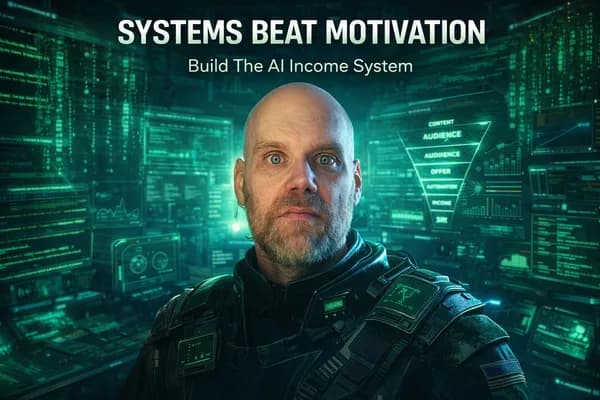

Many veterans blame niches, platforms, or courses when an online launch stalls—pointing at LinkedIn, Shopify, or a coaching program instead of the real cause. This reflex hides a deeper mismatch between military structure and freedom-based entrepreneurship.
Did You Know?
Many veterans blame the ‘wrong niche’ or platform when online launches fail, yet veteran-owned firms averaged $3.03M in revenue as of 2024—suggesting the problem is systems and mindset, not capability.
Source: U.S. Census Bureau (2024); Vet100 (2026)
The real problem is mindset and systems: military command-and-control clarity clashes with entrepreneurship’s ambiguity and rapid testing. Veterans bring discipline, leadership, and execution—see MGT’s Vet100 growth—but those strengths need a different operating system for async funnels and audience-building.
You’ll learn why this happens, which strengths veteran entrepreneurs can leverage (Census Bureau shows veteran firms average $3.03M revenue), and a practical operating system to fix the gap. The following sections unpack a practical operating system that preserves military strengths while enabling entrepreneurial flexibility and scale.
Veterans' Advantage and 2026 Statistics
Veteran entrepreneurs enter online business with measurable advantages. Veteran-owned firms averaged $3.03M in annual revenue and supported average payrolls of $590,195, based on data through 2024. Those figures contradict the notion that veterans inherently struggle as founders.
Across 304,823 veteran-owned businesses, total revenue reached $922.2B in 2024, showing broad economic participation and resilience. Veteran-led companies can and do scale: MGT’s eightfold growth and placement on the 2026 Vet100 illustrates repeatable paths from startup to national recognition.
Practical interpretation for veterans moving online
These numbers mean veterans aren’t starting from a deficit—they often have access to capital, payroll capacity, and networks that support online growth. Tools like Veterans' Advantage (discounts), LinkedIn (B2B outreach), and Shopify (e-commerce) map directly onto the revenue and payroll strengths shown in the data.
Veteran business highlights
High Average Revenue
Veteran-owned firms average $3.03M in annual revenue, demonstrating scale beyond small-business norms.
Significant Payrolls
Average payrolls of $590,195 indicate veterans create well-paying, multi-employee firms.
Large Business Base
304,823 veteran-owned businesses generated $922.2B in revenue as of 2024, showing widespread economic impact.
Startup to Scale Examples
Veteran-led MGT grew eightfold and appeared on the 2026 Vet100, illustrating growth potential in tech and online ventures.
| Feature | Veterans' Advantage | Shopify | |
|---|---|---|---|
| Primary use | Membership discounts for travel, retail, and services (veteran-focused) | Professional networking and B2B outreach | Hosted e-commerce platform for online stores |
| Typical cost | Annual membership (discount-focused benefits) | Free basic profile; Premium tiers from ~$29/mo | Plans from $29/mo (Basic) to higher tiers |
| Role for veteran businesses | Reduces operating expenses via targeted discounts | Builds sales pipelines and hires through professional networking | Drives direct online revenue for veteran e-commerce ventures |
| Evidence in 2024/2026 context | Supports cashflow; complements revenue strength ($3.03M avg) | Used for outreach and recruiting by veteran firms; aligns with Vet100 growth stories | Platform used by veteran entrepreneurs to capture a share of the $922.2B veteran-owned revenue |
Why the Military Mindset Clashes with Online Business
Military training conditions people to follow clear orders, respect chain of command, and meet concrete standards. Veterans excel at Standard Operating Procedures, accountability, and mission discipline — traits that contribute to the strong performance of veteran-owned firms (average revenue $3.03M; $922.2B total veteran-owned revenue through 2024).
Operational Strengths, Creative Constraints
Veterans bring discipline, accountability, and standards — assets in scaling businesses. Those same habits can create paralysis when entrepreneurship demands rapid iteration and market testing.
- ✓ Discipline & SOPs
- ✓ Risk-avoidance & permission-seeking
Entrepreneurship, by contrast, values uncertainty-first tactics: build-measure-learn, A/B tests, and fast customer feedback. Tools like Google Analytics, Hotjar, and Optimizely reward iteration; platforms such as Shopify, Kajabi, ClickFunnels, and Mailchimp require launching imperfect products to learn what converts.
That gap produces predictable psychological consequences for veterans: paralysis, perfectionism, and waiting for permission. Instead of shipping a minimum viable course on Kajabi and testing pricing, a veteran founder may spend months refining slides and compliance checklists.
Concrete launch examples: content paralysis (refusing to post on LinkedIn or YouTube until every script is perfect), overtraining (producing an exhaustive 40-module course instead of a 4-module MVP), and scope creep in funnels built in ClickFunnels. Waiting for a “green light” replaces rapid customer interviews and a first email blast via Mailchimp.
How this shows up in practice
- Delaying launches to meet imagined standards rather than metrics.
- Over-engineering product features before validating demand.
- Relying on approval chains instead of customer feedback loops.
- Confusing readiness with perfection, reducing experiments and A/B tests.
Build a Simple Operating System (A Practical Fix)
Veterans can convert discipline, resilience, and mission-focus into repeatable business systems that reduce noise and increase conversion. The OS principle is to channel those strengths into a compact, measurable routine.
Four-step OS
- Pick one audience (example: veteran founders in cybersecurity).
- Define one offer — e.g., a $5,000 vulnerability assessment or a fixed-price package.
- Choose one platform — LinkedIn for B2B or Shopify for e-commerce.
- Implement one daily system and track metrics.
Four-step Operating System
Pick One Audience
Choose a single niche (e.g., veteran founders in cybersecurity or small-business IT) and document their top three pain points.
Define One Offer
Craft a single, clear offer—consulting, a $5,000 vulnerability assessment, or a starter info product—with a fixed price and outcome.
Choose One Platform
Commit to LinkedIn for B2B or Shopify for e-commerce; optimize that channel before expanding.
Daily OS (Measurable)
Execute: 1 content piece, 5 conversations, 1 market study, 1 improvement each day—track them on a simple scorecard.
Daily system example: publish one content piece, have five qualifying conversations, run one focused market study, and make one measurable improvement. Track these as counts on a simple scorecard; review weekly and iterate.
Use veteran benchmarks as targets—average revenue per veteran business is $3.03M and average payroll is $590,195. MGT’s Vet100 growth example shows how focus scales outcomes.
| Feature | Chaotic Multi-Project | Simple OS | Veteran Benchmark |
|---|---|---|---|
| Focus | Multiple audiences and scattered offers | One audience, one offer, one platform | Mission-driven consistency |
| Daily Actions (measurable) | Ad-hoc tasks with no metrics | 1 content, 5 conversations, 1 market study, 1 improvement | Structured daily routines common in veteran firms |
| Revenue Outcome | Unpredictable; lower conversion | Clear pipeline and repeatable sales motions | Average revenue per vet biz: $3.03M |
| Payroll / Scale | Limited scale; hiring rarely optimized | Predictable scaling toward team roles | Average payroll: $590,195; 11 employees |
| Best Platforms | Multiple channels causing context-switching | Single platform (LinkedIn for B2B, Shopify for e-commerce) | LinkedIn & Shopify are effective channel choices |
Frequently Asked Questions
FAQ Accordion
Are veterans really at a disadvantage in online business? ▼
How do I start if I keep waiting until I feel ready? ▼
Can AI replace the need to learn marketing and sales? ▼
Conclusion
🎯 Key Takeaways
- → Veterans bring leadership, discipline, and commercial strength — veteran firms average $3.03M revenue; 304,823 veteran-owned businesses generated $922.2B (2024).
- → Adopt mindset shifts and a simple operating system: choose one audience, one offer, one platform (e.g., LinkedIn for B2B, Shopify for e‑commerce).
- → Commit to a small daily system, stop waiting for permission, build using your strengths, and accelerate with AI tools like ChatGPT and Slack integrations.
Veterans possess leadership, discipline, and mission focus that translate to business success. Veteran firms average $3.03 million in annual revenue, with 304,823 veteran-owned businesses generating $922.2 billion in 2024.
Next steps
The barrier is less capability than mindset and systems; a simple operating system solves both. Choose one audience, one offer, and one platform—LinkedIn for B2B or Shopify for e‑commerce—and design a repeatable, tiny daily workflow. That focus replicates military clarity into marketing and sales.
Start with a 20-minute morning system: outreach, content, and follow-up. Use tools—ChatGPT for copy, Slack integrations for operations, and Shopify or LinkedIn features for distribution—to accelerate execution.
Stop waiting for permission; build from strengths and iterate. If you want a model, study MGT (2026 Vet100) and then commit to the small daily system that turns veterans' strengths into revenue. Start today, track results weekly, and scale what works. Use AI to compound gains fast.
