
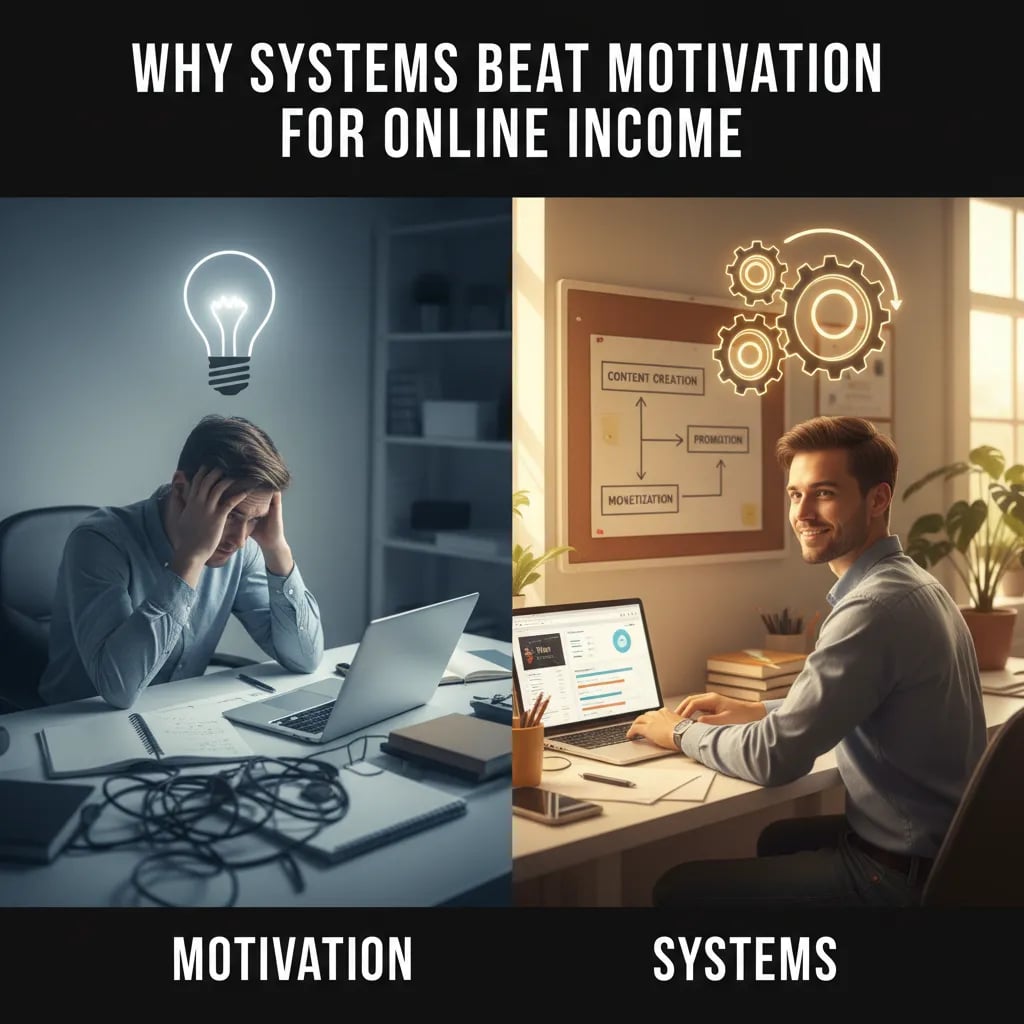



On January 1, I’m basically unstoppable—new notebook, fresh pens, big promises. Then January 2 shows up with a dead phone battery, a surprise bill, and my brain asking, “Do we really have to?” That tiny wobble is how I learned the uncomfortable truth: if my income plan depends on my mood, I don’t have a plan. I have a vibe. And vibes don’t pay rent.
January 2: The Day Motivation Gets Exposed
January 1 feels like a movie montage. Clean notebook. Big promises. I’m up early, coffee in hand, telling myself this is the year I finally build online business systems and stop “winging it.”
Then January 2 shows up like real life always does. The kid wakes up cranky. Work pings me early. I slept weird. The bank app sends a reminder I didn’t ask for. And that line hits me in the chest again: Bills don’t.
New Year Energy vs. Real-Life Interruptions
On January 1, motivation is loud. On January 2, everything else is louder. That’s when I notice the truth: if my income depends on how I feel today, I’m one bad week away from quitting.
“I’ll Just Be Disciplined” Works… Until It Doesn’t
I used to think discipline was the answer. Just push harder. Just grind. And yeah, it works right up until the first curveball—sick day, surprise expense, family stuff, a week where nothing converts. Discipline is a battery. Life drains it.
What drains it fastest is the invisible tax: decision fatigue. Every day I ask:
What should I post?
What offer should I pitch?
Who do I message?
What tool do I need now?
That’s why a decision fatigue fix matters more than another hype video. When the decisions stack up, willpower taps out.
My Unpopular Opinion: Motivation Is a Marketing Drug
Motivation sells planners, courses, and posters. It feels good. It looks good on Instagram. But it’s terrible for payroll. It doesn’t care about rent, groceries, or keeping the lights on.
“You do not rise to the level of your goals. You fall to the level of your systems.” — James Clear
The Guilt Spiral After Missing One Day
Here’s the messy part: I miss one day and my brain calls it “falling off.” Then I feel guilty, so I avoid the work, and suddenly it’s a week. That’s why I started building an online income system that doesn’t require me to be “on” all the time—just consistent enough to let the system carry the weight.

Why Systems Win: They Don’t Need Your Mood
I used to think online income was about “wanting it bad enough.” Then I noticed a pattern: on high-energy days, I’d post, pitch, and plan. On low-energy days, I’d scroll, second-guess, and stall. My results matched my mood—and that’s a terrible way to build a life.
Decision fatigue is real (and it’s sneaky)
Decision fatigue is simple: too many choices and your brain quit. What should I post? Which platform? What offer? What headline? By noon, I’d already burned my willpower on tiny decisions. Then I’d tell myself I “wasn’t motivated.”
That’s why I started to build online business systems. Not because I’m a robot—because I’m human.
Systems are pre-made decisions
A system is just a set of decisions you make once, so you don’t have to make them again tomorrow. A system doesn’t care if you’re tired. It doesn’t need hype music. It shows up even when you don’t.
This is also how automated income systems get built: one clear offer, one traffic source, one follow-up, and one daily action. Consistency and clarity beat random bursts. Even search engines work that way—when you publish useful content on a steady schedule, they understand what you’re about and reward it over time. Not because you “hacked” anything, but because you stayed clear and helpful.
“You have to discipline yourself to work with intensity.”
—Cal Newport
The payoff: predictable actions → predictable money → calmer nervous system
When my actions became repeatable, my income stopped feeling like a lottery ticket. And my nervous system finally got the message: we’re not scrambling today. We’re executing.
Mini-example: my weekday system (even on low-mood days)
20 minutes: write one helpful post tied to my offer (no overthinking).
10 minutes: publish it and reuse the same format.
5 minutes: send it to my email list.
0 minutes (automated): AI business automation tags the lead, schedules follow-ups, and delivers the freebie.
Some days I feel unstoppable. Some days I feel nothing. The system still runs.
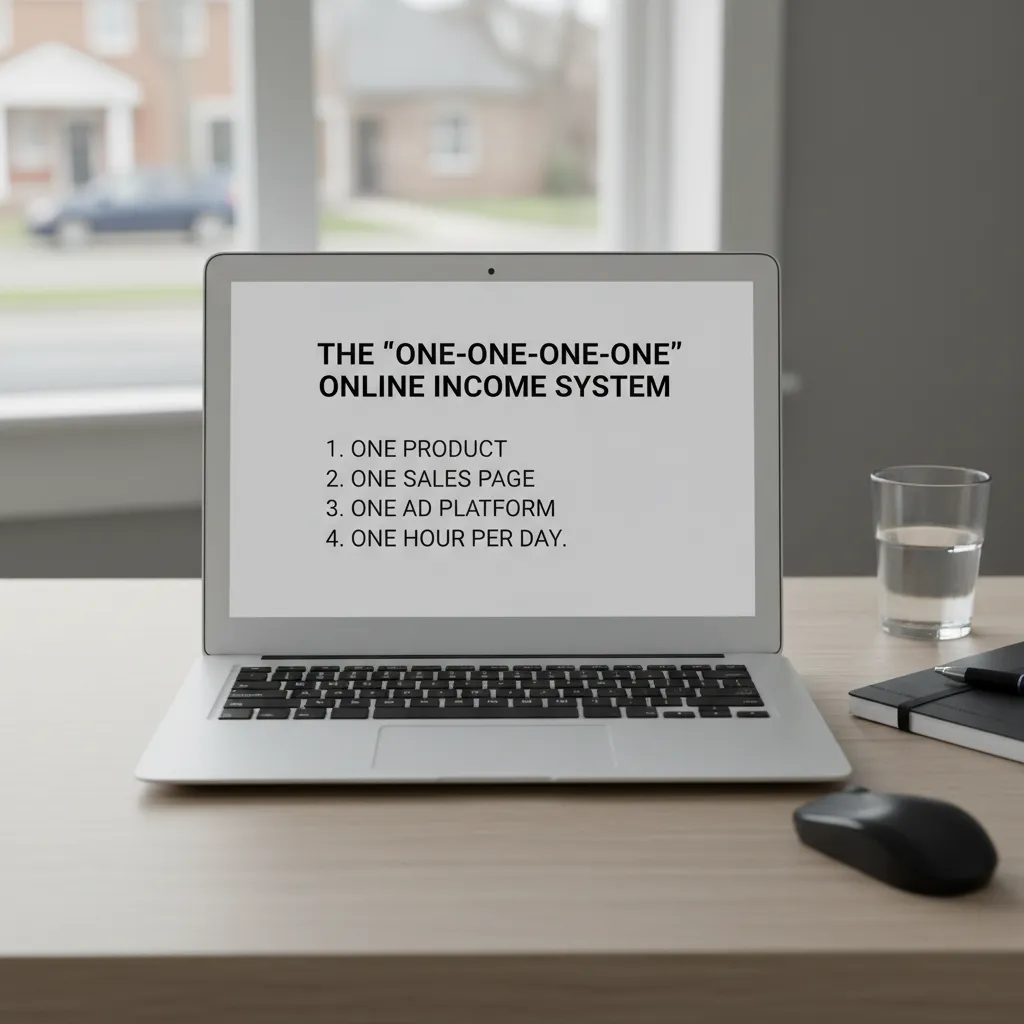
The “One-One-One-One” Online Income System (Keep It Boring)
When I finally started making progress online, it wasn’t because I found more motivation. It was because I stopped “winging it” and built a boring online income system I could repeat even on low-energy days. I treat it like a field manual: four parts, measured weekly, adjusted without drama.
Seth Godin: “The best way to be missed is to be inconsistent.”
1) One Traffic Source You Commit To (Pick It and Stop Wandering)
I used to bounce between platforms like I was “diversifying.” Really, I was avoiding the hard part: consistency. Pick one lane and stay there long enough to learn it.
YouTube (search + trust)
LinkedIn (network + authority)
Email newsletter (owned audience)
My rule: one primary channel for 90 days. No exceptions.
2) One Clear Offer (What You Sell, Who It’s For, What It Fixes)
If I can’t explain my offer in one breath, it’s not ready. A simple sales funnel starts with clarity:
Who it’s for (example: online business for veterans)
Problem it solves (leads, time, consistency, confidence)
Outcome they get (booked calls, a weekly content plan, first $1k)
3) One Automated Follow-Up Process (So Leads Don’t Slip)
This is where most people leak money. I set up automated follow-up so the system keeps working when I don’t feel like talking.
Email sequence (5–7 emails)
DM follow-up prompts
CRM reminders for “warm” leads
I use AI business automation to draft replies, tag leads, and schedule posts—nothing fancy, just less friction. The goal is automated income systems, not a tech hobby.
4) One Daily Non-Negotiable Action (Small, Measurable)
Every day I do one thing that moves the system:
30 minutes outreach or
1 piece of content or
5 follow-ups
If I lose motivation for 10 days, the posts are still queued, the emails still send, and the follow-ups still go out. That’s the point. I “audit system gaps” the same way SEO tools check keyword gaps: what’s missing, what’s weak, what needs tightening—then I fix the process, not my mood.
Veterans Get This: SOPs, Not Pep Talks
I’ve never met a good unit that ran on “feeling fired up.” It ran on SOPs—standard operating procedures. Same time. Same checks. Same standards. When people tell me they want an online business for veterans, I don’t think “motivation.” I think: repeatable actions that work on bad days.
The military doesn’t give you the option to wing it when life gets loud. You don’t skip steps because you’re tired. You don’t “freestyle” because your mood is off. That mindset is exactly how you build online business systems that don’t collapse the moment your schedule gets hit.
When Life Gets Loud, SOPs Keep You Moving
I remember pre-mission routines where everything was boring on purpose. Checklists. Inspections. Gear laid out the same way every time. Not because we loved paperwork—because boring beats broken. That’s what I want in business too: boring, reliable, repeatable.
In my online work, the “mission” is simple: traffic, offer, follow-up. When I don’t have an SOP, I start making tiny decisions all day. What should I post? Which tool should I try? Should I rewrite the page again? That’s decision fatigue dressed up as “working.”
My Daily Business SOP (No Hype Required)
Here’s the kind of checklist that keeps me steady, even when motivation is gone:
One traffic action (publish one short post or send one email)
One offer action (improve one line on the page or answer one sales question)
One follow-up action (queue messages, tag leads, schedule replies)
One review (5 minutes: what worked, what didn’t)
That’s how automated income systems start: not with a giant funnel map, but with a small SOP you can repeat.
Don’t Over-Optimize the System (Or the Keywords)
I learned this the hard way: overcomplicating kills execution. It’s like trying to add 17 steps to a weapons check—more “perfect,” less useful. Same with SEO: stuffing phrases hurts the reader and the results. Simple systems win because they get done.
“Discipline equals freedom.” — Jocko Willink
Veterans already have the advantage: repeatability, accountability, and clarity. SOPs create reliability. Automation creates breathing room.
A Tiny ‘Systems Audit’ You Can Do Tonight (No New Tools)
When my motivation drops, I don’t try to “get inspired.” I audit my system. Not a big overhaul—just a quick check to see what’s missing. This is how I build online business systems that still work on low-energy days, because they’re simple enough to run without a pep talk.
Ask Yourself 4 Blunt Questions
Open a notes app or grab a scrap of paper and answer these, fast and honest:
What’s my traffic source? Where do new people actually come from—one place I can commit to?
What’s my offer? What do I sell, and what problem does it solve?
What’s my follow-up? After someone sees my content, what happens next?
What’s my daily action? The one move I can do every day that pushes the system forward.
Most people I talk to have “content,” but no follow-up. Or they have an offer, but no traffic. That’s why the work feels random. Peace of mind comes from predictability, and predictability comes from knowing which piece is missing.
David Allen: “You can do anything, but not everything.”
Find the Missing Link (Then Keep It Natural)
Modern SEO rewards natural language, not forced keywords. Same idea here: your system should feel natural to run. If you’re trying to do five platforms, three offers, and a dozen tasks, you don’t have a system—you have noise. If it takes longer to plan the system than to run it, it’s not a system yet.
Run a 7-Day Experiment
For the next seven days, do your daily non-negotiable action every day, even at 60% effort. That’s how automated income systems start: small, repeatable actions that stack. And if you want a taste of AI business automation, use one automation max this week—like a scheduled email follow-up—so you don’t spiral into tool-hunting.
If you want predictable money, you need predictable actions. If you want freedom, you need automation. If you want peace of mind, you need systems. Motivation is optional. Systems are not. If you want to build income that runs even when motivation disappears, follow along. I document the system daily.
