
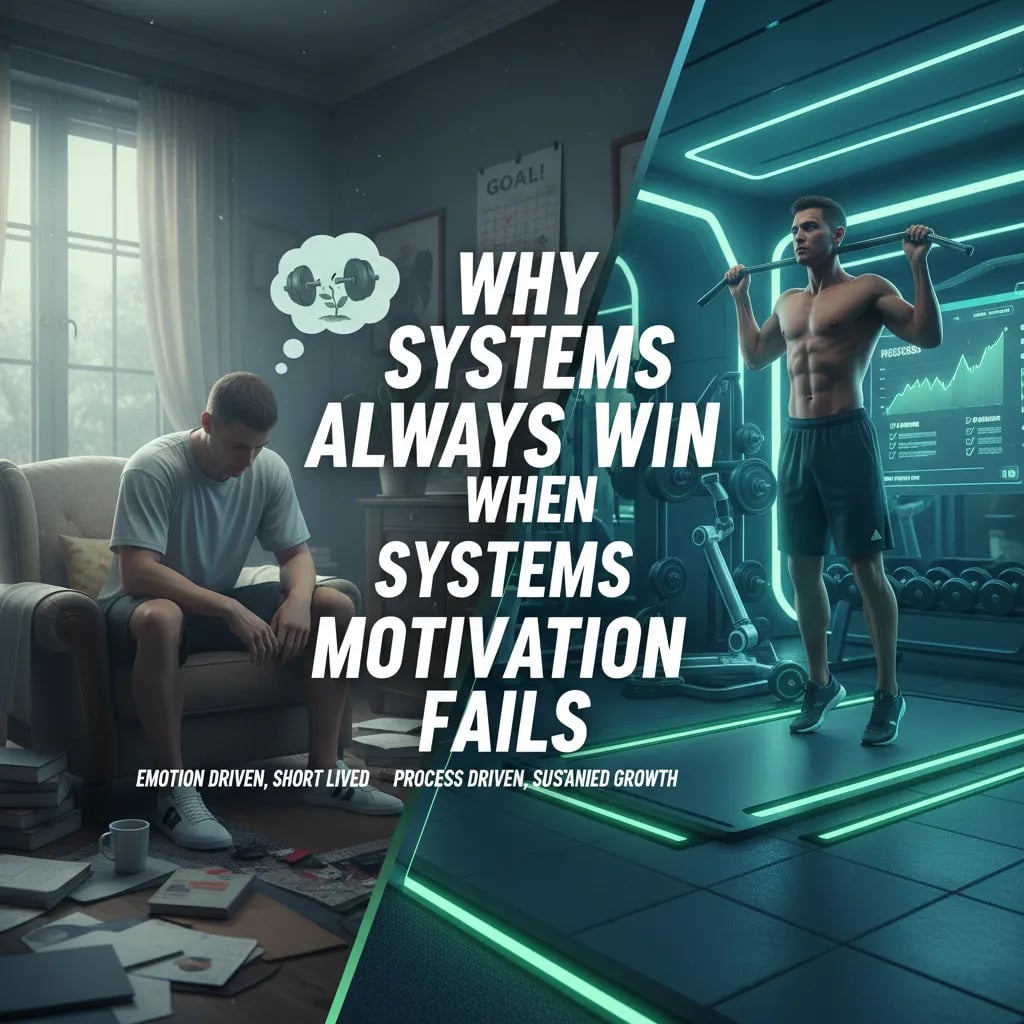


I used to wait for lightning bolts of motivation — and then get furious when the storm never came. One winter morning in 2023, after three missed launch dates and a sleepless night, I stopped waiting. I built one tiny routine and watched work actually happen on the crappy days. This piece is the diary of that stubborn experiment: why motivation feels great but evaporates, and how systems — boring, small, repeatable things — quietly win.
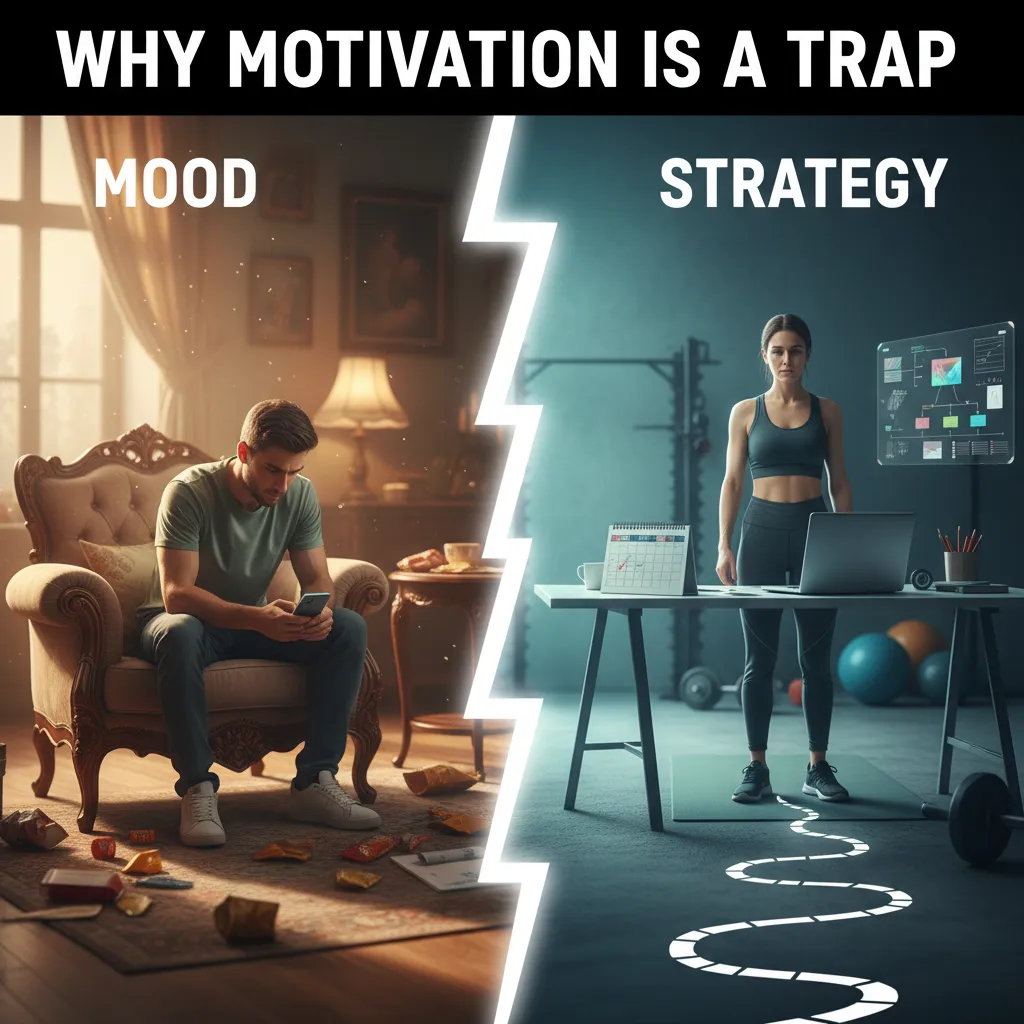
Why Motivation Is a Trap (Difference Between Mood and Strategy)
The Difference Between Mood and Strategy (and Why You Need to See It)
For years, I treated motivation like a plan. If I felt inspired, I worked. If I didn’t, I waited. That’s the trap. Motivation depends on mood, and mood depends on sleep, stress, and whatever life throws at you. That’s not a strategy. That’s gambling.
I learned this the hard way during a 2023 launch. I pulled an all-nighter to “get ahead.” The next day I was foggy, short-tempered, and slow. One bad night turned into a week of half-work: missed posts, delayed follow-ups, and a growing sense that I was “behind.” That’s when I saw it clearly: fleeting motivation can’t carry real results.
When Motivation Fails, the House Usually Wins
Feeling-led work is like walking into a casino with rent money. Sometimes you win. Often you don’t. And you can’t build a business on “often.” When motivation fails, you don’t just lose a day—you lose momentum, confidence, and time.
Research backs up how personal and fragile motivation is. Deloitte (2025) reports that 60% of workers expect organizations to boost their motivation, yet only 33% believe managers understand their personal motivations. Translation: motivation is “unit of one.” It’s individual, shifting, and hard for anyone (even you) to predict.
Wild Card: The Athlete Test (Shift Mindset)
Imagine a pro athlete who trains only when they “feel it.” Absurd, right? But that’s what creative work looks like without systems. We call it freedom, but it’s really randomness. The moment I did a Shift Mindset from “I need to feel ready” to “I need a repeatable process,” my stress dropped and my output got steadier—especially as a solopreneur.
You do not rise to the level of your goals. You fall to the level of your systems. — James Clear
Motivation is a spark. Strategy is a map. Systems are the road.
Tiny habits compound into big changes over time. — B. J. Fogg
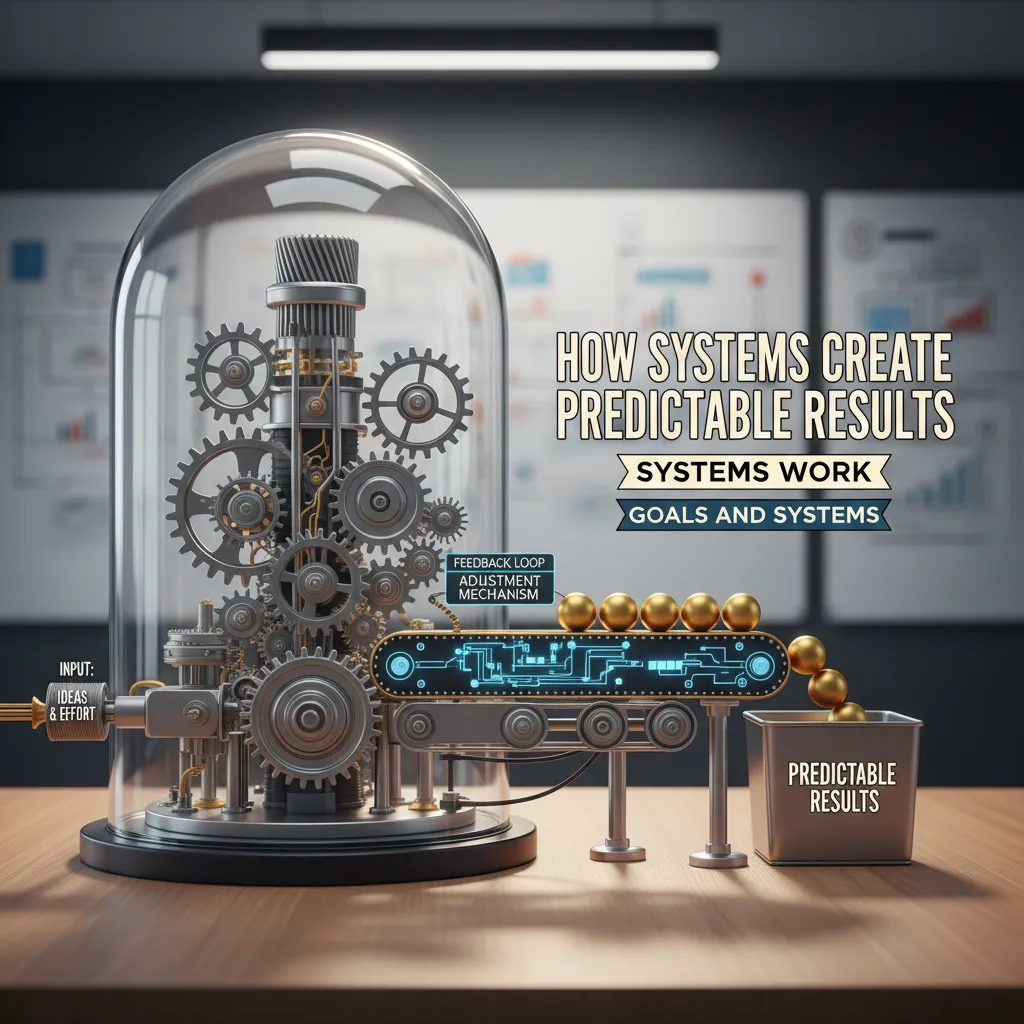
How Systems Create Predictable Results (Systems Work & Goals And Systems)
I used to wait for motivation like it was a green light. Some days it showed up. Most days it didn’t. And my results matched that randomness. Then I learned why systems win: they don’t care how I feel. They create predictable results because they tell me exactly what to do when my brain wants to quit.
Systems Work When Motivation Is Gone
An effective system is simple: a cue, a tiny action, and a scheduled slot. That’s it. No “should I?” No debating. Just execution. This is where consistency beats talent, mood, and big bursts of effort.
Cue: something that triggers the habit (wake up, open laptop, coffee).
Tiny action: small enough to start even on bad days.
Scheduled slot: a time you protect like a meeting.
My 15-Minute Window (And Why It Worked)
I set a rule: 15 minutes of writing, first thing. Not “write a great newsletter.” Just “open the doc and write for 15.” That tiny routine lowered friction. It also used intention—I already decided—so I didn’t need motivation to choose.
Some mornings I wrote garbage. But I still shipped. And shipping created momentum. That’s the progress principle: small wins make you more likely to keep going tomorrow.
If motivation is the spark, systems are the engine that keeps the car moving. — Cal Newport
Goals And Systems: Outcome vs. Process
Here’s the shift that changed everything: Goals And Systems aren’t enemies, but they play different roles. Goals point to the destination. Systems handle the driving.
Start with process, not outcomes. The tiny daily steps are non-negotiable. — James Clear
I also stopped obsessing over performance goals (“hit X subscribers”) and leaned into learning goals (“write daily and improve one thing each issue”). Learning goals build resilience because even a “bad” day still counts as practice.
A Quick Picture: Plant vs. Rainstorm
If your business was a plant, systems are the watering schedule. Motivation is the occasional rainstorm. Rain feels amazing—but the schedule is what keeps it alive.
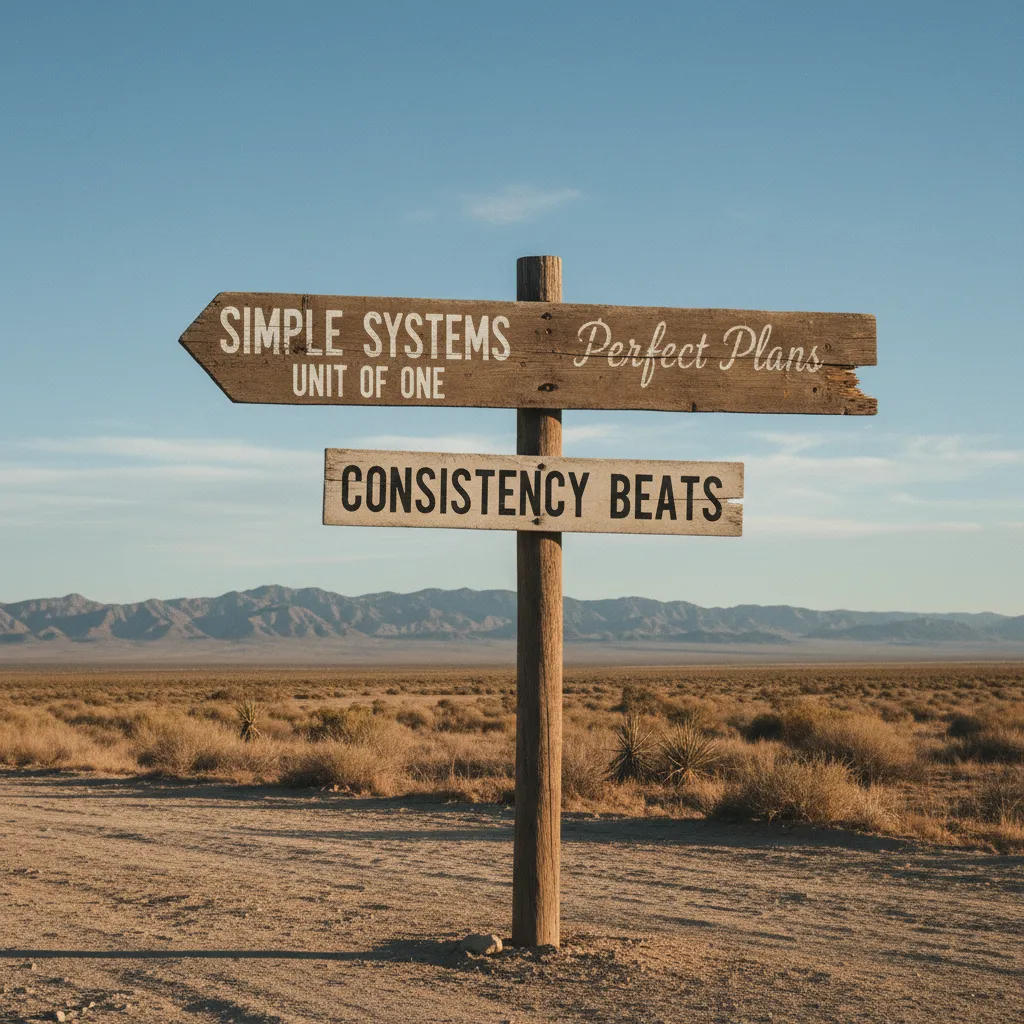
Simple Systems Beat Perfect Plans (Unit Of One & Consistency Beats)
I used to think I needed a perfect plan to win. I built a 12-step launch plan with pages of notes, tools, and “if this, then that” rules. It looked professional. It also made me tired before I even started.
Then I tried something almost boring: one marketing post per day. That was it. No fancy funnel. No big campaign. Just one post, every day, and a simple follow-up habit. Within weeks, I had more replies, more DMs, and way less burnout. The work felt lighter because it was repeatable actions, not constant reinvention.
Make it tiny, then show up. Consistency beats intensity. — B. J. Fogg
The “Unit of One” Rule: Win Today, Not the Whole Year
The best mindset shift I’ve found is the unit of one: I treat each day like a single unit to win. Not “crush Q1.” Not “fix my business.” Just: Did I complete today’s unit?
One unit repeated 365 times becomes a year of progress. It also lowers stress because I’m not carrying the whole future in my head.
Repeatable Actions That Drive Client Getting
You don’t need complex funnels — you need repeatable actions:
Post daily (one clear idea, one story, one lesson).
Start conversations (comment, DM, reply to replies).
Follow up (simple check-in, no pressure).
This is where consistency beats motivation. And it matters even more now: about 60% of workers expect organizations to boost motivation in 2025. That tells me people are waiting to be “made motivated.” Systems don’t wait.
Content Calendar = Less Thinking, More Looking Professional
I keep a tiny content calendar so I don’t rely on mood. I also aim for learning goals (get better at hooks, clarity, and offers) instead of pure performance goals. Learning builds resilience when a post flops.
Big goals are won on the small, boring days. — James Clear
How to Build Your First System (How To Start & Step One Shift)
The Step One Shift for building systems is simple: stop asking, “What do I feel like doing today?” and start asking, “What’s my unit of one?” One tiny daily action that moves one outcome forward—especially on the days motivation disappears.
I learned this the hard way. I used to plan big weeks, then miss two days and spiral. The fix wasn’t more hype. It was intention. Research backs this up: intention sustains action when motivation fades. So I picked one outcome and made it stupid simple.
Pick One Outcome, Then Choose Your “Unit of One”
If you’re wondering How To Start, don’t build a full machine. Build one gear. For solopreneurs, this reduces stress and can Save Time because you stop renegotiating your day.
Example outcomes and units of one:
Outcome: more clients → Unit of one: send 1 helpful DM
Outcome: grow audience → Unit of one: publish 1 short post
Outcome: better health → Unit of one: walk 10 minutes
Start with one tiny habit and expand from there. Simplicity is the secret weapon. — Derek Sivers
Schedule It Like a Meeting (Non-Negotiable)
This is where building habits becomes real. I blocked 20 minutes at 9:00 AM every day. No debate. No “later.” My “bad day” completion rate jumped because the decision was already made.
Try this time block:
9:00–9:20 AM — Unit of One (no phone, no tabs, just execute)
Optional Tools: WOOP + Progress Principle
WOOP keeps the system honest: Wish, Outcome, Obstacle, Plan. Example: “If I feel resistance at 9:00, then I open the draft and write one sentence.” The Progress Principle helps too: small wins create momentum, even when motivation is low.
Build the process first; results usually follow. — Cal Newport
30-Day Micro-Experiment Checklist
Pick one outcome
Define the unit of one (one daily action)
Calendar block it (same time daily)
Track for 30 days (done/not done)
Iterate: keep it easy, then scale
Wild Cards: Analogies, Scenarios, and Slightly Cranky Advice (Shift Mindset & Human Performance)
Systems are the weatherproof coat
I treat systems like a weatherproof coat I wear even when the sun is out. Not because I’m negative—because I’m realistic. Motivation is a mood. Moods change. A coat doesn’t care. A system doesn’t care either. It just shows up and does the job, which is how you get better human outcomes without begging for sustained motivation.
Consistency is the quiet multiplier of results. — James Clear
A note on intrinsic motivation (and why it’s personal)
Deloitte (2025) points out that hyper-personalization of motivation unlocks human and business outcomes—because what drives me won’t drive you. Their research also highlights that about 60% of people perform better with personalized experiences, and around 33% say it increases loyalty. I read that and thought: cool, but I still can’t rely on feelings. So I build systems that trigger my intrinsic motivation—small wins, clear next steps, less friction.
If my future self could send one instruction
It wouldn’t be “work harder.” It would be: “Do the tiny thing today.” Send the follow-up. Write the first paragraph. Post the simple update. Systems focus on repeatable processes while goals emphasize outcomes, and I’ve learned the process is what carries me when the outcome feels far away.
Design your days before motivation designs them for you. — Cal Newport
2025 solopreneur scenario: no more weekend heroics
I picture a solopreneur in 2025 who keeps trying to “catch up” on weekends. Big bursts. Big crashes. Then they Shift Mindset: weekday 15-minute system, every day. One short post. One DM. One follow-up. That’s it. Learning goals (get 1% clearer, write 1% better) build resilience better than pure performance goals (hit $10k this month), according to research summarized by The Science of Big Goals and AIB. Human Performance improves because the bar is low, and the repetition is high.
Slightly cranky advice
Stop waiting for passion to RSVP — it never does. Build the system, then let motivation show up late and take credit. If you want systems that work even on bad days, follow the journey and steal what works.
Sources: SixFigureProcrastinator (sixfigureprocrastinator.com), Deloitte (deloitte.com, 2025), The Science of Big Goals (nextbigideaclub.com), AIB (aib.edu.au), ForwardForty (forwardforty.com)
