
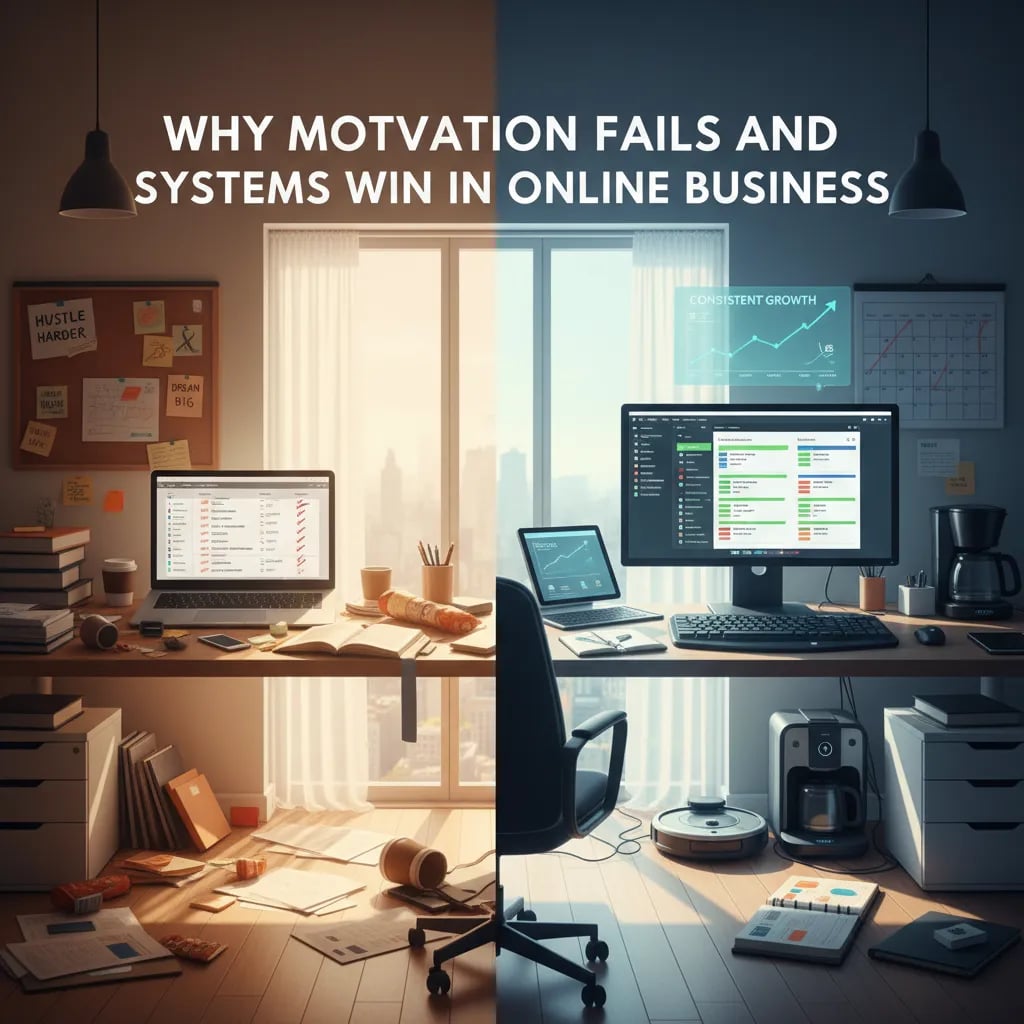


I used to believe motivation was the secret sauce to online business success—that sudden rush of energy could push me through any challenge. But one frosty morning, remembering my days in the military where discipline trumped feelings, I realized: motivation is fickle but systems are dependable. This post shares that revelation and shows how you can stop chasing fleeting emotions and start building steadfast systems that actually move your business forward.
The Motivation Mirage: Why It Often Lets You Down
I learned something harsh during my military service that changed everything about how I approach business. Every morning at 0500, that alarm went off whether I felt like getting up or not. Rain, shine, hungover, exhausted – it didn't matter. The system demanded action, and action happened.
Here's what I discovered: motivation is a terrible business partner.
The Daily Emotional Rollercoaster
Think about yesterday. How motivated did you feel when you woke up? Now think about last Tuesday. Different story, right? That's the problem with building your business on feelings – they change faster than the weather.
Motivation depends on emotional states that fluctuate daily. One day you're fired up, ready to conquer the world. The next day, you can barely answer emails. This emotional ping-pong game destroys consistency, and consistency is what separates successful online businesses from failed dreams.
I've watched countless entrepreneurs ride this motivation rollercoaster. They launch with massive energy, work eighteen-hour days for two weeks, then crash completely. They blame themselves for lacking willpower, but the real problem is the system they're using – or rather, the lack of one.
Why Motivation Versus Systems Creates a Losing Battle
Relying solely on motivation leads to inconsistent results and frequent burnout. When your business depends on "feeling it," you're essentially gambling with your income. Some days you win, most days you lose.
"Motivation is what gets you started. Habit is what keeps you going." – Jim Ryün
The military taught me something powerful: you don't wake up and feel like doing push-ups; you do them because it's the system. Nobody asked if I felt motivated to clean my weapon or follow protocol. The procedure existed, and we followed it. Period.
The Discipline Factor in Productivity in Business
Business should mimic military discipline with established procedures. When I transitioned to entrepreneurship, I initially fell into the motivation trap. I'd have incredible days followed by complete crashes. My income reflected this chaos – unpredictable and stressful.
Then I remembered those military routines. What if I treated my business tasks the same way I treated morning formation? What if motivation never entered the equation?
I started building simple systems:
Content creation happened every Tuesday at 9 AM, regardless of mood
Email responses followed a template and schedule
Social media posts went live automatically
Client calls happened at predetermined times
The transformation was immediate. My productivity in business skyrocketed not because I became more motivated, but because motivation became irrelevant. The work happened whether I felt like it or not.
Research confirms this approach: motivation is inflexible and often demoralizing, creating a failure state until goals are achieved. Every day you don't feel motivated becomes a day you've "failed," which only makes tomorrow harder.
Systems eliminate this emotional burden entirely. They create a process-oriented approach rather than emotional dependence, making success predictable instead of accidental.
What Are Systems and Why They Matter More Than Goals
I learned something powerful during my military service that changed how I think about business forever. In the Army, we didn't wake up asking if we felt motivated to complete our mission. We followed procedures. We executed systems. Business works the exact same way.
A system is simply a repeatable process that produces results without constant decision-making or daily willpower. Think of it as your business autopilot – once it's set, it runs whether you're having a good day or a terrible one.
"You do not rise to the level of your goals. You fall to the level of your systems." – James Clear
Creating Business Systems That Actually Work
The difference between goals and systems is profound. Goals focus on outcomes – "I want to make $10,000 this month." Systems focus on processes – "I will publish three valuable posts every week." Goals are destinations. Systems are the vehicle that gets you there.
Here's what scalable business systems look like in practice:
Automated content schedules that publish your posts without you remembering
Email follow-up sequences that nurture leads while you sleep
AI chat assistants that answer customer questions 24/7
Sales funnels that convert visitors into buyers automatically
Each of these removes decision fatigue from your daily routine. Instead of asking "What should I post today?" your system already knows. Instead of manually responding to every email, your sequences handle the heavy lifting.
Why Systems Are More Important Than Raw Motivation
Motivation is an emotion. Emotions change hourly. I've seen brilliant entrepreneurs burn out because they relied on feeling inspired every single day. That's exhausting and unsustainable.
Systems work differently. They generate ongoing momentum through daily processes, regardless of how you feel. When you wake up unmotivated (and you will), your systems still run. Your content still publishes. Your leads still get nurtured. Your business still moves forward.
This consistency creates something powerful: predictable results. Instead of random bursts of activity followed by weeks of nothing, you get steady progress that compounds over time.
The Compounding Effect of Continuous Improvement Systems
Here's where systems become truly powerful. Each day your system runs, it gets slightly better. Your content improves. Your email sequences get more effective. Your processes become more refined.
Goals don't compound – you either hit them or you don't. But systems compound daily. A simple content system that publishes three posts per week creates 156 pieces of content annually. That's 156 opportunities for people to find you, trust you, and buy from you.
"Systems are the invisible architecture behind every business that lasts."
The data backs this up completely. Businesses with documented systems see higher consistency in daily actions, reduced stress levels when manual processes get automated, and results that compound rather than plateau.
Most importantly, systems scale. Your motivation doesn't scale – there's only one of you. But a well-designed system can handle ten customers or ten thousand customers with minimal additional effort from you.

Building Your Own Systems: A Practical Starter Guide
When I first started my online business, I spent my mornings staring at endless to-do lists. Every task felt urgent. Every decision drained my energy. I was running on pure motivation, and frankly, it was exhausting.
That's when I learned the most valuable lesson from my military background: building effective systems beats relying on willpower every single time.
"Systems don't ask if you're motivated; they just get the job done."
Start Small: Automate One Simple Task Today
The beauty of systems isn't in their complexity—it's in their simplicity. I started by automating my most repetitive task: social media posting. Instead of manually sharing content three times a day, I scheduled everything on Sunday morning.
That single change freed up two hours daily. More importantly, it showed me how automation in business could transform my entire workflow.
Pick one task you do repeatedly. Maybe it's responding to customer inquiries, sending welcome emails, or posting product updates. Find a tool that can handle it automatically. Your future self will thank you.
Build Your Daily Habits System
James Clear said it perfectly:
"Big changes come from tiny consistent steps."
My daily habits system follows three simple rules:
Schedule one piece of content or marketing action every morning
Identify one manual step I can eliminate from my workflow
Set up one new automated process, no matter how small
This approach creates momentum. Small system improvements today genuinely yield big freedom later. I've seen it happen in my own business dozens of times.
Essential Tools for Stress-Free Productivity
You don't need expensive software to start. Here's what actually works:
AI Chat Assistants: Handle customer questions while you sleep. I use them for initial inquiries and frequently asked questions.
Email Automation: Set up welcome sequences and follow-up messages. Once configured, they nurture leads without your involvement.
Content Schedulers: Plan weeks of posts in advance. Consistency becomes effortless when it's automated.
Remove Manual Steps Systematically
Every week, I hunt for one manual process to eliminate. Last month, I automated my invoice creation. The month before, I set up automatic client onboarding emails.
Each small change compounds. What used to take me forty hours weekly now takes twenty-five. The freed time goes into growing my business, not managing it.
The military taught me that reliable systems beat good intentions every time. You don't wait for motivation to complete your mission. You follow the process, execute the steps, and achieve the objective.
Your business deserves the same disciplined approach. Start with one automated task today. Add another tomorrow. Within a month, you'll wonder how you ever operated without these systems supporting you.
Remember: implementing small system changes daily builds momentum that transforms your entire operation. The goal isn't perfection—it's progress through proven processes.
The Systems-First Mentality: Transforming How You Approach Business
I learned something crucial in the military that transformed how I approach business today. We never relied on feeling motivated to complete a mission. We followed procedures. We trusted systems. That's exactly what systems mindset entrepreneurship is about – shifting from emotional dependency to process mastery.
When I first started my online business, I chased inspiration like it was fuel. Some days I'd work sixteen hours straight, riding the wave of excitement. Other days, I couldn't even open my laptop. Sound familiar? That's the motivation trap most entrepreneurs fall into.
From Goals to Processes
Adopting a mindset that prioritizes processes over big goals shifts focus to consistent improvement. Instead of obsessing over hitting $10,000 months, I started focusing on completing daily tasks: publishing one piece of content, sending follow-up emails, optimizing one sales page element.
This shift changed everything. Systems for entrepreneurs aren't just tools – they're psychological anchors. When motivation dips (and it always does), systems keep you moving forward. I've automated my content schedule, set up email sequences, and created standard operating procedures for every aspect of my business.
"Success comes from daily habits more than occasional inspiration." – James Clear
The Real-World Impact
Here's what I discovered: entrepreneurs who focus on systems experience less burnout and more predictable income. Research shows that systems reduce stress and increase satisfaction by focusing on controllable actions. When you know exactly what to do each day, decision fatigue disappears.
My income became predictable once I stopped depending on creativity strikes and started following documented processes. Monday mornings no longer felt overwhelming because I had clear systems guiding my work. The emotional ups and downs smoothed out into steady progress.
Rally Your Team Around Systems
If you work with contractors or employees, this becomes even more powerful. Team systems improve predictability and collaboration by giving everyone the same playbook. I learned to rally your team around documented procedures rather than relying on individual talent alone.
"Great teams are built on repeatable systems, not just passionate individuals."
Aligning your team around documented procedures amplifies efficiency and collaboration. When someone knows exactly how to handle customer inquiries or process orders, quality stays consistent regardless of who's working that day.
Building Your Systems Foundation
Productivity for entrepreneurs starts with identifying repetitive tasks and systematizing them. I began with simple automation: scheduling social media posts, setting up email autoresponders, creating templates for common responses.
Each system I built created mental space for higher-level thinking. Instead of constantly making small decisions, I could focus on strategy and growth. The compound effect surprised me – small systems today really do create big freedom later.
The systems-first mentality doesn't eliminate passion or creativity. It protects them. When the operational side runs smoothly, you have energy left for innovation and strategic thinking. That's how sustainable online businesses are built.
Wild Cards: A Thought Experiment and Military Analogies To Drive It Home
Close your eyes and imagine this. You wake up tomorrow morning, and there's no emotional check-in. No "Do I feel motivated today?" No internal debate about whether you have enough energy to tackle your business. Instead, you simply execute a clear, predetermined process.
This isn't fantasy. This is exactly how systems versus goals thinking transforms your entire approach to online business.
The Military Mindset: Mission Always Executes
During my time in the military, I never saw a mission canceled because someone "wasn't feeling it." The objective was clear. The process was defined. The execution was non-negotiable.
Rain or shine, tired or energized, motivated or dragging—the mission moved forward. Not because we were superhuman, but because we followed systems.
Your business deserves the same discipline. When you adopt a systems first mentality, you remove emotion from the equation entirely. Your content gets published whether you feel creative or not. Your emails get sent whether you feel confident or not. Your sales processes run whether you feel optimistic or not.
"Discipline is choosing between what you want now and what you want most." – Abraham Lincoln
The Machine Analogy That Changes Everything
Think of your business as a complex, beautiful machine. Most entrepreneurs try to run this machine on fuel—bursts of motivation, excitement about new ideas, or temporary energy surges from inspirational content.
But here's the problem: fuel burns out. It's consumed quickly and needs constant refilling.
Systems, however, work like oil in that machine. They reduce friction between all the moving parts. They keep everything running smoothly for months, even years, without constant attention. While motivation versus systems might seem like a philosophical debate, it's actually about choosing sustainable operation over temporary bursts.
The Real Wild Card Revelation
The wildest part isn't that systems work better than motivation. It's how they compound over time in ways motivation never could.
When you rely on motivation, you're starting from zero every single day. When you build systems, each day builds on the previous one. Your automated content schedule creates consistent audience growth. Your email sequences nurture leads while you sleep. Your sales funnels convert prospects without you being present.
As someone once told me, "Motivation gets you started; systems keep you going." But I'd take it further—systems don't just keep you going, they multiply your efforts exponentially.
Your New Operating System
Stop asking yourself if you feel ready to work on your business today. Instead, ask what system you can implement that will work regardless of how you feel tomorrow.
Because here's the truth every successful online entrepreneur discovers: the moment you stop needing to feel motivated is the moment your business starts feeling inevitable.
That's when you've truly moved from hoping for success to systematically creating it.
