


I used to wait for the surge: the YouTube pep talk, the 3 a.m ‘this is it’ feeling. Then I noticed a pattern — my best weeks came when I followed routines I didn't have to think about. As a veteran, structure was my default in service. Why would entrepreneurship be any different? This post is me translating military discipline into an online-business playbook: no hype, no viral-lottery thinking — just repeatable systems that turn effort into predictable income.
1) The Motivation Myth (why 'feelings' fail me and you)
Motivation vs systems: the trap I keep falling into
I remember the week after a rousing webinar. I was fired up. I posted every day, sent messages, and told myself, “This is it. This is my year.” Then Friday hit. The energy was gone. The posting stopped. The “plan” turned into silence.
That’s the motivation myth: it feels like fuel, but it burns fast. In my experience, motivation spikes last hours to days, not weeks. That’s why overcoming motivation challenges isn’t about finding better hype—it’s about building something that works when you feel nothing.
Motivation is weather, not a supply line
Motivation is like weather. Some days it’s sunny and everything feels easy. Other days it’s cold, heavy, and you don’t want to move. If your business depends on “good weather,” you’ll stall the moment life gets real.
And I know what triggers me: YouTube videos, breakthrough calls, and those big internal speeches. They create intensity, but they rarely create habits.
Maj. John Michaels (Ret.), Small Business Consultant: "Discipline outperforms enthusiasm when it comes to growth."
Why veterans misunderstand entrepreneurship when motivation is the plan
In the military, we didn’t wait to feel ready. We relied on structure. That’s why systems for veterans are not a weakness—they’re our advantage. But when I treated entrepreneurship like a motivation game, I kept resetting to zero.
My quick antidote: a 3-item nightly checklist
I replaced hype with a simple system I could follow even on low-energy days:
Write tomorrow’s one post topic
List 3 people to start conversations with
Pick 1 task that moves leads forward
Actionable takeaway: assume motivation will drop. Design around that inevitability with motivation vs systems thinking—3–5 non-negotiable actions that run whether you feel inspired or not.
2) Military Principles Applied to Entrepreneurship
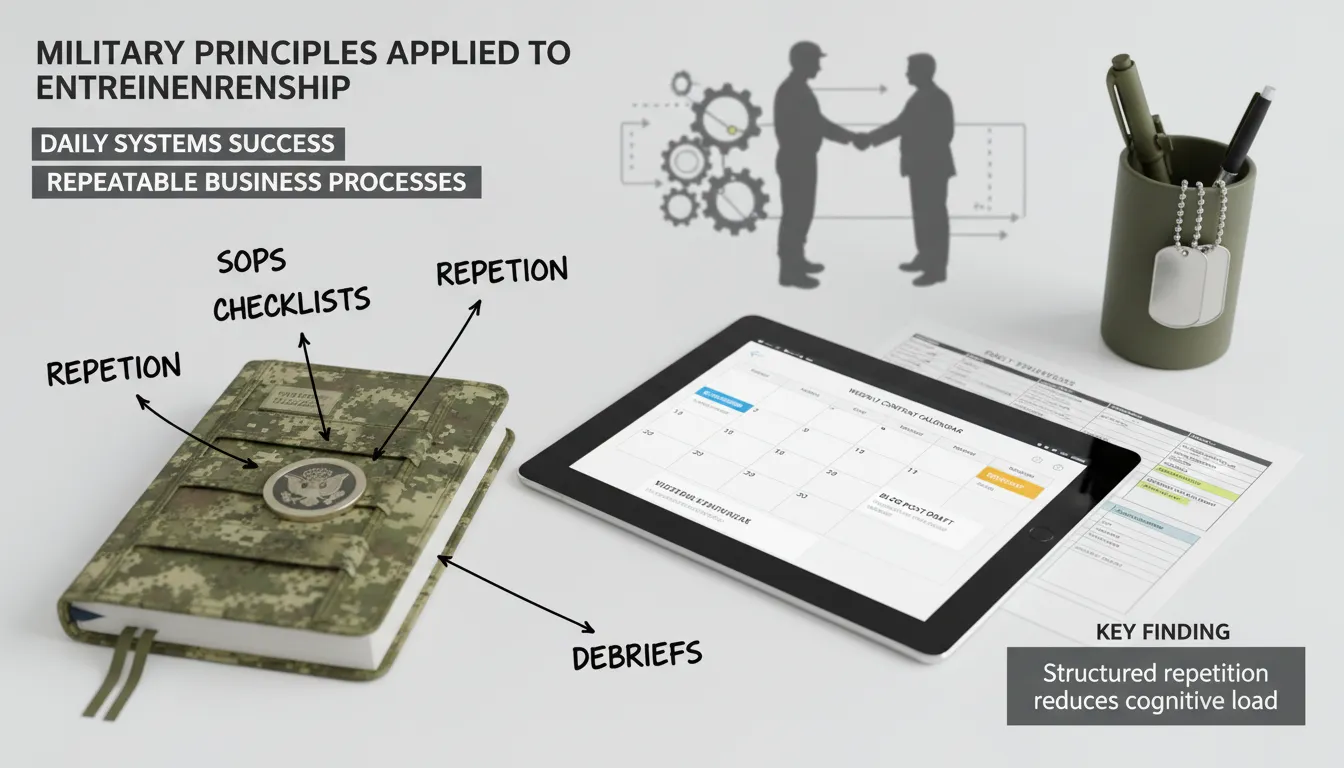
When I started building an online business, I made a rookie mistake: I left my SOP mindset at the gate. In service, we didn’t rely on “feeling ready.” We relied on SOPs, checklists, repetition, and debriefs—the toolkit that made complex operations simple. Those same military principles entrepreneurship runs on are exactly what most veterans need in business.
Use SOPs and Checklists to Reduce Mental Load
Military practices translate directly to repeatable business processes. Structured repetition reduces cognitive load and improves output consistency. That’s why systems for veterans work so well: you stop deciding and start executing.
I once adapted a pre-deployment checklist into a weekly content calendar. Same idea, different mission: instead of “gear, comms, route,” it became “topic, hook, CTA, post, follow-up.” The analogy stuck because it’s true.
Debriefs = Customer Feedback Loops
After-action reviews map perfectly to product and marketing feedback. Every week, I ask: What worked? What failed? What do I change next run? That’s how you build daily systems success without needing hype.
Jill Taylor, Founder & Veteran Coach: "The best entrepreneurs I've seen are those who treat business like a series of small, well-executed missions."
Example: A 7-Day Campaign SOP
A campaign SOP turns one idea into a 7-day content sequence. Here’s the structure I use:
Trigger: new offer, new lead magnet, or low leads
Sequence: Day 1 problem, Day 2 story, Day 3 tip, Day 4 proof, Day 5 objection, Day 6 CTA, Day 7 recap
Responsible: me (or assign to a VA later)
Cadence: post daily, reply to comments within 24 hours
Action This Week
Draft one SOP for a repeatable 30-minute marketing task (posting, DM outreach, or lead tracking). Keep it simple, then run it 3 times. That’s how missions become momentum.

3) The 3-Part System Framework I Use
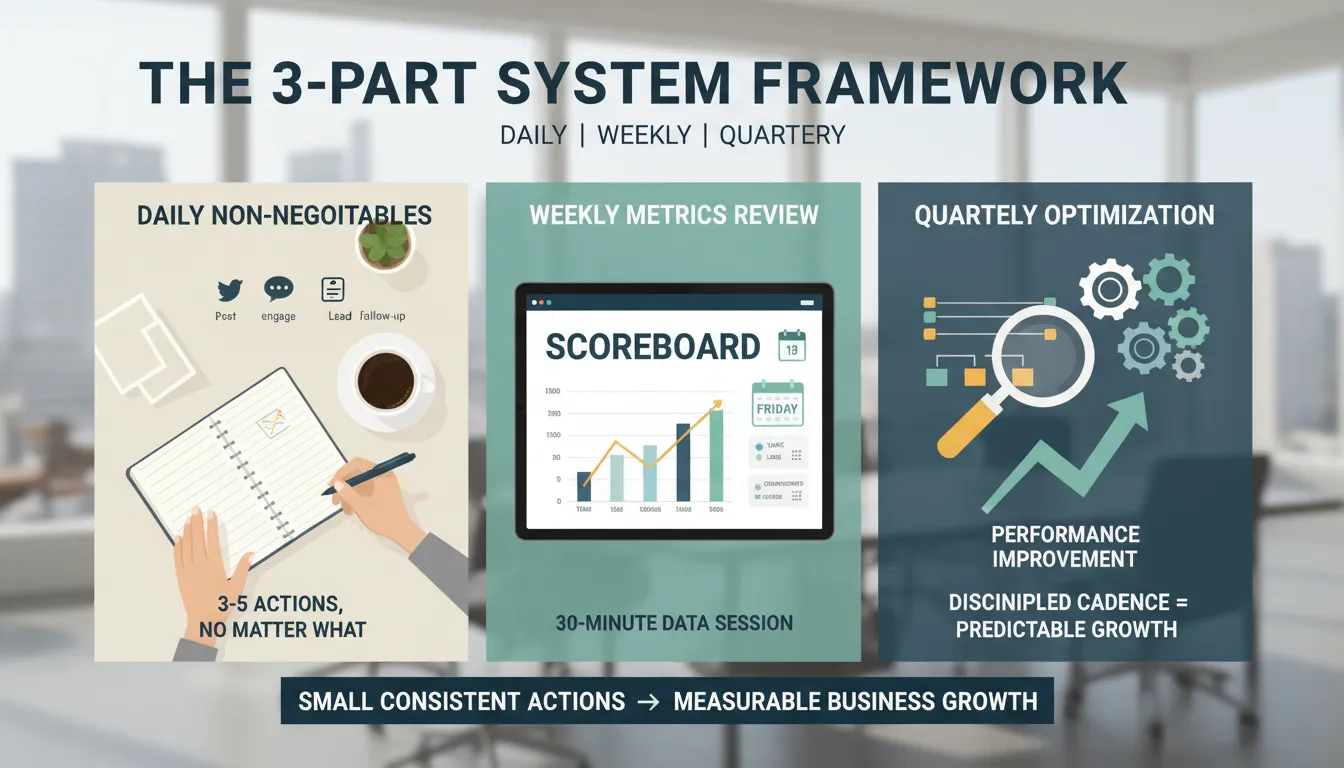
I stopped trying to “get motivated” and built a 3 part system framework I can run on autopilot. It’s simple: Daily Non-Negotiables, a weekly metrics review, and Quarterly Optimization. That daily/weekly/quarterly cadence is what creates steady performance gains—because small actions, done consistently, compound into real growth.
1) Daily Non-Negotiables (3–5 actions)
These are the moves I complete no matter what. Not big projects—just reps.
Post one piece of content (short, clear, helpful)
Engage with 10–20 people (comments + DMs)
Follow up with 3–5 leads
Build one asset (email, offer, or simple landing page)
Tools: a checklist in Notes/Trello + a 25-minute timer.
2) Weekly Metrics Review (Friday, 30 minutes)
Every Friday I run a scoreboard session. No emotions—just numbers: traffic, leads, conversions. This is where I catch problems early and keep my predictable income systems on track.
My 7-item weekly review checklist:
Traffic by channel
Leads captured
Calls booked / replies
Conversions (sales)
Content posted (count)
Top post + why it worked
One fix for next week
3) Quarterly Optimization (every 90 days)
This is where my quarterly optimization strategies live: double down on what’s working, cut what isn’t, and tighten the process. I treat it like a 90-day improvement cycle.
90-Day Worksheet | Fill In |
|---|---|
Keep | ___ |
Kill | ___ |
Improve | ___ |
One focus metric | ___ |
Sandra Ruiz, CEO of VetGrowth: "Routine checks and quarterly pivots are what separate surviving from scaling."
This framework keeps me out of the viral lottery mindset. I don’t need hype—I need a system I can execute.
4) Building Systems for Online Business (practical setups)
When I’m building online business momentum, I don’t “get inspired.” I run my systems. Small, consistent time investments multiply when they’re tied to a system—so I keep mine light: 10–30 minutes daily.
Daily posting system (daily systems success)
My lightweight content pipeline is simple: I schedule 3 posts + 1 conversation starter every day. I batch ideas once, then let the schedule carry me.
Post 1: lesson learned
Post 2: quick tip + example
Post 3: proof (result, screenshot, story)
Starter: one question that invites replies
Conversation system (DMs → leads)
Lead nurturing converts when follow-up is systematic, not hopeful. I capture every DM/comment and use one script:
“Appreciate you. What are you trying to achieve right now?”
“If I sent a 2-minute checklist, would you use it?”
“Cool—want me to hold you accountable this week?”
Lead tracking systems (my accountability ledger)
Every night, I update a minimal CRM—no drama, no guessing. This “ledger” replaced wishful thinking.
Name + handle
Pain point
Last contact date
Next step (follow-up date)
Review system (weekly scoreboard + micro-debrief)
Metric | Target | Actual |
|---|---|---|
Posts | 28 | __ |
Convos started | 7 | __ |
Leads added | 10 | __ |
Sales calls/offers | 3 | __ |
After each launch, I do a 10-minute debrief: What worked? What broke? What gets repeated?
Tools (optional, simple wins)
I use Notion for SOPs, Airtable for leads, and Buffer for scheduling—because simple is better.
Ethan Brooks, Digital Strategist & Marine Veteran: “My rule: if it can be done in under 30 minutes daily, I'll do it every day.”
Case study: I had an offer that stalled. I didn’t rewrite it—I fixed follow-up cadence: Day 0, 2, 5, 9. Same message, cleaner tracking. It became a slow-but-steady seller.
5) Weekly Metrics Review — My Honest Scoreboard
Every Friday, I block one hour for a weekly metrics review. Same time, same place—right after my last coffee and before I shut the laptop for the weekend. That ritual matters, because weekly reviews pull me back to the numbers that actually touch revenue. They also give me one clear lesson learned, not a pile of feelings.
What I Track (No Fluff)
I don’t guess. I use lead tracking systems so I can see the full path: attention → conversations → calls → offers.
Website visitors (traffic)
Email signups (leads)
DMs turned into calls (sales activity)
Offer conversion rate (calls → buyers)
My 6-Row Scoreboard (Template + Sample)
Row | This Week |
|---|---|
Visitors | 1,240 |
Leads | 38 |
Conversion Rate | 12% |
Offer Revenue | $1,800 |
Cost | $120 |
Next Test | New CTA on landing page |
My Confession: I Chased Vanity Metrics
Early on, I obsessed over likes, views, and “reach.” It felt productive, but it didn’t pay bills. The weekly review forced me to face reality: conversions beat clout. Now I make one small, testable change each week—headline, CTA, follow-up script, or offer wording—because regular measurement creates steady improvements.
Karen Nguyen, SBA Advisor: "A weekly review turns assumptions into evidence — then into better decisions."
Even events like VETS26 (June 1–4, 2026) go on the board: contacts made, follow-ups sent, calls booked. This is why a weekly metrics review is non-negotiable for predictable income systems.
6) Quarterly Optimization: What to Double, What to Dump
Every 90 days, I run what I call a force-multipliers review. I’m not asking, “What do I feel like doing next?” I’m asking, “What produced the best ROI, and what quietly drained my time?” This is one of my most reliable quarterly optimization strategies because it turns scattered effort into clear priorities.
I pull the numbers from my weekly reviews inside the 3 part system framework—traffic, leads, conversions—and I follow one rule: pick 2 experiments to scale and 1 to kill. Time-boxed optimization forces deliberate scaling and pruning. It keeps me from “kind of” improving everything and actually improving something.
Dr. Lisa Harper, Business Psychologist: "Structured, time-boxed experiments remove ego from business decisions."
My 90-Day Test Template
I design each test like a mission: clear intent, clear measure, clear decision.
Hypothesis: If I do X, then Y will improve because Z.
Metric: The one number I will track weekly.
Minimum Detectable Effect: The smallest win that matters (ex: +20% leads).
Decision Rule: After 90 days, if metric hits target → scale. If not → kill or revise.
An Honest “Dump” Example
I once kept a low-priced “quick audit” offer alive because it sounded helpful. But it was slippery: lots of questions, lots of custom work, almost no conversions into bigger packages. At the 90-day mark, the data made it obvious—kill it. That freed time to focus on a higher-margin service with a tighter scope, and my calendar got cleaner fast.
Why Quarterly Cycles Work for Veterans
Weekly tweaks are like checking your gear. Quarterly reviews are the after-action loop—long enough to see patterns, short enough to stay sharp. That cadence is how I build predictable income systems.
Action Step
Schedule your next 90-day optimization meeting now. Invite a trusted peer and have them challenge your “pet projects.” Discipline means pulling the plug on what isn’t working.
7) Contracting, Certifications, and Events (leveraging external ecosystems)
I used to think conferences were “nice to have.” Then I realized events and certifications can be systemized lead sources—but only when I tracked them like any other channel. Procurement is measurable. If you treat it like a mission, you can turn procurement opportunities veterans hear about into real contract opportunities veterans can win.
Certifications that open doors (NVBDC + SDVOSB/VOSB)
Supplier diversity teams and federal buyers need proof. That’s why NVBDC certification and service disabled veteran set-asides like SDVOSB/VOSB matter. They don’t replace performance—but they get you into the right rooms and databases faster. NVBDC is also tied to corporate sourcing, and nvbdc hits road in 2026 to connect veteran-owned firms to a $122 billion procurement marketplace.
Angela Ruiz, Director of Veteran Outreach, NVBDC: "Certification and consistent follow-up unlock doors in procurement that luck never will."
Events I track like a pipeline (not a pep rally)
VETS26 Conference (June 1–4, 2026): 60+ training sessions, 200+ exhibitors—plan sessions that match your next 90 days.
VHA virtual (July 23, 2026): SDVOSB & VOSB contracting insights.
SBA FY2026 veteran sessions: practical steps for federal contracting.
Veteran Business Battle (Houston, 2026): pitch reps + partner leads.
Veteran Business Summit (May 9, 2024): innovation panels and networking I still mine for contacts.
My SOP: event-to-CRM follow-up (90 days)
Log every contact in CRM within 24 hours (event, need, next step).
Run a 60–90 day nurture sequence and track replies, meetings, and bids.
Pre-write this 3-message SOP:
Day 2: Great meeting you—here’s my capability statement + 1 relevant past win.
Day 14: Quick check-in—who owns vendor onboarding for this category?
Day 60: Sharing a short update + asking for a 15-min fit call.
I track ROI per event: leads → meetings → proposals → awards. That’s how ecosystems become systems.
8) Wild Cards: Analogies, Hypotheticals, and a Short Manifesto
Motivation vs systems: convoy vs fuel
I think about motivation vs systems like this: motivation is fuel. Systems are the convoy. Fuel matters, sure—but a full tank doesn’t help if you don’t have vehicles staged, routes planned, comms checked, and a pace set. The convoy is what gets you to the objective when the weather turns and your feelings don’t show up.
“Systems are the muscle memory of business; build them and you stop having to try so hard.” — Tom Delgado, Veteran Small Business Advocate
Hypothetical: could a VOSB double wins in 12 months?
Let’s run a back-of-envelope plan for veteran owned businesses using my 3-part framework. Not hype—just math and military principles entrepreneurship can respect.
Daily Non-Negotiables (15–45 min): 1 outreach message, 1 follow-up, 1 capability proof (past performance snippet, short case study, or one-page).
Weekly Metrics Review (30 min): track touches, replies, calls booked, bids submitted, awards.
Quarterly Optimization: cut what’s not converting; double down on agencies/prime partners that reply.
If you go from 2 bids/month to 4 bids/month by tightening your pipeline, you don’t need a miracle. Over 12 months, that’s 24 more shots on goal. Even a small lift in win rate can change your year.
Playful tangent: a “mission brief” for a product launch
Commander’s Intent: ship offer, collect leads, learn fast.
Primary Objective: 10 sales calls in 14 days.
Rules of Engagement: post daily, follow up twice, debrief every Friday.
My short manifesto (steal this)
I automate the predictable, I optimize the variable.
Feelings are optional. Checklists aren’t.
30-day challenge
Pick one non-negotiable and commit for 30 days. Post it in the comments and report back—did the system carry you when motivation didn’t?
9) Conclusion & Call to Action
I used to think I needed more drive. If I could just stay fired up, my content would hit, my offers would sell, and my building online business journey would finally “take off.” But that was me gambling on virality. When I stopped chasing motivation and started building systems for veterans, everything got calmer—and more consistent. Systems create predictable outcomes when you apply them the same way, over and over. That’s how predictable income systems are built.
The 3-Part Play I’m Committed To
I’m sticking to the same three moves: daily non-negotiables, a weekly metrics review, and quarterly optimization. Daily actions keep me in motion even when I’m tired. Weekly numbers keep me honest. Quarterly tweaks keep me improving instead of restarting. That’s the difference between “trying” and operating.
Michael Sanders, Former Navy Officer and Entrepreneur: “Consistency is the quiet compounder of business success.”
Your Next Steps (This Week, This Friday, 30 Days)
Here’s my challenge: draft one SOP this week. Keep it simple—one page, plain language, repeatable steps. Then schedule your first metrics review for this upcoming Friday. Put it on your calendar like a formation time. Finally, send me a progress note in 30 days or drop one daily non-negotiable in the comments. Low friction. High accountability.
Use Events and Certifications as Part of the System
If you’re going to VETS26 or catching the NVBDC road tour, don’t treat it like inspiration. Treat it like workflow. Plan who you’ll meet, what you’ll follow up on, and how it feeds your lead tracking and outreach system. Events and certifications amplify systems when they’re integrated, not when they’re random.
Structure doesn’t kill creativity—it makes your creativity accountable. That’s military discipline turned into entrepreneurial results.
