
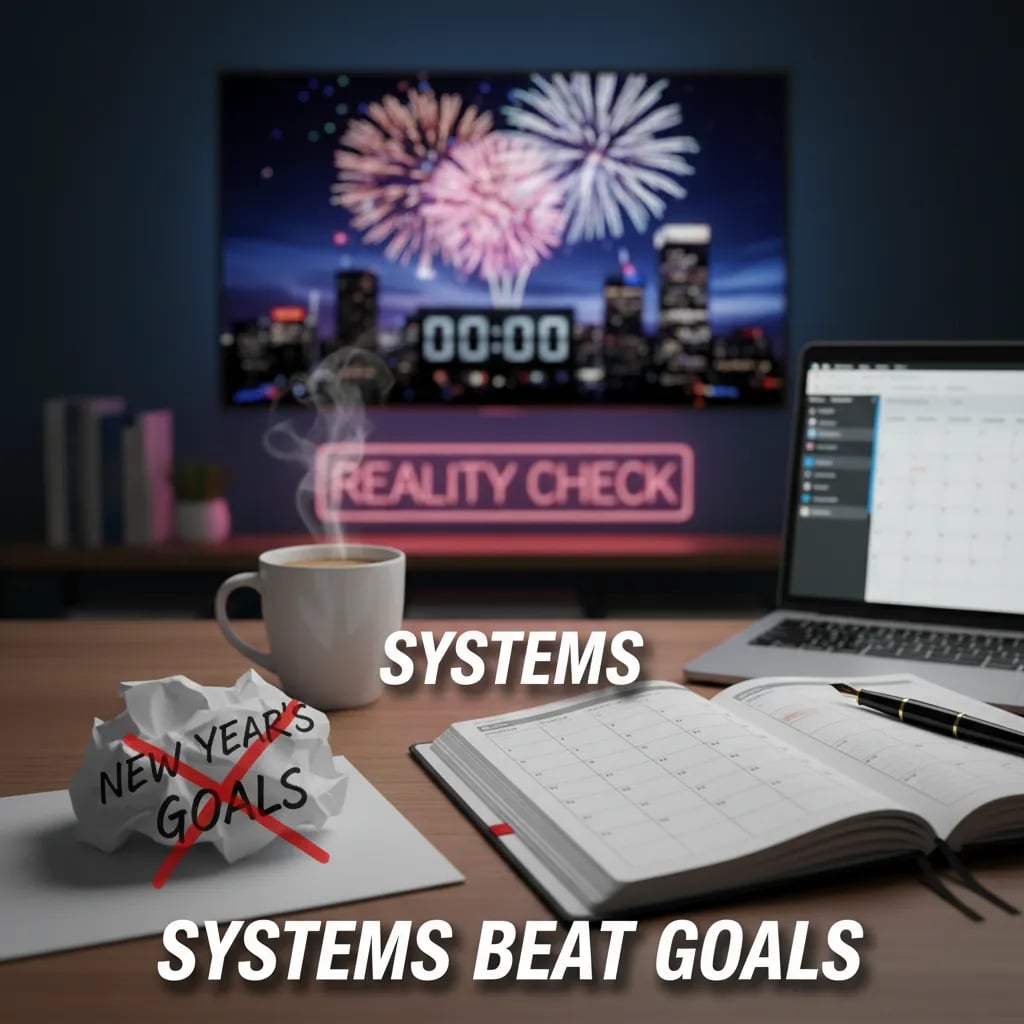



I used to be the person who bought a planner on December 31 and promised myself a different life. This year I traded fireworks for a checklist and found the truth: the loud promise on New Year's Eve rarely survives the second Friday of January. Over coffee I sketched a 'system' that replaced my resolutions, and it stuck. I'm telling you that story here — because systems quietly do the work motivation never will.
Why Motivation Fails Every January
New Year’s resolutions run on emotion—and emotion expires
Every Dec 31, I feel it too: the clean-slate rush. I write big New Year’s resolutions like they’re contracts with my future self. The problem is the fuel source. Motivation is emotional, and emotions fluctuate. One great night, one inspiring video, one “this time I mean it” speech—and then real life shows up on Jan 3 with bad sleep, work stress, and a fridge full of leftovers.
That’s when motivation wanes. Not because I’m broken, but because motivation was never built to last.
My two-week gym guilt spiral (and the January gym surge)
I learned this the hard way with the most common resolution category: health. I joined the gym in early January, right on cue with the yearly gym surge. The first week felt heroic. By week two, I was bargaining with myself: “I’ll go tomorrow.” Then tomorrow became next week. Soon I wasn’t building a habit—I was collecting guilt.
That pattern has a name for a reason. The second Friday in January is often called Quitter’s Day, because so many people hit the wall at the same time.
Resolution statistics explain the early abandonment
When I finally looked at the resolution statistics, it stopped feeling personal and started feeling predictable:
23% quit in the first week.
43% quit by the end of January.
Average resolution lifespan: 3.74 months.
Only about 6% last beyond a year (Forbes-like polling).
Some reports suggest 80%88% fail early (Baylor College of Medicine).
That’s not a character flaw. That’s motivation-based failure at scale.
Dr. Michael Evans, Baylor College of Medicine: "Motivation is a spark, not a furnace — it ignites action briefly but won't heat habits over months."
You don’t rise to your goals; you fall to your systems
Here’s what finally clicked for me: You don’t rise to your goals. You fall to your systems. When I relied on willpower, I hit Quitter’s Day without mercy. When I had no plan for busy days, low-energy days, or “I don’t feel like it” days, my progress collapsed right on schedule.
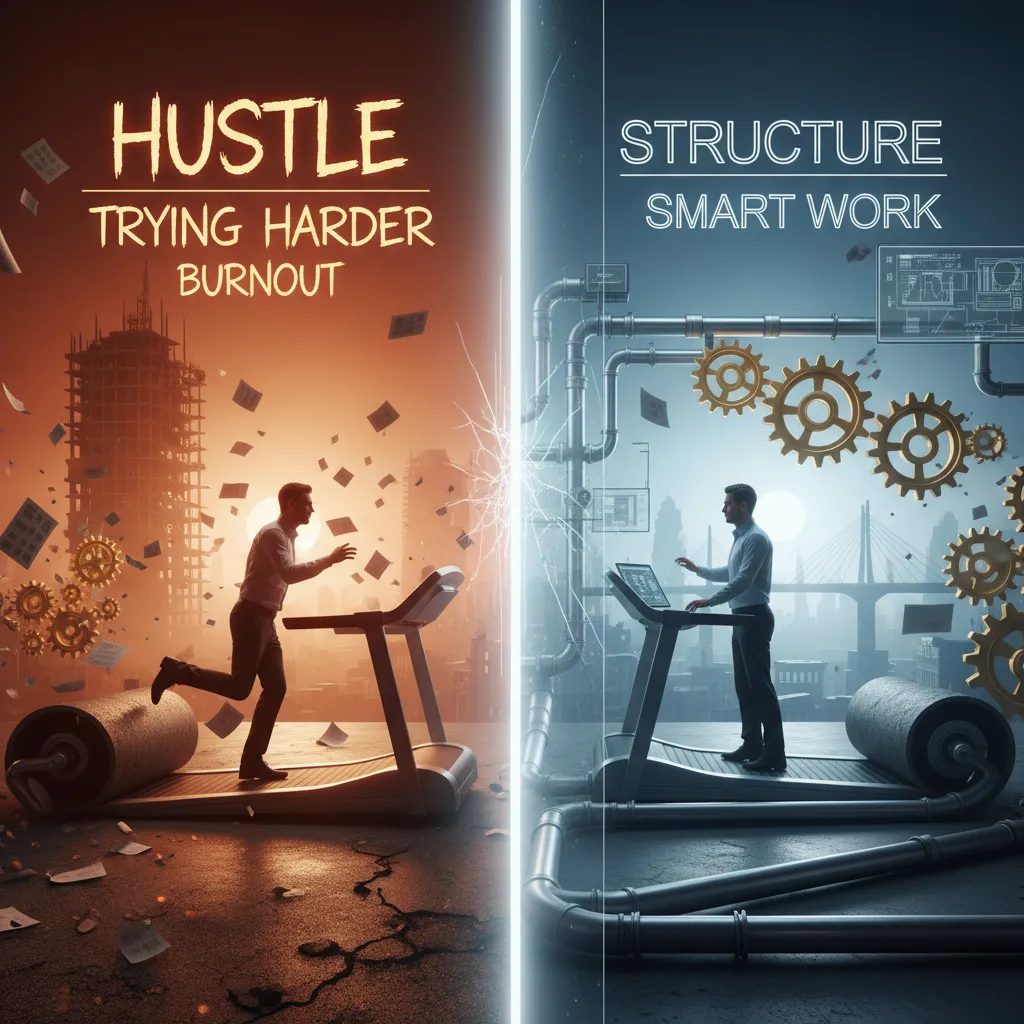
Hustle vs Structure: Why 'Trying Harder' Burns Out
I used to think goal success was a volume game: more effort, more intensity, more “no excuses.” So every January, I’d chase action-oriented goals like a personal dare. I remember sprinting through two-week eating cleans that felt heroic… until life got busy. One late meeting, one stressful weekend, one birthday dinner, and the whole thing collapsed. Hustle didn’t fail because I was weak. Hustle failed because it was built on urgency, not design.
Hustle Reacts to Pressure (and It’s Expensive)
Hustle is fireworks: bright, loud, and gone fast. It reacts to whatever feels urgent today—guilt, inspiration, panic, a before-and-after photo. The problem is that urgency demands constant choices: “Should I work out now?” “What can I eat?” “Do I have time?” Research backs this up: structure lowers decision fatigue, and when decision fatigue rises, adherence drops. Hustle makes you decide all day long, then blames you when you’re tired at night.
Structure Repeats (and Protects Long-Term Success)
Structure is a slow-burn candle. It repeats even when I’m not in the mood. Instead of a massive reset, I build a small ritual that can survive real life. That’s how health improvement actually sticks—especially when so many resolutions (often cited around 79%) aim at health.
10-minute walk after lunch
15-minute draft before checking messages
Same grocery list every week
These aren’t dramatic. They’re repeatable. And designing repeatable actions (not one-off pushes) lines up with what we know about habit formation: the brain learns patterns, not promises.
Dr. Sarah Thompson, behavioral scientist: "Structure turns friction into form. You make less decision-making energy available and more automatic wins."
Sprinting vs Installing a Treadmill
I think of hustle as sprinting until my lungs burn. Systems are like installing an efficient treadmill in my house: the barrier is lower, the routine is easier to start, and the effort is spread out. That’s where long-term success comes from.
One more thing I learned: action-oriented goals (what you’ll do) tend to beat avoidance goals (what you’ll stop). “Walk 10 minutes” gives me a clear next step. “Stop being unhealthy” just gives me shame and confusion.
The Annual Restart Trap: Why We Rebuild Motivation, Not Infrastructure
Resolution failure starts with a leaky roof
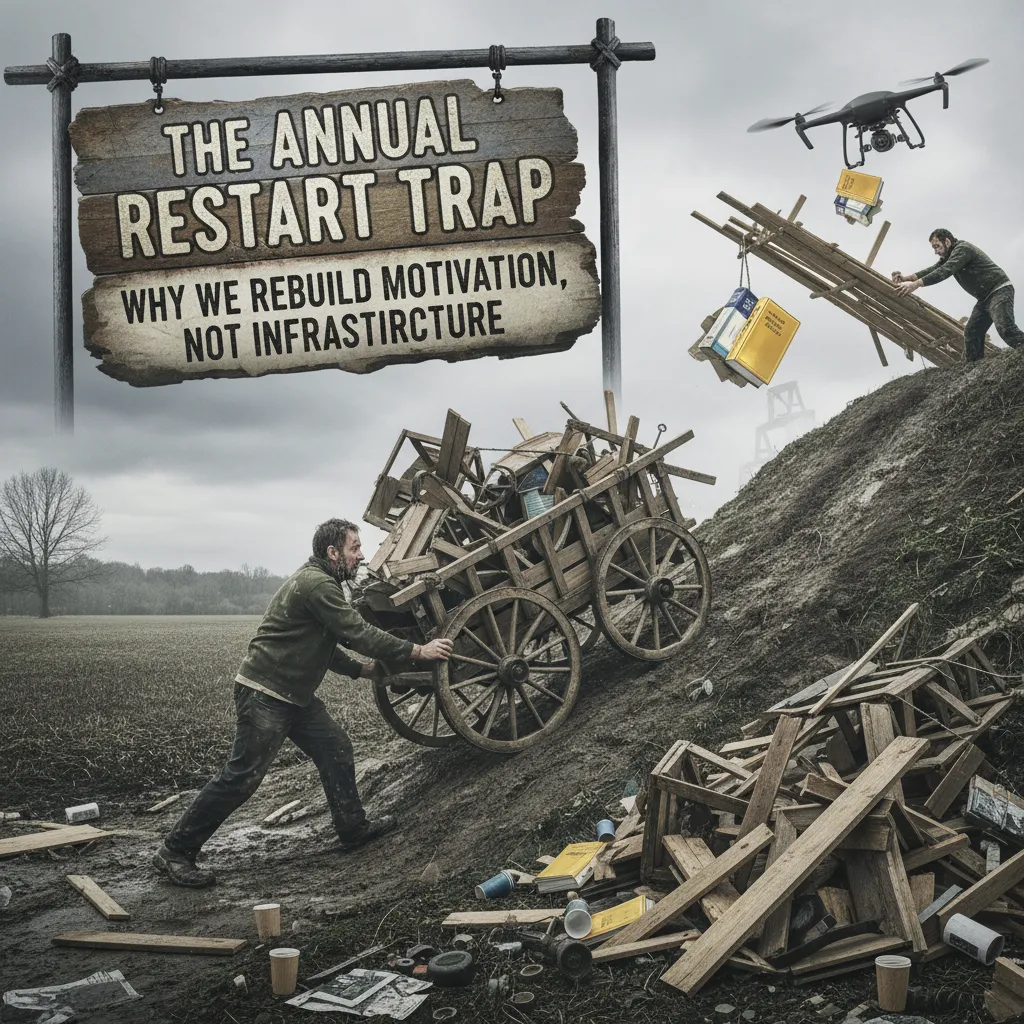
Every January, I watch the same movie play out. New planner. New app. New “30-day challenge.” It feels like progress, but it’s mostly lipstick on a leaky roof. We rebuild motivation instead of investing in the boring infrastructure that holds behavior up when life gets loud.
The resolution statistics tell on us. In 2024, about 3 in 10 Americans made resolutions, and 62% said they felt pressured. That pressure shows up in my feed every year: “Join me,” “Start fresh,” “Don’t fall behind.” Social energy is a spark, not a power grid.
Goal abandonment and the myth of “this time I’ll just try harder”
I used to swap programs like I was changing outfits. One month: keto. Next month: running plan. Then a viral morning routine with six supplements and a 5 a.m. alarm. I wasn’t building a life. I was collecting tactics.
When I finally tracked my habits, the pattern was obvious: novelty made me feel motivated, but continuity made me consistent. My goal abandonment wasn’t a character flaw. It was a system problem.
Quitter’s Day is predictable (and preventable)
There’s a reason people talk about Quitter’s Day—that point in January when the hype fades and real life wins. Some surveys say only 25% stick with resolutions after 30 days, and just 9% keep them all year. That’s not because everyone is lazy. It’s because most goals are built on emotion, not structure.
Karen Li, behavior change coach: "People confuse activity for progress — a filled calendar isn't the same as an installed system."
Why younger adults get hit hardest by trend-chasing
I notice it most with ages 18–24, who skew toward fitness goals. Fitness doesn’t reward hype; it rewards repeatable reps. Meanwhile, ages 25–44 often aim at finances—another area where automation beats inspiration.
Instead of chasing content, I now ask: What infrastructure makes the next action easy?
Remove friction: gym clothes laid out, groceries planned, auto-transfers scheduled
Lower the bar: “10 minutes counts” so I don’t need perfect conditions
Repeat the same cue: same time, same trigger, same first step
What Actually Works: Install Simple, Boring Systems
On New Year’s Eve, I used to write big goals like they were magic spells. Then January hit, and my energy dipped. That’s when I learned the hard truth: long-term success doesn’t come from a perfect plan—it comes from a boring one you repeat.
Research and polling trends back this up: action-oriented, consistent systems beat “avoidance goals” (like “stop eating junk”) because they tell you what to do today. And since health improvement dominates resolution season—about 79% of resolutions lean that way—simple daily practices matter more than hype. Among ages 18–24, 53% say they want to exercise more, yet only about 9% keep resolutions all year. Motivation isn’t the missing piece. Infrastructure is.
My “fitness resolutions” system (small commitments that scale)
When I want real health improvement, I don’t chase a perfect routine. I install a minimum system I can do on a bad day:
10-minute morning mobility (timer on, no debate)
3 strength sessions/week (simple full-body template)
Weekly meal playbook (same breakfast, 2 lunch options, 3 dinners)
That’s it. Not sexy. But it keeps me moving even when life gets loud.
The three boring business systems I actually use
I run versions of these every week because they don’t rely on inspiration:
Content system: publish 1 micro-post weekly (one idea, one takeaway, one CTA)
Traffic system: track one channel consistently (search, YouTube, or LinkedIn—pick one)
Follow-up system: automate email nudges so leads don’t vanish when I get busy
James Rivera, small-business owner: "My traffic system doubled leads in six months because I showed up the same way every week — not because I chased the next hack."
Simple accountability methods that keep systems alive
Most people don’t need more willpower—they need a loop. Planner use is around 35% among people who keep resolutions, and I get why. I keep it basic:
Weekly check-in (10 minutes, same day)
One-page tracker (yes/no boxes)
Trusted friend for a quick screenshot of progress
Your Real New Year Reset: Install One System and Let Time Do the Work
Every year I watch the same pattern play out with New Year’s resolutions. The promises are big, the plans are messy, and the calendar flips to mid-January like a trap door. That’s why “Quitter’s Day” isn’t shocking to me anymore—it’s predictable. The numbers back it up: about 23% quit by the end of the first week, 43% quit by the end of January, and only around 6% last beyond a year. Goals aren’t the issue. The lack of a system is.
My One-System Reset (and Why It Finally Worked)
This is the part where I stopped chasing action-oriented goals like “write a book” or “post every day” and did something almost boring. I installed one system: a 10-minute daily writing ritual. Same time. Same place. No pressure to be brilliant. Just show up and type.
By month three, my output didn’t just improve—it became normal. I wasn’t “motivated.” I was scheduled. And that matters, because single-system focus reduces decision fatigue. When I only had one small rule to follow, I didn’t waste energy negotiating with myself every morning.
Dr. Michael Evans, Baylor College of Medicine: "One consistent, small routine reduces the cognitive load that usually hijacks resolutions by mid-January."
Imagine a Quitter’s Day Potluck Instead
Here’s my wild card thought: imagine a Quitter’s Day potluck where nobody brings a resolution. They bring one tiny system. Someone shows up with “walk for five minutes after lunch.” Another brings “prep tomorrow’s breakfast before bed.” It would be weirdly practical—and way less shameful—because systems don’t require a personality transplant. They just require a repeat.
Do This This Week
Choose one small system, make it tiny enough to win on your worst day, schedule it, and protect it like an appointment. That’s the real reset. Time compounds small behaviors into measurable results when the system stays consistent. Forget ten resolutions. Install one system—and let time do the heavy lifting.
