

I’ll be honest: the first time I thought about starting an online business, I froze. It’s strange—after years of facing down grueling field exercises and 3 a.m. wakeups with nothing but a stale cup of coffee, suddenly setting up a simple website felt impossibly daunting. Maybe you’ve felt it too—a weird kind of stage fright, except instead of a rifle, you’re armed with 'best small business ideas' from YouTube. But here’s the real twist: most veterans aren’t missing grit; we’re just sometimes over-complicating what really should be simple. In this post, I’ll share how I shook off my own ‘analysis paralysis’ and the messy, very human path I took to finding security (and a bit of sanity) with an AI-powered side hustle.
Why Military Discipline Feels Useless in Civilian Life (But isn’t)
My first month out of the Army, I was more lost than a butter bar without a map. I’d spent years running on orders, moving from one mission to the next, always with a clear chain of command. Suddenly, in civilian life, that structure vanished. I thought my military discipline would make me unstoppable, but instead, I found myself overcomplicating every decision, waiting for the “right” moment to act, and second-guessing every step. The truth is, military training conditions us to face chaos head-on, but it also wires us to expect complexity and wait for orders—two habits that can stall veteran entrepreneurship in its tracks.
In the military, we’re taught to plan for every contingency, to rehearse until muscle memory takes over. That’s great when you’re prepping for a field op, but when it comes to launching a side hustle or starting an online business, it can backfire. I caught myself building elaborate business plans, mapping out every possible outcome, and researching AI tools until my eyes glazed over. Meanwhile, my civilian friends were already making sales with half-baked websites and basic offers. That’s when it hit me: military discipline isn’t useless—it just needs a new mission.
The infamous “hurry up and wait” from service life morphs into endless delays in the civilian world. We tell ourselves, “I’ll start after this deployment,” or “once I know everything about AI,” but there’s always another excuse. I had to unlearn the instinct to wait for orders. In business, nobody’s coming to tell you to move. As I realized, “In the military, we ran on orders. In business, you have to run on imperfect action.”
Here’s the secret: that same veteran discipline, when tweaked, makes you deadly efficient as an entrepreneur. Instead of obsessing over perfect plans, you act swiftly, adapt on the fly, and embrace simplicity. The best veteran entrepreneurship mindset isn’t about rigid control—it’s about resourcefulness and adaptability. Chaos is normal; the trick is to cut through it with simple, focused action. Pick one problem to solve, one offer to promote, and one piece of content to publish. Let your discipline drive consistency, not complexity.
Military discipline seems mismatched in civilian life, but it’s actually your most powerful asset—if you stop waiting for orders and start building. Once you break the cycle of overthinking and endless waiting, you’ll find that the skills you honed in uniform are exactly what you need to thrive in the world of AI-powered side hustles.
Unlearning: How 'Hurry Up and Wait' Became My Worst Civilian Habit
Years in uniform taught me to “hurry up and wait.” We’d rush to the motor pool or a field site, only to stand around for hours, waiting for the next move. I thought I’d left that behind when I left the service. But in civilian life, I realized I’d just swapped waiting for orders with waiting for the “perfect” moment to take action—especially when it came to launching an online business for economic stability.
Every 1st and 15th, I’d feel that familiar anxiety as my bank balance dipped. I’d tell myself, “I’ll start my side hustle after deployment,” or “once my schedule clears up,” or “when I finally understand AI.” The truth? There was always another excuse. I’d spend weeks researching AI-powered tools, reading about veteran financial stability, and watching YouTube tutorials on online business launch strategies. But I never actually launched anything. I was over-prepping instead of moving forward.
One afternoon, staring at a spreadsheet of “business ideas,” it hit me: I wasn’t lacking discipline or passion—I was stuck in analysis paralysis. Most veterans I talk to face the same thing. We’re trained to plan for every contingency, but in the world of AI-powered side income, that habit backfires. We wait for the right time, the right tool, and the right plan. But the gig economy doesn’t wait for us to feel ready.
Here’s what I learned: Freedom isn’t a magic door. It’s a hallway. And the light switch is right next to you. The secret to veteran financial stability isn’t in endless preparation—it’s in starting scrappy and improving as you go. The first dollar I made online didn’t come from a perfect funnel or a flawless marketing plan. It came from publishing a messy blog post and sharing my story. That imperfect action broke the cycle of waiting and gave me the confidence to keep going.
Years of waiting for the next field problem led to a pattern of delaying action post-service.
Bank balance anxiety was real—until I changed my approach and took imperfect action.
Excuses like “after deployment” or “when I know AI” kept me stuck.
Most veterans face analysis paralysis—not a lack of drive.
Freedom comes from shipping imperfect work, not endless preparation.
AI-powered tools are now helping veterans transition faster—offering everything from resume builders to business launch blueprints. But no tool can replace the moment you decide to act. If you’re stuck in the “hurry up and wait” loop, remember: the only way to economic stability is to start before you feel ready. The hallway is open. Flip the switch.
Ditching the Overwhelm: My Wildly Simple 30-Day AI Side Hustle Blueprint
If you’re anything like me, you’ve probably stared at a blank screen, paralyzed by the sheer number of “must-do” steps for launching a side hustle for veterans. I used to think AI-powered tools were just another layer of complexity—until I realized they could be my shortcut to action, not another delay. AI wasn’t some scary robot—it was my digital battle buddy, ready to automate the grunt work so I could focus on the mission.
Here’s the truth: Most veterans are overtrained for chaos and underprepared for simplicity. I learned this the hard way. There was a week I almost built a funnel, email series, blog, and chatbot—all at once. I ended up scrapping everything and starting over with just one link and a single mission. That’s when things finally clicked. Simplicity isn’t laziness; it’s discipline in disguise.
Step 1 (Day 1–3): Pick a Single Problem
Use your experience to identify one problem you can solve for someone just a step behind you. For me, it was helping active-duty soldiers escape the paycheck-to-paycheck grind. I crafted my “I help” statement: I help soldiers go from broke to earning their first online commission using simple AI-powered affiliate funnels. This single sentence became my compass—no more chasing shiny objects or copying someone else’s formula.Step 2 (Day 4–7): Focus on One Offer
Don’t juggle ten tactics. Choose one income vehicle: affiliate marketing, done-for-you AI setups, or a mini info product. For beginners, affiliate marketing is the fastest route—no product creation, just trust and traffic. Put your offer on a simple landing page or link page you control.Step 3 (Day 8–21): Automate a Tiny Content Engine
AI-powered tools like Jasper and Canva became my “digital battle buddies.” Each week, I’d create one long-form story (a blog or video), then slice it into 3–5 short posts. AI handled the outlines, hooks, and repurposing—so even with a packed schedule, I kept publishing. The goal: progress, not perfection.Step 4 (Day 22–30): Track Just One Metric
Forget likes and views. I measured one thing: how many people “raised their hand”—subscribed, replied, or clicked my link. If the number grew, I was on the right path. If not, I tweaked my message or shared more of my story.
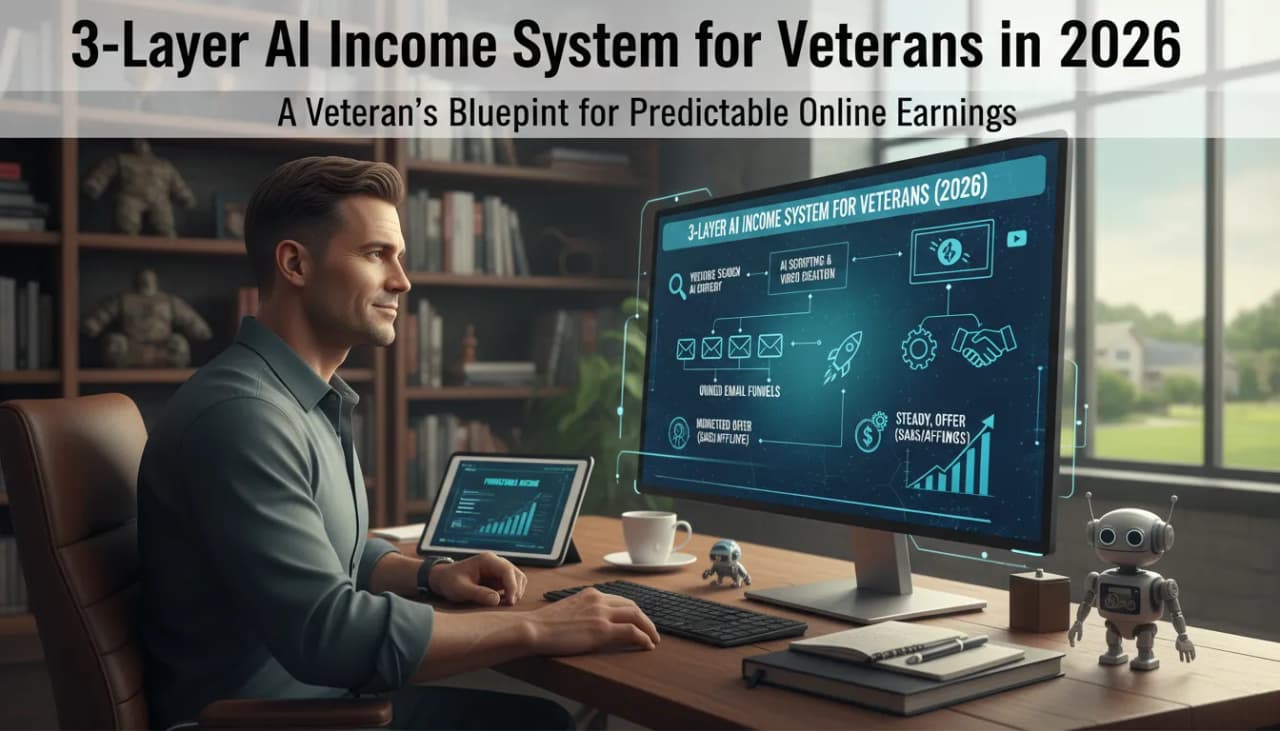
This 30-day plan for veterans takes the guesswork out of mission-driven entrepreneurship. Each step is mapped, focused, and powered by simple AI systems—so you can finally earn your first online dollar without overwhelm.

From Combat to Content: Building a Mini AI Engine (Without Overthinking)
In the military, we never waited for perfect intel before rolling out—so why wait for perfect content? That mindset shift is what helped me build my first mini AI content engine and finally break the cycle of “hurry up and wait” in my civilian life. Creating weekly stories with AI feels a lot like prepping for a briefing—except now, the audience can reply, ask questions, and even become your next client or customer.
Let me be real: my first published post was embarrassingly imperfect. I wrote it in a VA waiting room, using Jasper to brainstorm and Canva to slap together a simple graphic. No fancy camera, no studio mic—just my story and a basic AI toolkit. But here’s the kicker: that rough post earned me my first lead. It proved that content creation doesn’t require pro gear or endless research. It just needs your voice and a willingness to hit “publish.”
Here’s how I kept things simple and consistent, even with a packed schedule:
One long, a few short: Each week, I create one longer story—like a blog post or a YouTube video—sharing a lesson learned or a challenge overcome. Then, I use AI to slice that into 3–5 short posts for LinkedIn, Instagram, or Facebook. It’s like prepping a briefing and then sending out the highlights for those who missed the meeting.
AI-powered brainstorming: Jasper helps me outline, script, and repurpose content while I’m on family duty or stuck at the VA. Canva makes graphics a breeze, even if you’re not a designer. These AI automation tools do the heavy lifting, so you can focus on telling your story.
Weekly After Action Reports: Every Friday, I send out a recap email—my “After Action Report”—summarizing what worked, what didn’t, and what’s next. Veterans love a good debrief, and these newsletters double as both accountability and community-building.
Publishing in public: Sharing your journey online keeps you honest (and human). It’s not about being perfect; it’s about showing up. Authenticity fuels trust and loyalty, which are the backbone of digital coaching and other online income streams for veterans.
“We never waited for perfect intel before rolling out—why wait for perfect content?”
The real mission isn’t to create flawless content but to build momentum. With a mini-AI content engine, you can publish consistently—even when life gets chaotic. Progress, not perfection, is the goal.
Stop Counting Followers, Start Counting Hand Raises: Metrics that Matter
When I first started building my online income streams, I fell into the same trap as most beginner entrepreneurs: obsessing over follower counts and likes. I’d refresh my social media, hoping for that dopamine hit—another follower, another heart. But the truth hit me the day a single DM landed in my inbox. It was a fellow veteran asking, “Can you help me set up my first AI-powered funnel?” That one message meant more than a hundred likes ever could. It was proof that real business progress comes from meaningful actions—subscribers, direct messages, and people raising their hands to say, “I want in.”
In the military, we never measured success by how many people watched us do pushups. We counted the reps that actually made us stronger. If I’d tracked my push-ups like I tracked my likes, I’d be in worse shape than on field day. The same applies to tracking metrics for business. Vanity numbers—followers, views, likes—are just noise if they don’t lead to engagement or income. For veteran financial stability, you need to focus on the numbers that move the needle.
That’s why, in my 30-day mission plan, the final step (Day 22–30) is all about tracking one weekly metric that actually matters. I call these “hand raises.” It could be:
New email subscribers
Direct replies to your posts
DMs asking for help or more info
Clicks on your offer or landing page
Pick one, and track it every week. If the number climbs, you’re on target. If it stalls, don’t panic—adjust your message, share more of your story, or show your face (literally or digitally) to build trust. AI-powered tools make this easier than ever. With simple dashboards, you can see at a glance how many people are engaging, where they’re coming from, and which content sparks action. These tools are a game-changer for veterans who want to measure operational efficiency and customer engagement without drowning in spreadsheets.
Remember, “It’s not the applause that matters; it’s the handshake at the end of the brief.” The only numbers that matter in a mission are the ones that move you closer to your objective. By tracking hand raises, not vanity stats, you keep your side hustle growth realistic, rewarding, and laser-focused on what counts—real people, real progress, and real income.

Surviving Government Whiplash: Building Financial Independence, Not Just Another Paycheck
If you’ve ever felt your stomach drop at the mention of a government shutdown or budget cut, you’re not alone. I used to feel that same stress—wondering if my next paycheck would show up on time or if a new policy would throw my finances into chaos. But the moment I started earning side income online, that anxiety faded. Suddenly, I wasn’t just waiting for the next raise or promotion. I had real veteran financial stability—and peace of mind.
Here’s the truth: owning a digital-first, portable business means you never have to rely on a single paycheck again. For military families, portability isn’t just a perk—it’s a necessity. Deployments, PCS moves, and unpredictable schedules can wreck traditional jobs. But with a laptop and Wi-Fi, you can build a business that travels with you. Freelance platforms like Upwork or Fiverr let you earn from anywhere, turning your skills into income no matter where you’re stationed.
For veterans, true financial independence isn’t about stacking up more obligations or clocking extra hours. It’s about building assets—systems and skills that keep working even when you’re not. I remember the bittersweet feeling of getting a raise, only to realize my expenses had “dressed right dress” and marched right up alongside it. That’s when I understood: the quick sale or the next pay bump isn’t the real reward. The real win is turning military discipline into long-term independence.
AI automation is a game-changer here. When I first started, I was overwhelmed by all the moving parts—websites, funnels, emails, and content. But AI tools helped me simplify, automate, and scale. Now, even when policy changes or budget drama hit, my income streams keep flowing. AI lets you future-proof your finances, so you’re not left scrambling when the rules change.
Here’s what I learned:
Assets, not hours: Build systems that work for you, not just more shifts to cover.
Portable businesses: Choose models that move with you—affiliate marketing, info products, or freelance gigs.
Resilience over reliance: Diversify your income so you’re not at the mercy of one boss or government check.
'A boss can fire you; a client can choose someone else. Your skills are the only asset you ever really own.'
Financial peace comes from diversifying income through online ventures, not just chasing raises or promotions. For veterans, that’s the new mission: build assets, leverage AI, and create a life where you call the shots—no matter what’s happening in Washington.
Call to Arms: Your Mission — Publish, Connect, Repeat
If you’ve made it this far, you know the drill: mission-driven entrepreneurship isn’t about waiting for the perfect moment—it’s about taking action, right now. The biggest lesson I’ve learned since leaving the military is that the same grit that got us through deployments and field problems is the exact fuel we need to launch an online business. But here’s the catch: in the civilian world, simplicity wins every time. The most successful veteran entrepreneurship stories I’ve seen aren’t built on complicated plans—they’re built on showing up, sharing, and improving in public.
So, here’s your call to arms. Start by choosing your “I help” statement. Be specific, be bold. Don’t water it down. If you’re the go-to fitness motivator, own it. If you've mastered the art of VA claims, don't hesitate to express it. This sentence is your mission statement—your guiding star for your side hustle for veterans. Next, pick one simple offer. Don’t overthink it. Put it out there, even if it’s not perfect. The only way to learn is by doing, and the only way to earn is by launching.
Now, share your story. Publish one honest piece of content this week—a blog post, a video, or even a heartfelt email. Tell people where you started, what you’ve learned, and how you can help. Invite others to join you. Veterans are natural community builders, and when you lead by example, you inspire others to take action. This is the heart of mission-driven entrepreneurship: building in public, sharing your wins and failures, and creating accountability—not just for yourself, but for every veteran watching.
Then, repeat. Every week, every month. Don’t let a bad day turn into a lost month. Improvement compounds, and the more you publish and connect, the more your confidence and results will grow. Remember, transformation happens through public action. Don’t build in isolation—community sharing accelerates growth and keeps you moving forward, even when motivation dips.
If you want to see this process unfold in real time, subscribe to my newsletter and join my YouTube ‘battle rhythm.’ I’m building AI-powered funnels and side hustles in public, sharing every win, every mistake, and every lesson. Because you can’t lose if you keep showing up—and no veteran should have to launch alone.
“You can’t lose if you keep showing up.”
So, here’s my challenge to you: publish, connect, repeat. Take the first real step and refuse to quit. Your journey as a veteran entrepreneur starts now, and simplicity is your secret weapon.
