

I still remember the weight of the uniform the day I took it off for the last time. We smiled for pictures, shook hands, and I walked into Monday like everyone else — an unnamed employee, drowning in meetings about meetings. That emptiness pushed me into online business: funnels, affiliate marketing, and eventually AI. This post is my map back to mission and control — written for veterans who feel like they traded one system for another.
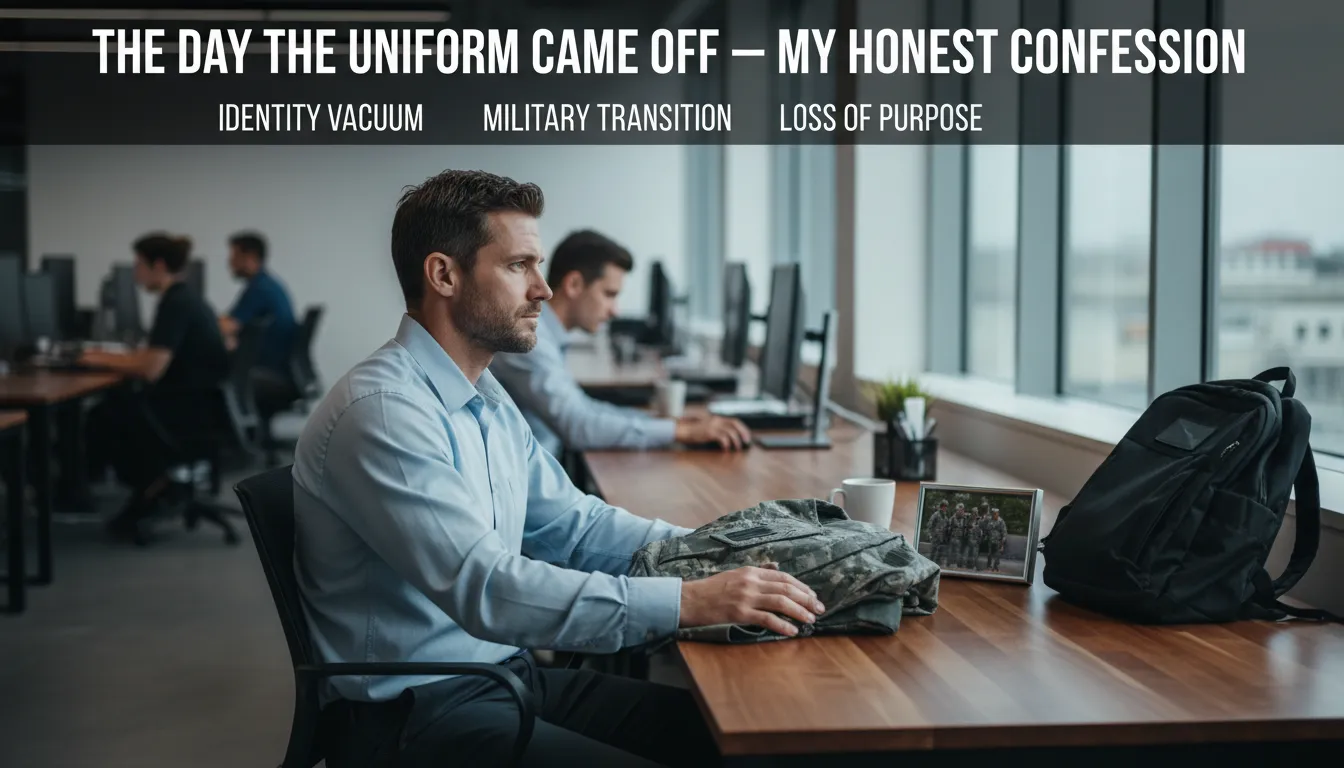
1) The Day the Uniform Came Off — My Honest Confession
Civilian Life Hit Harder Than I Expected
Nobody briefs you for that moment. You hang the uniform up. You shake hands. You smile for pictures. I thought I’d feel relief. Instead, I felt an identity vacuum—like someone pulled the plug on my purpose.
Then Monday hits. And suddenly… I’m just “an employee.” No rank. No mission clarity. No brotherhood. Just calendars, small talk, and meetings about meetings. If you’ve felt that hollow feeling during a military transition, you’re not weak. You’re normal.
The Awkward Normal of Military Transition
There are over 200,000 servicemembers moving into civilian life each year (2026 estimate). And the VA has pointed out for years that transition stress and mental health challenges are real. One stat that stuck with me: 44% of veterans report difficulty adjusting to civilian life. Naming it early matters, because shame grows in silence.
“Identity loss after service is common — naming it is the first step toward rebuilding.”
— Dr. Emily Harris, Veteran Transition Psychologist
My First Performance Review Felt Like a Bad AAR
I’ll never forget my first civilian performance review. It felt like an after-action report with no map, no commander’s intent, and no clear standard. “You’re doing fine,” they said. But “fine” felt like a cage.
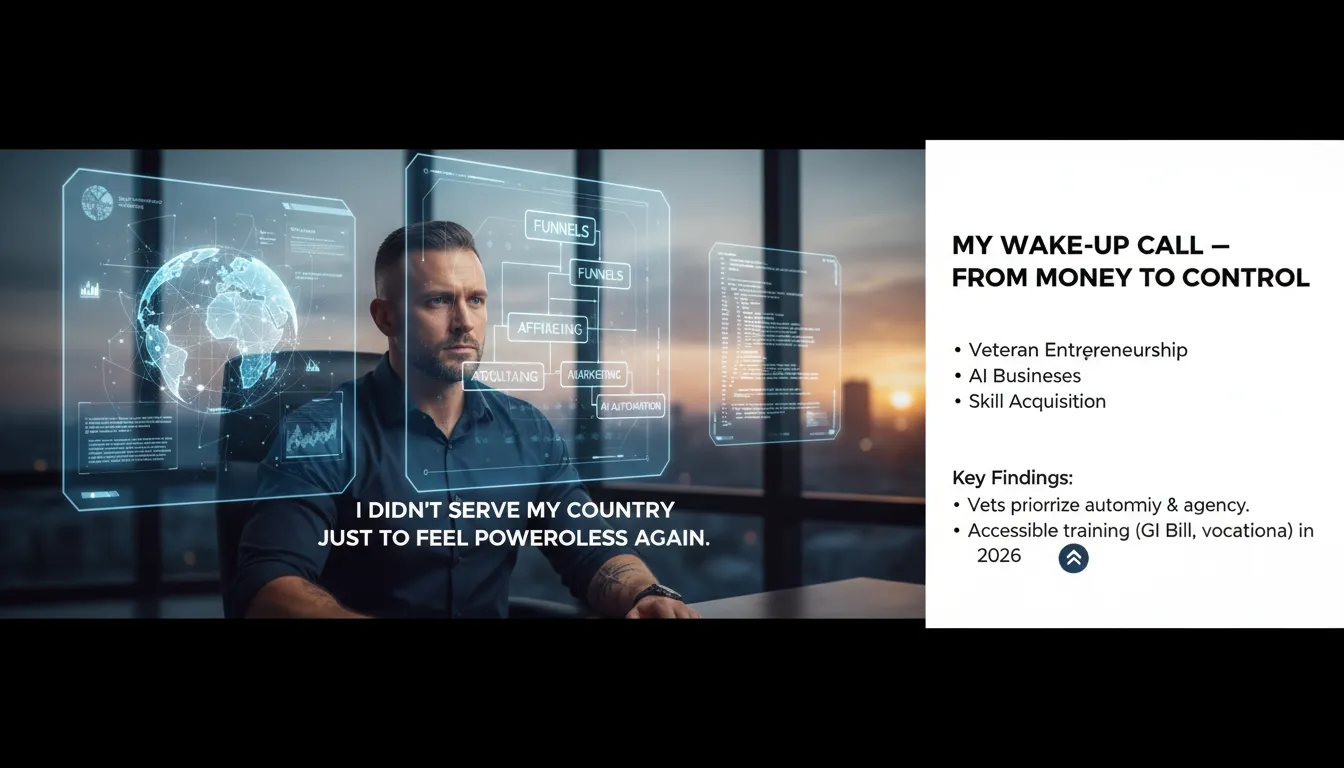
I remember thinking, “I didn’t serve my country just to feel powerless again.” I wasn’t broke. I wasn’t failing. But I felt a quiet loss purpose—like I’d traded deployments for deadlines and called it progress.
2) The Civilian Matrix — Quiet, Sticky, Familiar
Civilian life doesn’t shout. It numbs.
When I stepped into civilian life, I expected the hard part to be finding employment. That’s what everyone measures: resume, interview, offer letter. But the “Civilian Matrix” isn’t loud. It doesn’t yell at you. It just pays you every two weeks. It promises retirement someday. It repeats the same message: stability > freedom. And it keeps you just busy enough that you never build anything of your own.
Nearly one-third of veterans say finding employment is difficult after service, and 33% cite it as the biggest hurdle. Those numbers matter—but they don’t tell the whole story. Employment-focused programs can help you get hired, but they’re often insufficient for identity rebuilding. A routine paycheck can mask the deeper hit: loss of purpose and the slow grind of social integration problems.
Lt. Col. John Miller (Ret.), Founder, Veterans in Tech: "The civilian world offers stability, but many vets trade mission for comfort — and later regret it."
Different uniform, same dependency
I traded deployments for deadlines. Instead of a chain of command in camo, it was a corporate hierarchy in polos. And if I’m honest, I almost re-enlisted into it—because it felt safe. My employment struggles weren’t just about money. They were about being capped, managed, and replaceable.
Quick diagnostic: are you inside the matrix?
Do you feel relief on payday… then dread on Monday?
Is your “plan” basically wait for a raise?
Are you too busy to learn a skill that creates options?
Do you miss the mission more than the job?
3) My Wake-Up Call — From Money to Control
I remember sitting in my civilian job thinking, “I didn’t serve my country just to feel powerless again.” I wasn’t broke. Bills were paid. But I felt capped—like someone installed a governor on my life. That’s when veteran entrepreneurship stopped sounding like a “side hustle” and started sounding like a way out.
I found online business in the most unsexy way: late-night YouTube and notes on a legal pad. Funnels. Affiliate marketing. AI businesses. AI automation. At first, I thought it was about money. It wasn’t. It was about control. Control of my time. Control of my output. Control of my future.
Sarah Bennett, Founder of VetFunnels: “Control is the currency veterans miss — entrepreneurship restores agency.”
My First Funnel Failed (and It Helped Me)
My first funnel was a mess. The headline was vague, the offer was unclear, and I checked stats every hour like it was a heart monitor. I burned out fast—trying to brute-force results the way I used to push through field problems.
Then I learned leverage: email automation to follow up, and AI to repurpose one post into five. Same effort, more reach, less stress. Sustainable beats heroic.
Why Veterans Learn Digital Systems Fast
We’re trained for systems: inputs, outputs, checklists, after-action reviews. That makes skill acquisition in digital business faster—if we stay focused and avoid shiny-object syndrome.
Actionable Tip: One Micro-Skill, Two Experiments
Pick one: copy, funnels, or paid ads.
Run two small tests this week (two headlines, two audiences, two emails).
Over 200,000 servicemembers transition each year, and in 2026, GI Bill and vocational options make training more accessible. Build a small accountability cell with other vets and execute.
4) What Veterans Actually Miss — Not the Routine, the Raison d’Être
When people talk about loss purpose after service, they assume we miss the routine. I don’t. I don’t miss 4am formations or inspections. What I miss is the raison d’être—the reason the day mattered. That gap is one of the most common veteran challenges, and it can hit mental health hard when life starts feeling like endless busywork.
What we actually miss
Clear objectives
Measurable results
Brotherhood
Competence
Growth
Dr. Marcus Alvarez, Clinical Psychologist, Veterans' Mental Health: "Purpose and measurable progress are essential to mental resilience after service."
That’s why entrepreneurship fits so many of us. Business becomes a new battlefield: mission, movement, feedback, and wins you can track. Research backs this up—purposeful work correlates with improved mental health indicators. And when we translate military strengths into entrepreneurial frameworks, we reduce that “skills mismatch” feeling that makes civilian work feel pointless.
Brotherhood, rebuilt
I found my “unit” again in a small mastermind group—five operators, weekly calls, honest feedback. No rank, no ego—just accountability. And when I needed extra support, programs like DAV reminded me I wasn’t alone; they offer lifetime assistance for veterans.
Operator thinking + AI = measurable progress
Employee thinking asks, “What do I do today?” Operator thinking asks, “What asset am I building?” AI speeds competence-building by turning effort into output you can measure—content, leads, offers, systems.
Exercise: Weekly Mission Scorecard
Objective | Metric | Target |
|---|---|---|
Traffic | Posts published | 3 |
Leads | Email opt-ins | 25 |
Sales | Calls/offers sent | 5 |
5) AI Is Not Skynet — It's a Force Multiplier
Relax. You’re not building Terminators. You’re building leverage. In veteran entrepreneurship, AI doesn’t replace discipline—it amplifies it. Research keeps pointing to the same thing: AI is a key enabler for scaling small veteran-led businesses, and when you pair it with our SOP mindset, you can outperform local competitors and reach global markets.
Lt. Gen. Mark Benson (Ret.), Tech Advisor for Veterans' Programs: "When veterans apply SOPs to AI, the result is exponential productivity — not replacement."
Practical Wins for AI Businesses (No Hype)
Create content without burnout
Automate emails
Build funnels
Launch micro-SaaS tools
Generate leads while you sleep (24/7 passive lead flow)
One weekend, I fed one research brief into an AI writer and mapped out 10 blog posts, plus captions and an email sequence. That’s the “10x repurposing” effect—often cutting production time by ~70%. Instead of grinding all Saturday, I reviewed, edited, scheduled… and got my weekend back.
Quick How-To: Lead Magnet Funnel + Automation
Use an AI copywriter to draft a 1-page lead magnet + landing page.
Connect a form to an autoresponder (welcome email + 5-day sequence).
Add one automation rule: new subscriber → tag → send sequence.
Trigger: Form Submit → Action: Add Tag "LeadMagnet" → Action: Start Email Sequence
Oversight Matters (This Is Where Vets Win)
AI needs governance. Don’t outsource judgment. Keep a checklist: facts, tone, compliance, and brand voice. Keep building real skills—sales, offers, and customer service—so you don’t become dependent.
Low-Cost Tool Stack (Ethical + Simple)
Tool Type | Examples | Tradeoff |
|---|---|---|
Content AI | ChatGPT, Claude | $20–$30/mo; saves hours |
Automation | Zapier, Make | $0–$30/mo; setup time upfront |
Email/CRM | MailerLite, ConvertKit | $0–$30/mo; needs clean lists |

6) The Identity Shift — From Employee to Operator
In my military transition, the hardest part wasn’t learning a new job. It was the identity shift. I stopped asking, “How do I make extra money?” and started asking, “What mission am I building?”
Because when you build:
“A content system; A funnel; An offer; A simple AI-powered asset You’re no longer trading time.”
Employee Thinking vs Operator Thinking (3 Dimensions)
Dimension | Employee | Operator |
|---|---|---|
Time | Hours-for-dollars | Builds once, earns repeatedly |
Scale | Limited by schedule | Systems + AI scale output |
Ownership | Rents a role | Owns infrastructure |
Research backs this up: when I reframe income as infrastructure, I burn out less and stick with it longer. That’s the point of asset creation.
Small Case Study: Micro-SaaS Operator
A former medic I know built a simple micro-SaaS billing tool for small clinics. Basic AI reads invoices, flags errors, and drafts follow-up emails. He sells it on a monthly plan. No hype—just a clean system that keeps paying.
Rebecca Torres, CEO of Veterans Digital Lab: “Operator thinking turns military habits into business assets — it’s a mindset shift more than a skill set.”
Fear of Being Bad Is Normal
I remind myself: I wasn’t good at land nav on day one either. Unfamiliar doesn’t mean impossible—it means training curve.
Exercise: Draft Your First 90-Day Mission
Structured 90-day missions increase completion rates for veteran founders. Write yours:
Mission:
I help [who] get [result] using [AI/system].30 days: pick niche + publish 10 posts + outline offer
60 days: build funnel + email sequence + first 5 sales calls
90 days: ship one AI-powered asset + 10 paying customers
7) The 3 Phases of Escaping the Civilian Matrix — A Tactical Roadmap
Over 200,000 servicemembers transition every year, and 33% say finding employment is the biggest hurdle. I get it—those transition challenges hit hard because the civilian system is quiet, not kind. The fix is a phased plan. Research shows phased approaches improve completion and reduce dropout, and smoother transitions are linked to better long-term mental health resilience.
Alex Nguyen, Director of Veteran Entrepreneurship Programs: “Breaking transition into phases lets veterans apply familiar training cycles to business building.”
Phase 1: Awareness (Recon) — Your Job Isn’t Your Identity
Like recon, this phase is about seeing the terrain: a paycheck isn’t purpose. Timeline: 3–12 months.
Write your mission: who you help + what result.
Track energy: what work makes you feel alive?
Support: DAV, Operation Family Fund, a peer accountability group.
Phase 2: Skill Acquisition (Training) — Funnels, Traffic, AI, Automation
This is your vocational training for freedom. Use 2026 GI Bill expansions to fund courses and certs. Timeline: 3–12 months.
Learn: funnels, email, offers, basic ads, AI content systems.
Find a mentor + weekly scorecard.
1 offer + 1 audience + 1 channel(keep it simple).
Phase 3: Asset Creation (Deployment) — Repeatable Revenue
Now you build assets: subscriptions, micro-SaaS, affiliates. This is where most quit—because it’s unfamiliar, and veterans hate being bad at things. You weren’t good at land nav on day one either.
Common failure modes + countermeasures
Perfectionism → ship v1 in 7 days.
Tool overload → one stack, one workflow.
Isolation → weekly accountability call.
8) You Don’t Need to Go Viral — Build Operator Energy
Civilian life isn’t a popularity contest
When I stepped into civilian life, I thought I had to “win” the job market the same way people win online: big attention. But here’s the truth I live by now:
You don’t need to go viral. You need: A clear message; A defined audience; A simple funnel; Consistent traffic.
Maya Patel, Growth Lead at Freedom Funnels: "Consistency beats virality. Veterans win when they build systems that compound."
Operator steps (not influencer vibes)
Niche selection: pick one problem you can solve for people stuck finding employment or building income after service.
One-page funnel: headline + 3 bullets + email opt-in + one offer.
3 content pillars: (1) transition skills, (2) AI leverage, (3) proof/results.
30 minutes daily: one post, one email, or one short video. No excuses.
Real veteran example: steady beats loud
A former infantry buddy of mine never went viral. He posted three times a week, drove traffic to a one-page checklist, and sold a simple AI resume service. Small audience, steady leads, growing revenue. Operator-focused strategies create sustainable income growth.
What I track (and what I ignore)
I ignore likes. I track:
Metric | Why it matters |
|---|---|
Conversion rate | Message clarity |
CPL | Traffic efficiency |
LTV | Real business value |
7-day micro-funnel test ($100)
Micro-tests reduce risk and improve learning velocity. Run:
$100 niche ads to one opt-in page
Goal:
10-30 leadsWatch: conversion rate, CPL, first-sale LTV
Consistent traffic checklist
Email list (daily/weekly)
SEO posts targeting “finding employment” + your niche
Niche ads (small budgets)
Partnerships (podcasts, veteran groups, newsletters)
9) The Real Freedom — Optionality Over Flash
Financial well-being in civilian life: optionality beats status
I used to think freedom looked like a big number and a loud car. Then I learned the truth: It’s not Lambos. It’s:
Picking your kids up from school;
Not asking permission for leave;
Working from anywhere;
Knowing income isn’t capped.
That’s the kind of freedom most veterans are really chasing after the uniform comes off. In civilian life, the paycheck can feel “stable,” but it’s also fragile. One boss, one policy change, one layoff—and your whole plan shakes. With over 200,000 servicemembers transitioning yearly, this isn’t rare. It’s a system-wide need for better veteran support.
How AI businesses create real optionality
AI doesn’t replace discipline. It multiplies it. Automation turns effort into assets: content that keeps working, funnels that keep collecting leads, emails that keep selling. And the models that create the most optionality? Recurring revenue—subscriptions, micro-SaaS, retainers, or automated lead funnels. Small, steady income replaces fragile paycheck dependence, and that supports mental health too.
Carla Ruiz, Family First Financial Coach: "Freedom is optionality — businesses that create recurring revenue free families from fragile income patterns."
I’ll never forget the first time I took a weekday off for my kid’s recital—no request form, no guilt, no “make up the hours.” Just presence. That’s success.
Action step: 5 ways to buy optionality in 12 months
Build recurring revenue to cover 3 months of expenses.
Automate lead capture with a simple funnel.
Batch content weekly using AI to save 5+ hours.
Create one subscription offer (templates, coaching, community).
Track freedom metrics: time saved, flexibility, monthly recurring revenue.
10) Resources, Data & Hard Numbers — Where to Go Next
Veteran support + transition support: the numbers don’t lie
Every year, 200,000+ servicemembers transition out (VA). And the friction is real: 44% report difficulty adjusting, nearly one-third say employment is difficult, and 33% cite finding employment as the top hurdle (VA, DAV, Operation Family Fund, With Honor).
Dr. Alan Pierce, Research Lead, Veterans Transition Studies: “Policy shifts in 2026 matter — but personal plans and micro-assets provide the real day-to-day protection.”
Quick resource list (start here)
VA: transition resources + studies (VA)
DAV: claims and benefits help + DAV helpline (DAV)
Operation Family Fund: family stability support (Operation Family Fund)
With Honor: transition research + reports (
SFR_HVAC_EO_01212026.pdf)GI Bill / vocational funding: 2026 updates expanded training access for in-demand skills (GI Bill)
Physical health support: outdoor/community recovery notes (hometownherooutdoors)
Use 2026 GI Bill expansions to fund skill acquisition
I’d pair formal programs with entrepreneurship. In 2026, improved GI Bill and vocational funding make it easier to stack short training with real-world building.
Pick one track: funnels, AI basics, or no-code SaaS.
Use GI Bill/voc rehab to cover approved courses.
Ship one micro-asset: a landing page, email sequence, or simple tool.
If you’re facing housing instability or crisis
I’m going to be blunt: housing instability can hit fast during transition. If you’re at risk, prioritize safety: contact the VA, your local veteran nonprofits, and DAV for benefits navigation. For urgent mental health needs, use 988 (Press 1) and local emergency services.
Support networks that keep you moving
Mentorship programs (VA/DAV-connected)
Veteran mastermind groups
One accountability partner who checks your weekly output
11) Final Thought + Wild Cards — Mission > Motivation
You already escaped one system. Don’t get comfortable in another. The civilian matrix is quiet, but it still trains you to wait for permission, trade hours for safety, and call that “normal.” In this transition, what saves me isn’t hype—it’s a mission. Research backs it up: when business is framed like a mission, people persist longer and finish more. That’s why veteran entrepreneurship works when we treat it like an operation, not a side hustle.
Lt. Col. John Miller (Ret.), Founder, Veterans in Tech: “Mission-driven business building is the bridge from service to sustainable freedom.”
Wild Card #1: The Six-Figure Micro-AI Tool
Picture this: a veteran builds a tiny AI tool that handles appointment reminders and intake forms for 100 small clinics. It’s not flashy. It’s just useful. At $99/month, that’s real annual recurring revenue—six figures—built from one focused asset. That’s Phase 3: Asset Creation. Most quiet here because it’s unfamiliar, not because they can’t do it.
Wild Card #2: Your Business Is a Forward Operating Base
I think of my future business like a forward operating base: defendable (clear offer), resupplyable (simple systems), and mission-focused (one audience, one problem). Small rituals and community keep it standing. I still schedule quarterly “uniform days” at home—boots, coffee, planning—just to remember discipline.
Next Steps + Transition Support
If things get rocky, don’t white-knuckle it. Use your support networks, talk to someone, and get real transition support. Then take action: join a 30-day build sprint or find a mentor. Start with the AI Freedom system framework and begin building your own digital asset machine. Subscribe, follow the journey, and build your AI-powered freedom machine.
Mission > Motivation.
