
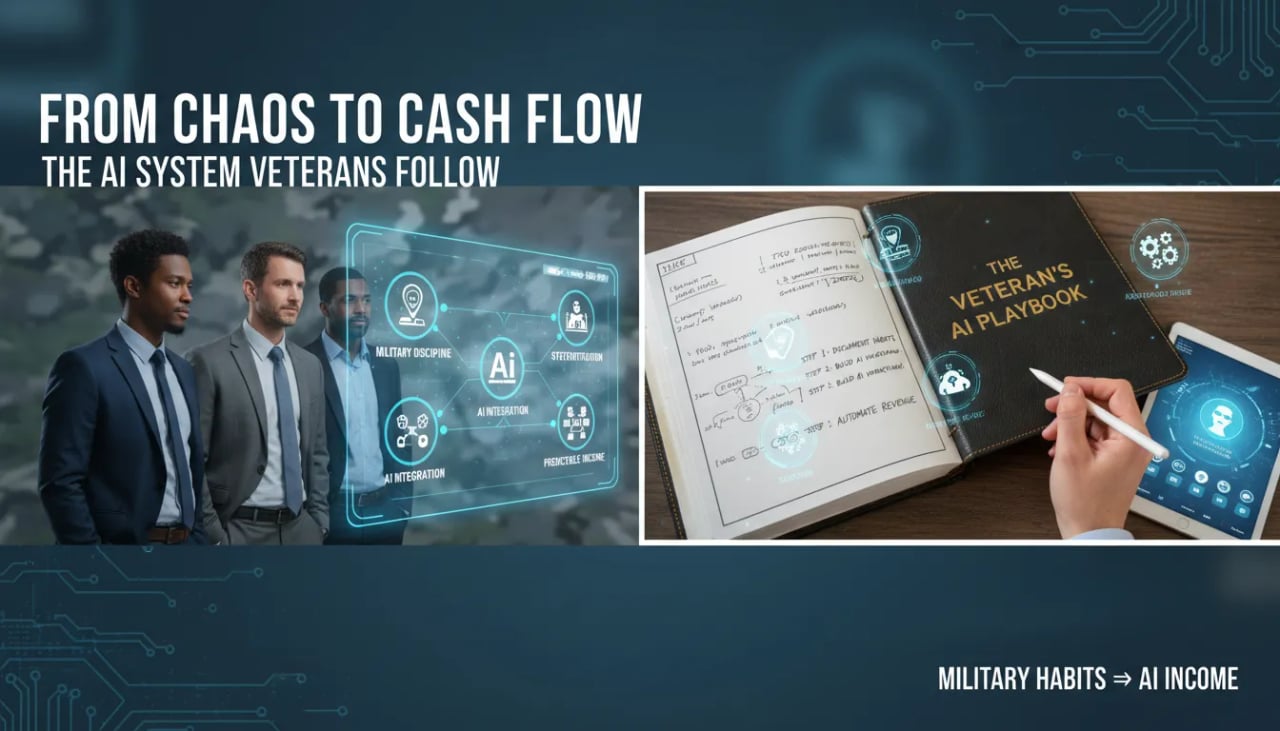



I remember the first week after my ETS: endless advice, zero direction. I tried posting whatever felt right, chasing virality, and burned out fast. Then I started treating my online work like a patrol: document the mission, run the checklist, and repeat. In this post I’ll show you, step-by-step, how I built an AI-ready veteran system that turned scattered effort into steady cash flow. This is a how-to from someone who’s made the mistakes and mapped the route. Even when I was working in a corporate job, was getting burnt out. So, I knew the focus on my online business intensified.
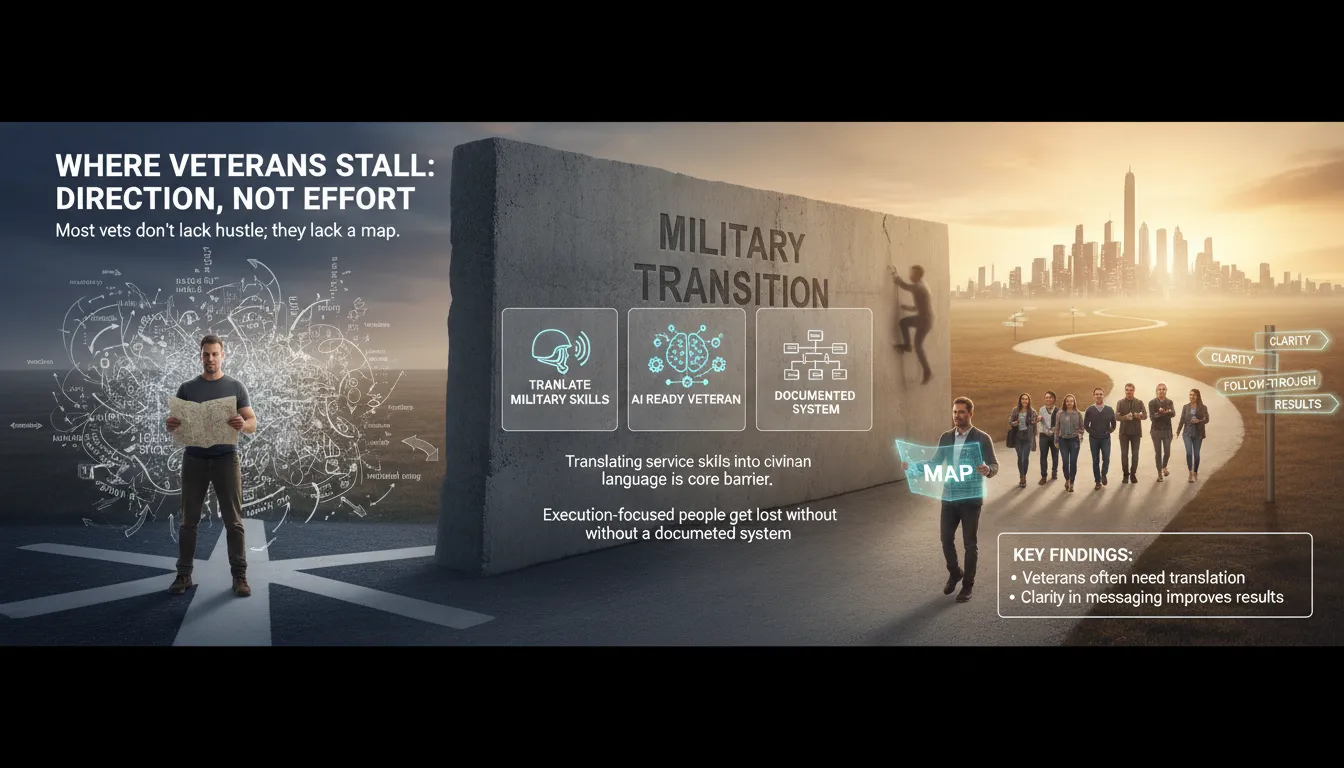
Where Veterans Stall: Direction, Not Effort
Most of us don’t lack hustle. We lack a map. In the Military Transition, you’re trained to execute clear orders with clear standards. Online business doesn’t feel like that. It feels like being handed a compass with no map—so you post random content, try random funnels, and end up with random income.
I saw the same pattern again and again: execution-focused people get stuck when there’s no documented system. We don’t need more motivation. We need a playbook we can run.
Alex Rivera, Founder, AI Ready Veteran: "Direction beats hustle—veterans execute best when given a clear playbook."
Military Transition Friction: You Must Translate Military Skills
A big hidden blocker is language. Veterans often need to Translate Military Skills into civilian terms—on resumes, in job interviews, and even in marketing. If you can’t explain what you do in plain words, you can’t sell it. That’s why a career search coach can help, but you can also start by translating your own experience into outcomes: time saved, risk reduced, money earned, problems solved.
The Trap: Broad Positioning Creates Scattered Actions
“Helping veterans make money online” sounds good, but it’s too wide. When your message is vague, your daily actions get vague. Clarity in messaging improves follow-through because you always know what to create, who it’s for, and what result it drives. That’s how an AI Ready Veteran thinks: specific inputs, repeatable outputs.
How-To: Write One Repeatable Daily Process
Inventory what you’re doing now (posts, DMs, videos, offers).
Circle what creates leads or sales.
Write a simple daily checklist you can repeat.
Daily Process = 1 asset + 3 conversations + 1 authority post
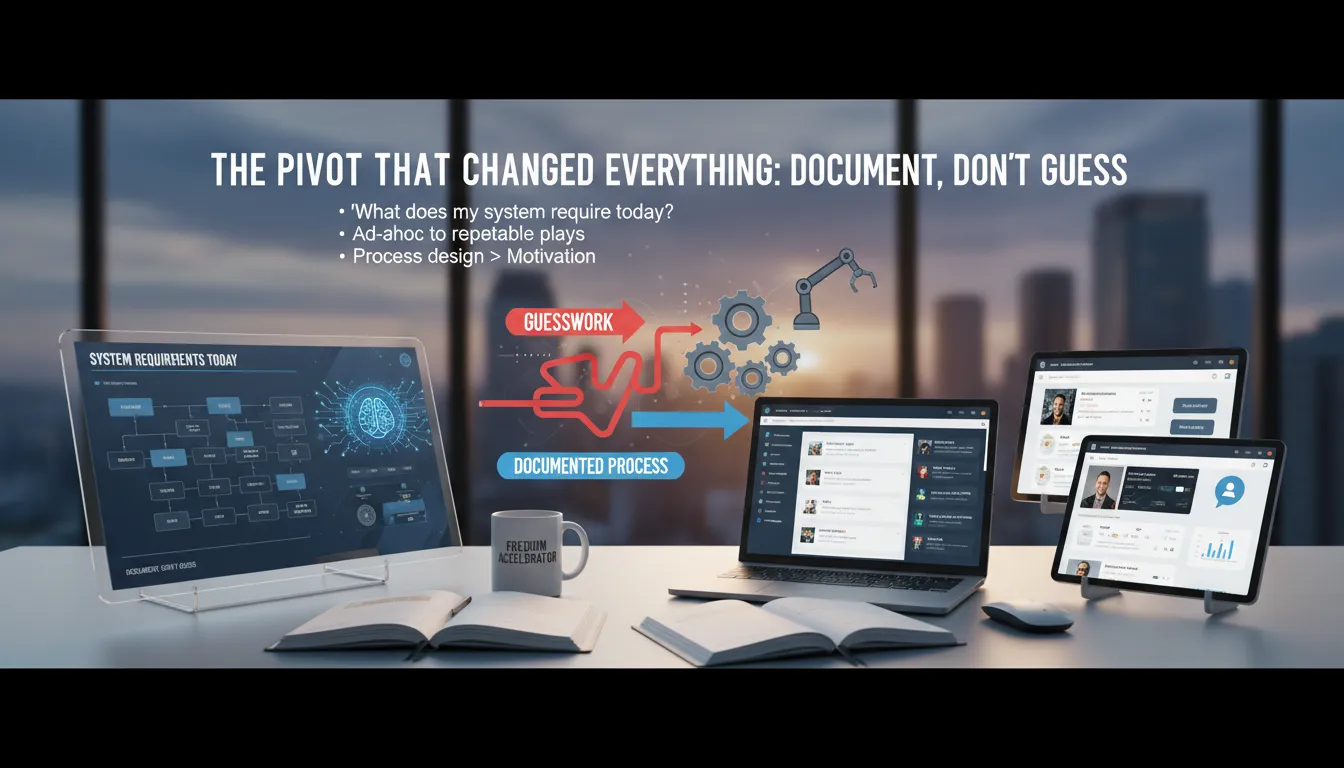
The Pivot That Changed Everything: Document, Don’t Guess
The breakthrough wasn’t motivation. It was documentation. I stopped asking, “What should I post today?” and started asking, “What does my system require today?” That one shift turned chaos into a plan I could follow even on low-energy days.
Why Documentation Beats Willpower (and Scales with AI Powered Tools)
When tasks lived in my head, they changed daily. When they lived in a single “living doc,” they became repeatable plays. That’s what lets you delegate to a VA, or automate steps with AI Powered Tools—because the tool can’t run a process you never wrote down.
Maria Gonzales, Program Lead, Vets Who Code: "A written process is the backbone of scale—our placements rose when we standardized follow-up."
How I Built My Process Doc (Inputs, Outputs, Cadence)
Here’s the simple how-to I use (and what I’d recommend to any Career Search mentor or Entrepreneurship Coach):
Inputs: ideas, questions from DMs, client calls, search terms.
Outputs: 1 YouTube, 3 short videos, 5 text posts, 10 comments.
Cadence: what I can sustain weekly without burning out.
Module 6 Made Me Stop Chasing Viral
Freedom Accelerator Module 6 pushed me to prioritize search content. So my doc now starts with: “What are veterans already searching for?” That keeps my content compounding instead of resetting every week.
The 15-Minute Daily Habit
Every day, I spend 15 minutes updating the doc: what worked, what didn’t, and the next repeatable step. My “system” stays current, and my execution stays simple.
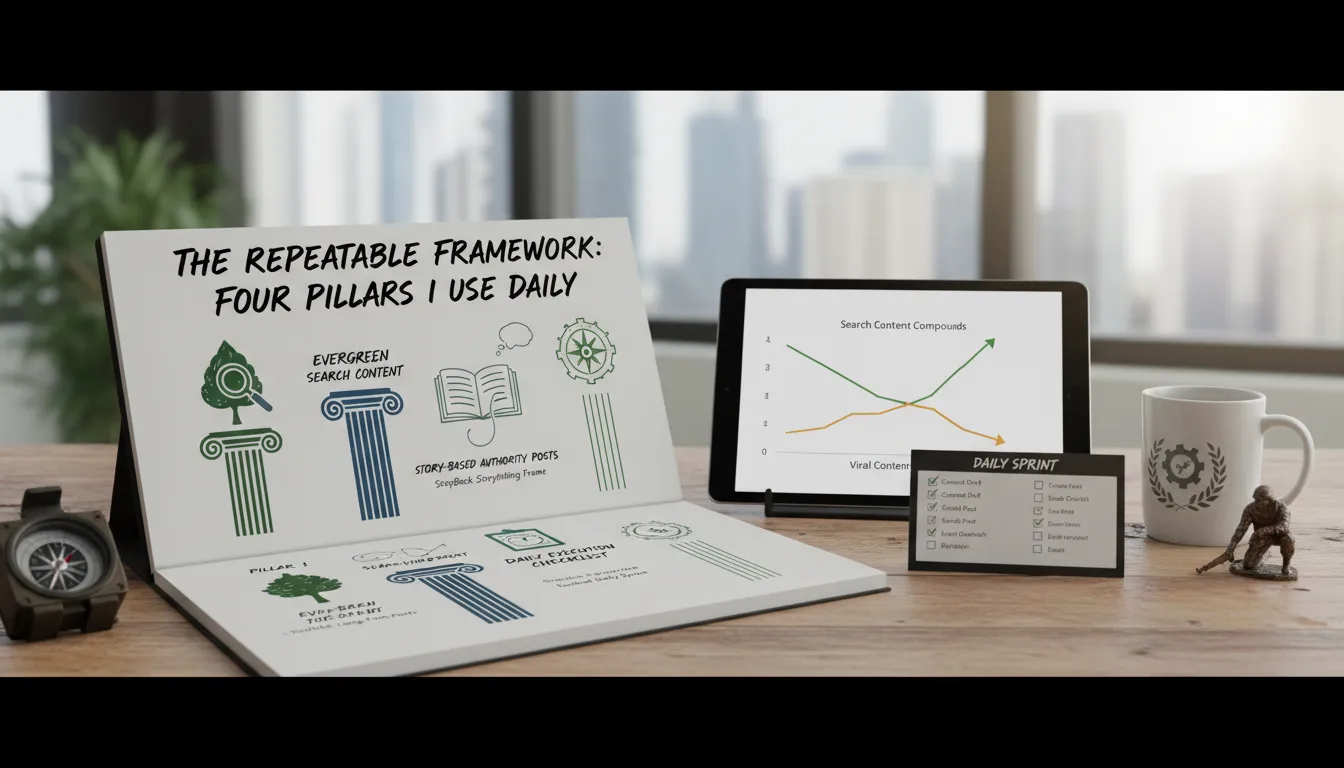
The Repeatable Framework: Four Pillars I Use Daily
This is my AI Ready Veteran operating system for Online Business. It keeps my Veteran Business actions simple, repeatable, and measurable.
Evan Thomas, Entrepreneurship Coach: "Systemized content wins—consistent assets compound where viral posts do not."
Pillar 1: Evergreen Search Content (Assets That Rank)
I publish YouTube + long-form posts built around what veterans already search. Search content compounds over time; viral content fades. Example title: “Best online business for veterans with no audience”. Script: Problem → 3 options → my pick → next step CTA. Measure: views from search, email opt-ins.
Pillar 2: Story-Based Authority Posts (Step Back Storytelling)
I use Step Back Storytelling: Hook → Problem → Pivot → Process → Payoff. Example hook: “I posted daily for 60 days and still had zero leads.” Pivot: “I stopped guessing and documented my system.” CTA: “Comment ‘CHECKLIST’ and I’ll send it.” Measure: comments, DMs started, calls booked.
Pillar 3: Daily Execution Checklist (Daily Sprint)
A documented checklist enforces tactical consistency. My Daily Sprint:
2–3 Reels
3–5 text threads
Stories + value comments
Start conversations daily
Measure: outbound DMs, replies, conversions.
Pillar 4: Clear Positioning (Sharp “How”)
“Helping veterans make money online” is vague. Mine is: I help veterans build a simple content system that turns search + stories into daily leads. Measure: profile clicks, opt-in rate.
Action step: Pick one pillar to fully document this week, then run it for 30 days.
Evergreen Search Content: Build Assets That Rank
I invest in YouTube and long-form search content because it compounds. Viral posts evaporate. Search keeps sending leads while I’m living my life. Freedom Accelerator Module 6 (Freedom_Accelerator_Module_6-min) drills this in: search-based growth creates stable lead flow.
Alex Rivera, Founder, AI Ready Veteran: "Search content is interest-bearing—make it work for you over months, not hours."
Market Research: Pick What Veterans Already Search
I don’t guess topics. I do Market Research with YouTube autocomplete, SEO tools, and AI research assistants. I look for questions like:
How to Translate Military Skills to a civilian resume
Best AI Transition Tools for veterans
Veteran job placement help (remote, tech, federal)
One Video = One Search Intent (Simple Outline)
I build each video to answer one query, start to finish. Template:
Topic
3 key questions the viewer needs answered
10-minute video with timestamps
CTA: “Grab my checklist” or “Book a call”
I add timestamps in the description and a pinned comment so watch time stays high.
Repurpose Into the Daily Sprint
After publishing, I slice the long video into 2–3 reels and turn the main points into text threads. That feeds my Daily Sprint without creating random content.
Use AI, Keep My Voice
AI Powered tools speed research and scripting, but I document the final voice in my own words. Veterans can smell fake.
Track What Matters
I measure success by search impressions, watch time, and organic leads—not fleeting likes.
Story-Based Authority: The Step Back Storytelling Frame
When I want Veteran Success online, I don’t post “tips.” I run a story that proves my system works. Research backs this up: strong story structure boosts engagement and shifts belief because people can see the playbook in action—not just hear promises.
The Step Back Frame (Hook → Problem → Pivot → Process → Payoff)
Hook: “I wasted 3 hours making a post nobody read.”
Problem: I was relying on motivation, not Leadership Skills like planning and standards.
Pivot: I stopped asking, “What should I post?” and asked, “What does my system require?”
Process: I followed my checklist: one search asset + one Step Back story + daily conversations.
Payoff: Two DMs from veterans asking for the exact steps—real Problem Solving, not hype.
Evan Thomas, Entrepreneurship Coach: "Stories carry credibility. You're not selling—you're showing how the playbook works."
Headline Hooks to Rotate
“I thought consistency was the issue. It wasn’t.”
“This is the mistake I keep seeing veterans make online.”
“I almost quit—then I changed one part of my system.”
Payoff Templates
“If you want Veteran Success, copy this 3-step checklist: ___.”
“Here’s the exact system change that fixed it: ___.”
“DM me ‘PLAYBOOK’ and I’ll send the template I used.”
How-to: keep posts under 600 words; reel scripts 30–60 seconds. Then repurpose the same story into an email sequence and a project case study for credibility and extended reach.
Test: swap one generic post per week for a Step Back story. Measure authority by the depth of comments and DMs, not likes.
Daily Sprint: A Tactical Checklist That Removes Guesswork
In my Online Business, I don’t wake up asking, “What should I post today?” I run my Daily Sprint. It’s small on purpose, because small and repeatable actions compound faster than big, random bursts.
My Daily Sprint checklist (controlled aggression)
2–3 Reels
3–5 text threads
Conversations started daily (DMs or comments)
Stories (proof, behind-the-scenes, offers)
Value comments on other people’s posts
This is what I mean by controlled aggression: consistent output with measurable inputs. No guessing. No “waiting for inspiration.”
Time blocks that keep it tactical
Creation: 60–90 minutes (batch Reels + threads)
Engagement: 30 minutes (reply, start conversations, comment)
Documentation: 15 minutes (what worked, what didn’t, next tweaks)
How I run it with a checklist template
I use a simple daily tracker and mark each item complete. Streaks matter. Here’s the format:
Reels: [ ] [ ] [ ] Threads: [ ] [ ] [ ] [ ] [ ] DMs started: [ ] Stories: [ ] Value comments: [ ]
Where AI Powered Tools fit (after cadence)
Once the cadence is proven, I delegate or automate. I use AI Powered Tools for topic research, hook ideas, captions, and quick edits—then I keep my voice and my standards.
Maria Gonzales, Program Lead, Vets Who Code: "Small, consistent actions beat sporadic hype—our alumni saw steady progress once they ran a daily routine."
What I measure weekly (30-day sprint test)
Run this for 30 days and track: posts published, conversations started, and leads generated per week. That’s how you validate the system without emotion.
Positioning: From Vague to Specific (How to Nail the Message)
“Helping veterans make money online” is too broad. In Veteran Business, vague claims feel like noise. Specific positioning builds trust and boosts conversions because people can quickly see if you’re for them.
Alex Rivera, Founder, AI Ready Veteran: "Veterans don't follow fluff; they follow clarity. Say what you do and who exactly you serve."
3 positioning options I tested (and why they work)
Career Search Coach: “I help veterans translate military skills into tech resumes so they land interviews in 21 days.”
Entrepreneurship Coach: “I help veteran founders use AI tools to validate an offer and get their first 10 leads in 14 days.”
Veteran Business content system: “I run 30-day content sprints for vets to generate consistent DMs and calls in 30 days.”
How I build a one-line message
Pick a niche: who exactly (transitioning E-5s, new founders, tech career switchers).
Name the result: interviews, leads, booked calls, paid clients.
Add a timeframe: 14/21/30 days makes it measurable.
Use this template:
I help [who] achieve [result] using [method] in [timeframe].
Test it like a mission, not a mood
I run a two-week headline test: same offer, 3 headlines, rotate them across posts and profiles. I track click-throughs, DMs, and booked calls.
Headline | Metric to watch |
|---|---|
Outcome-first | Profile clicks |
Method-first | DM replies |
Timeframe-first | Call bookings |
Back it with proof. For example, Vets Who Code reported 97% job placement for 300+ veterans. If a variant underperforms after 30 days, I tighten the audience or rewrite the outcome—fast.
Proof That Systems Work: Results, Case Studies, and Numbers
When I switched from “post whatever” to a documented system, my results stopped swinging. Leads became predictable. Content got easier because I wasn’t reinventing the wheel. Confidence went up because I could see what worked. Income stabilized because the inputs were consistent.
Veteran Job Placement Benchmarks (What “Good” Looks Like)
Structured programs win because they remove guesswork. One clear example: Vets Who Code reported 97% job placement for 300+ veterans moving into tech roles (Military.com, 2025-11-21). I don’t treat that as a promise—I treat it as proof that systems beat motivation.
AI Powered Tools in the Real World (Not Theory)
The AI Ready Veteran nonprofit shows practical adoption by using OpenAI pre-built GPTs to smooth transitions—resume help, interview practice, and clearer next steps.
Dr. Susan Patel, Director of Transition Programs, AI Ready Veteran: “AI doesn’t replace the vet’s experience—it amplifies it when paired with a documented process.”
At the federal level, the Department of Veterans Affairs is expanding an AI strategy for veteran-facing digital services like appointment scheduling and benefits support—more evidence that process + automation is the direction of travel.
On the matching side, Eightfold AI improves job matches by recognizing transferable skills across career lifecycles—exactly what most veterans need when translating MOS experience.
How I Use These Numbers to Set 30/90/365-Day KPIs
Month 1: document your workflow; track daily outputs (posts, conversations, offers).
Month 3: aim for predictable leads; measure lead-to-call and call-to-sale rates.
Month 12: build compounding assets; compare your placement/match outcomes to aspirational benchmarks.
References: aireadyveteran.org; eightfold.ai; department.va.gov; vetswhocode.org
30/90/365 Implementation Plan: From Document to Automation
Business Planning in 30 Days: Document One Pillar + Baselines
I start with one pillar (search content or authority posts) and document it end-to-end: topic rules, hooks, posting times, and my Daily Sprint checklist. Then I run it for 30 days without “optimizing” early. This gives me clean baseline metrics for what’s actually working.
Leads/week
Conversions
Content published
Engagement
Practical tip: I keep a one-page playbook so I can delegate later without re-explaining the mission.
90 Days: AI Transition Tools + Delegation After Testing
At 90 days, I refine positioning (who I help, with what result, and how fast) and scale output. Only now do I delegate repetitive tasks to AI Transition Tools like OpenAI pre-built GPTs (AI Ready Veteran use case), scheduling apps, or a VA—because automation should follow documentation and testing.
Dr. Susan Patel, Director of Transition Programs, AI Ready Veteran: "Set the playbook first—then let AI and team members run parts of it while you focus on outcomes."
365 Days: Economic Stability Scorecard + Scale
At 365 days, I assess business health: income stability, client results, and even job placement rate if I’m using this system for resumes and pitches. I also track family support as a real measure of Economic Stability.
Automation Checklist (Keep Human vs Automate)
Keep human: storytelling, voice notes, offer decisions
Automate: scheduling, first drafts, repurposing, KPI reporting
I prioritize automation by starting with tasks that have the lowest impact on authenticity first.
Measure and Iterate
Weekly reviews, monthly KPI snapshots, quarterly strategy resets. I use a simple log: Week | Leads | Conversions | Posts | Notes.
Wild Cards: Quotes, Hypotheticals, and Creative Analogies
AI Ready Veteran headline test (and why it works)
Alex Rivera, Founder, AI Ready Veteran: "You didn’t survive service to gamble in civilian life. Build systems—that’s what you do."
I test that line as a headline because it forces Problem Solving. It draws a hard line between random posting and running a playbook. Veterans don’t need more hype—they need a mission they can repeat.
A 90-day hypothetical for Family Support
Picture this: you run the Daily Sprint for 90 days. You validate what brings leads, then you automate 50% of the repeat tasks (scheduling, first drafts, follow-ups). If you currently spend 2 hours a day, you just bought back 1 hour a day—about 30 hours a month. That’s real Family Support time. Income gets less “spiky” too, because your content and conversations stop depending on mood and start depending on a system.
My favorite analogy: squad patrol business
I treat my online business like a squad patrol: routes, checklists, and AARs. The route is your weekly content cadence. The checklist is your Daily Sprint. The AAR is a 10-minute review: what worked, what didn’t, what I’ll change tomorrow.
The odd tip that keeps you human
I keep one imperfect post per week. Not sloppy—just real. It invites genuine conversation, and that’s where trust (and clients) shows up.
Micro-case: leadership into freelance AI consulting
One vet I coached, “Marcus,” used his team-lead habits to sell a simple AI workflow setup for local contractors. He documented his process, posted weekly proof, and turned DMs into a $1,500/month retainer.
This weekend, set a timer for 30 minutes and write your one-page playbook. If you can brief a patrol, you can brief your business.
