

Christmas Eve has always been my truth-telling night. I remember stepping out of a crowded kitchen years ago — the house dim, my kids in mismatched pajamas, and a nagging spreadsheet I hadn’t checked all day. Instead of panic I felt oddly calm. That calm came from systems I’d built: a sales cadence that runs without me, an automated billing flow, checklists that survived my half-asleep mornings. In this post I tell the story of why quiet systems beat loud hustle, how my veteran training sneaked into entrepreneurship, and the first practical moves I make when I want real freedom.
1) Christmas Eve: The Quiet Test of Freedom (Path to freedom)
A quiet night showed me the gaps
Christmas Eve hits different. The house goes soft and still—low lights, familiar voices, no alerts screaming for attention. A couple years ago, I thought I had my path to freedom figured out. I was “doing the work,” posting daily, answering every message, fixing every little issue myself.
Then I tried to step away for one quiet night. Within an hour, my chest got tight. A client needed an update. A lead asked a question. A small payment issue popped up. I wasn’t present—I was on standby. That’s when the line hit me like a gut check: “If your income stops when you stop… You don’t own freedom. You rent it.”
The litmus test: stress means systems, not motivation
That night didn’t expose a motivation problem. It exposed a business systems problem. If you can’t leave without stress, your business systems need work—not another hype video.
What I needed was simple: documented steps and process automation so the basics kept moving when I didn’t. A quiet night uncovers the truth fast: are your processes written down, delegated, and automated… or trapped in your head?
Veterans know this: checklists work under pressure
I’m a veteran. We were trained on checklists and processes that work under pressure. That’s why I trust business systems more than hustle. Hustle is loud. Systems are calm. Systems run when you don’t.
John Lund: “Well-documented processes are the invisible workforce — they do the heavy lifting when you step away.”
Why real “freedom makers” look boring
The best freedom makers aren’t flashy. They’re predictable and repeatable. They help you work smarter, not longer, and earn shorter hours without panic.
Business systems that anyone can follow
Process automation for follow-ups, scheduling, and payments
Clear handoffs so you can delegate without redoing everything
Simple checklists that keep quality steady
That’s the real path to freedom: build once, use process automation, and let your business systems carry the load while you’re actually there for the moment.

2) Why Systems Beat Hustle (Veteran training → Business systems)
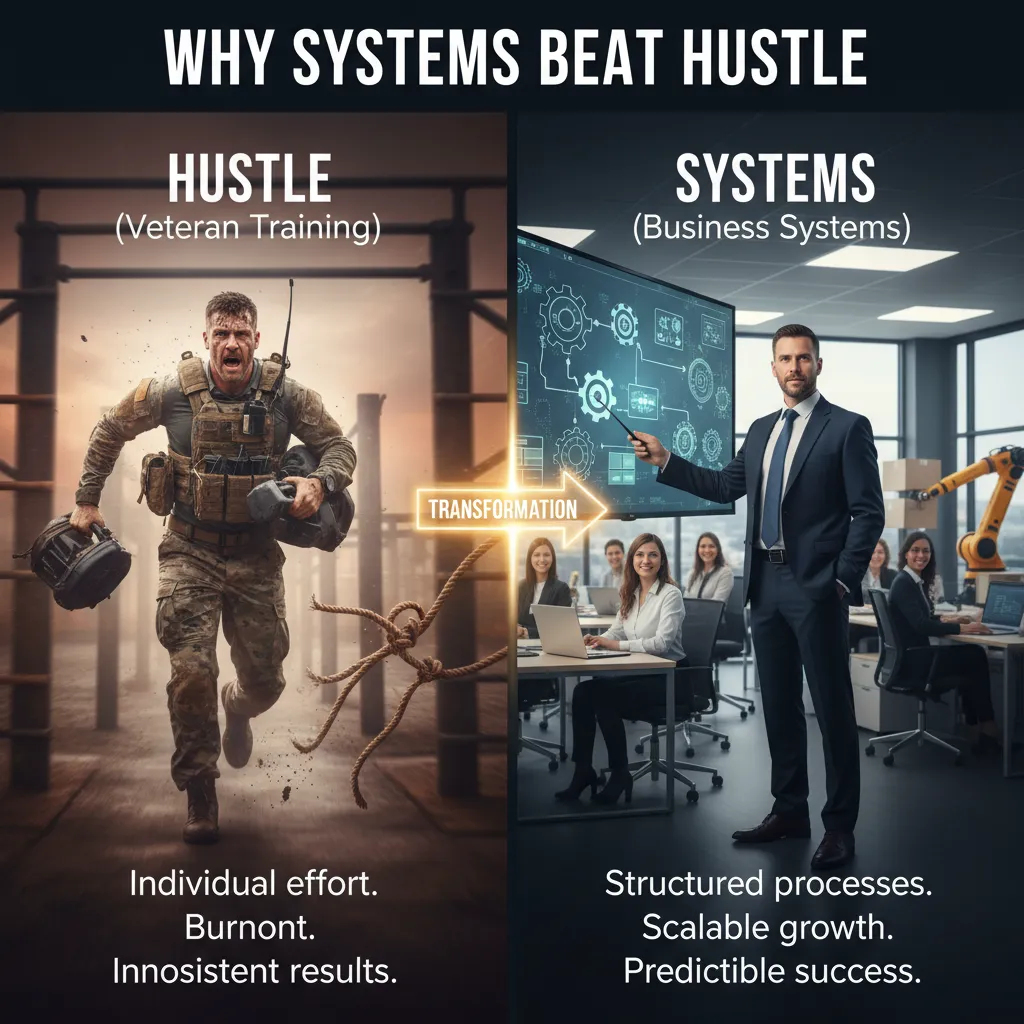
In uniform, I didn’t “feel like” doing the checklist. I did it because the checklist worked when people were tired, stressed, and distracted. That’s what business systems are to me now: a calm plan that holds up under pressure.
Checklists taught me to trust business processes, not moods
Online hustle culture says: post more, grind late, sleep less. But that’s not freedom—it’s just another rotation. When I build clear business processes, I don’t need a burst of motivation to keep the lights on. I need repeatable steps.
That’s where business automation is different from aimless hustle. Hustle is me pushing harder. Automation is the system carrying weight without me.
Process automation = fewer errors, better compliance
In manufacturing, automation isn’t about being fancy. It’s about safety, fewer mistakes, and consistent quality. Same idea in a small business. Process automation reduces costs and minimizes human error, and it improves compliance because the steps happen the same way every time.
John Lund: “Documented systems reveal automation opportunities and make handoffs obvious.”
Real examples of business automation I lean on
Automated billing: invoices go out on schedule, reminders follow up, and payments get tracked. No “did I forget?” stress.
A virtual assistant for routine emails: common questions get handled from templates and rules. That frees me (and my team) for higher-value tasks—work that actually grows the business.
A documented sales sequence: a simple step-by-step follow-up process reduces errors, keeps messaging consistent, and makes handoffs clean when someone else needs to run it.
Sources like OTRS talk about automation as a way to standardize work and cut mistakes. Freedom-makers and Think Tyler push the same core idea: the path to freedom is boring on purpose—document it, automate what you can, and delegate the rest.
That’s why I trust systems. They don’t need hype. They just run.
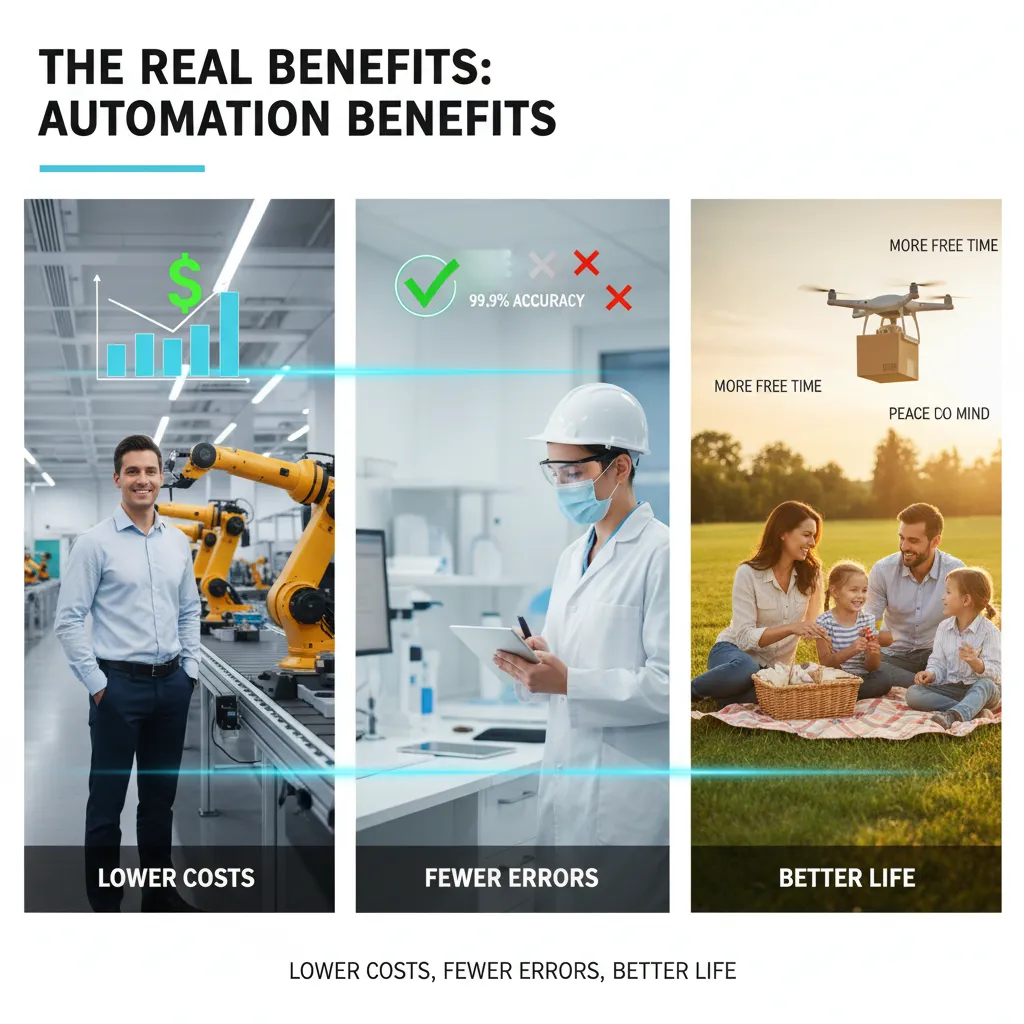
3) The Real Benefits: Lower Costs, Fewer Errors, Better Life (Automation benefits)
Lower costs and real cost savings (so I can stay in the room)
On Christmas Eve, I don’t want to be “on call” for my own business. I want quiet. That’s where lower costs start to matter. When I automate tasks—invoicing, follow-ups, scheduling, file handoffs—I stop paying the “panic tax” of last-minute fixes and rushed work. Across tools and case studies (like the kind you’ll find from OTRS and OptimiseandGrow), the theme is consistent: automation reduces operational costs and improves quality. Less rework. Less waste. More cost savings that show up as breathing room.
Fewer errors through documented systems
Veterans were trained on systems: checklists, processes that work under pressure. When I document a task, two things happen: I can hand it off, and I can see what should be automated next. That’s how you get fewer errors. Not because people try harder, but because the system catches mistakes early—like a workflow that won’t move forward until required fields are filled.
In manufacturing, automation is also tied to fewer injuries and less waste, while improving quality (Disher; Apec USA). Different world than online business, same lesson: repetitive work is where mistakes and wear-and-tear live.
Employee satisfaction: less monotony, more pride
Even if it’s just me and a virtual assistant setup, morale matters. When repetitive work gets automated, people get their brain back.
John Lund: “Automation shifts people from monotonous work to strategic roles, and that’s where satisfaction grows.”
That’s employee satisfaction: fewer copy-paste tasks, more problem-solving, higher productivity, and less burnout.
Better compliance, data analyses, faster reactions
Quiet systems also mean control. With cloud platforms and no-code tools (Quixy is a good example), I can build triggers and workflows that create a consistent customer experience.
Better compliance: steps don’t get skipped because the process is the process.
Data analyses: dashboards show what’s working without digging through spreadsheets.
Faster reactions: alerts fire when something breaks, not three days later.
That’s the real win: the business runs steady, and I’m present when the house finally gets quiet.
4) How I Build: Steps to Build Once and Let Systems Carry the Load
On Christmas Eve, I don’t want to be “on call.” I want to be on the couch, listening to the quiet. So, I build like a veteran: simple systems, tested under pressure. My rule is blunt: if it breaks when I step away, it’s not a business yet—it’s a job with extra steps.
My messy mini playbook: document → delegate → automate → monitor
I start with what I do three times a week. Not the big dreams—just the repeatable stuff that steals evenings. I open a doc and write the steps like a checklist. Then I pick the easiest win and automate tasks first. Research backs it up: automating repetitive tasks reduces human error and labor costs, and it keeps me from redoing the same work twice.
Document: write the steps, screenshots, links, and “what good looks like.”
Delegate tasks: if it needs judgment, I hand it to a human first.
Automate tasks: if it’s repeatable and rule based, I automate it.
Monitor: alerts, dashboards, and a weekly 15-minute review.
Tools and tactics that keep it quiet (cloud platforms + triggers)
I run most workflows on cloud platforms, so nothing depends on my laptop. For support and process flow, I’ve used tools like Quixy and OTRS to route requests, assign owners, and trigger follow-ups. When I need a human touch, I hire a virtual assistant for the messy middle: inbox sorting, tagging leads, updating CRM notes. I’d rather delegate tasks than force bad automation.
Templates help me move faster. I pull systems checklists from Think Tyler and OptimiseandGrow, then customize them to my business.
John Lund: “Start small: automate the thing that causes the most interruptions — you’ll buy back minutes that add up to real evenings.”
Christmas Eve calm checklist (systems I test before I unplug)
Billing automation: payments, receipts, failed charge retries.
Onboarding flow: welcome email, next steps, access links.
Customer replies: response templates + routing rules to automate tasks.
Error alerts: failed automations, broken links, form errors sent to email/SMS.
This is how I scale business without trading more hours for income: build once, automate tasks smart, and let the system carry the load.
5) Wild Cards: Hypothetical, Quote, and a Slightly Weird Analogy
What if the server crashed on Christmas Eve?
Picture this: it’s Christmas Eve, the house is finally quiet, and I’m halfway through a movie when my store goes down. No warning. No sales. Just a blank page and that sinking feeling in my gut.
That’s a real systems stress test. And testing systems under pressure exposes gaps quickly. If I have to “check the site” manually, I’m not free—I’m on call. But if I’ve built automated controls—uptime monitoring, instant alerts, and a simple rollback plan—then the night stays the night. An automated text tells me what broke, where, and what to do next. I can make one calm decision instead of twenty panicked ones.
Here’s what I learned the hard way: a single documented process can reveal multiple automation opportunities. The moment I write down “If X happens, do Y,” I start seeing where tools can take over. And documented automated processes support faster business decisions, because I’m not guessing—I’m following the playbook.
Freedom monotony vs. the skills gap
People chase excitement, but real freedom monotony is boring in the best way: the same checks, the same triggers, the same results. Automation fights monotony, but it also exposes a skills gap. If I don’t know how to set alerts, map a workflow, or write a clean checklist, I’ll default back to hustle. That’s why “work smarter” isn’t a slogan—it’s a skill investment.
A slightly weird analogy: the rucksack
I think about systems like a well-packed rucksack. Everything has a place. Tourniquet where I can reach it. Batteries where they belong. When it’s packed right, I move light. When it’s chaos, every step costs more. Business is the same: systems keep weight off my mind so I can be present.
“Treat your systems like habit training — small repetition becomes institutional memory.” — John Lund
If you can’t step away tonight without stress… something needs fixing. Not tomorrow. Not next year. Now. My one-night challenge: take 20 minutes and document one repeatable task—client onboarding, posting content, invoicing—start to finish. Then save it for follow-up resources like Bizsuccess CG (John Lund episode), the Freedom-makers article on systems, and Quixy’s automation benefits.
